
Views: 278 Author: Magic Household Cleaning Publish Time: 2026-11-05 Origin: Site
Content Menu
● Dryer Sheets vs. Liquid Fabric Softener: A Quick Comparison
● How Do Dryer Sheets and Fabric Softener Work?
>> Dryer Sheets: Conditioning During Tumble Drying
>> Liquid Fabric Softener: Conditioning During the Rinse
● Which Is Better for Softness, Static, and Fragrance?
>> For Static Cling: Consider Your Drying Routine
>> For Softness: Match the Treatment to the Fabric
>> For Fragrance: Avoid Format-Based Promises
● When Should You Avoid Dryer Sheets and Fabric Softener?
>> Towels and Absorbent Laundry
>> Moisture-Wicking Sportswear and Microfiber
>> Flame-Resistant Clothing and Specialty Fabrics
● Dryer Sheets or Fabric Softener for Sensitive Skin?
● How to Use Each Product Correctly
>> Using Liquid Fabric Softener
● A Practical Home Comparison: Find What Works for Your Laundry
● A Manufacturer's Checklist for Private-Label Laundry Products
>> Define the Product Before Approving the Sample
>> Validate Performance Beyond the First Impression
● Develop a Laundry-Care Range Around Real Customer Needs
>> Are Dryer Sheets the Same as Fabric Softener?
>> Can Dryer Sheets Replace Laundry Detergent?
>> Is Liquid Fabric Softener Better for Air-Dried Clothes?
>> Can I Use Dryer Sheets on Towels?
>> Are Fragrance-Free Dryer Sheets Safe for Everyone?
>> Why Do Clothes Still Have Static After Using a Dryer Sheet?
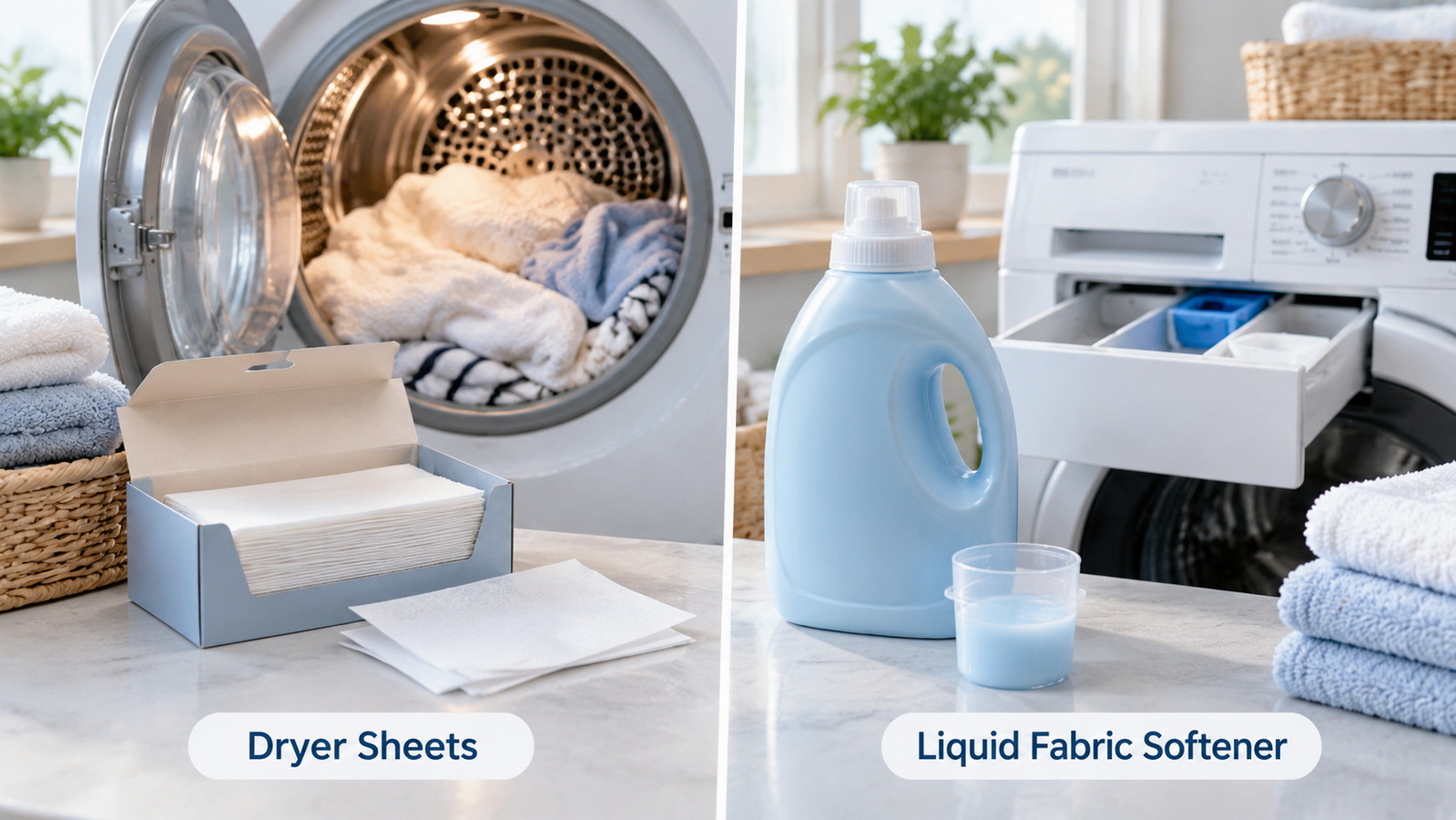
Dryer sheets vs. fabric softener: which should you choose for softer clothes, less static, and a more comfortable laundry routine? Dryer sheets deliver conditioning ingredients during tumble drying, while liquid fabric softener works during the rinse cycle. Both can improve fabric feel, but neither is suitable for every load.
My starting point is simple: compatibility matters more than fragrance. Choose according to the garment's care label, your drying method, and the result you actually need.
For laundry brands, the same principle applies. A successful product needs more than an appealing scent. Its formula, instructions, packaging, and performance claims must work together under realistic household conditions.
This guide explains the differences, identifies when to skip both products, and provides practical evaluation steps for consumers and private-label buyers.
Here, "fabric softener" means traditional liquid fabric conditioner. Dryer sheets also provide fabric-softening benefits, but use a different delivery format.
| Consideration | Dryer Sheets | Liquid Fabric Softener |
|---|---|---|
| When to use | At the beginning of tumble drying | During the washer’s rinse cycle |
| Main purpose | Softness and static control during drying | Fiber conditioning, softness, and static reduction |
| Application | Place the labeled number of sheets with damp laundry | Measure into the designated dispenser |
| Suitable for line drying | Not designed for this purpose | Can condition suitable fabrics before air drying |
| Dosing | Depends on sheet design and load size | Depends on concentration and load size |
| Main caution | Not suitable for every tumble-dryable fabric | Not suitable for every washable fabric |
| Fragrance options | Scented and fragrance-free formulations | Scented and fragrance-free formulations |
Dryer sheets carry conditioning ingredients on a sheet substrate. Heat and tumbling help distribute those ingredients across clothing.
The treatment changes how fabric surfaces interact, helping reduce static cling and creating a smoother feel. Depending on the formulation, sheets may also add fragrance and reduce the appearance of some wrinkles.
Their main practical advantage is convenience. There is no liquid to measure, although users still need to follow the package's load-size instructions.
"Use one sheet" is not a universal rule. Different products contain different amounts of conditioning material, and some appliance manuals impose their own restrictions.
Liquid fabric softener deposits conditioning ingredients on fibers during rinsing. This treatment reduces friction between fibers and can improve softness and static control.
In machines with a suitable dispenser, users add the measured product before starting the wash, and the appliance releases it at the appropriate stage.
Do not pour concentrated softener directly onto clothing unless the product instructions specifically allow that method. Follow the label for dosing, dispenser placement, and any required dilution.
From a formulation perspective, neither format is automatically superior. Performance depends on ingredient selection, dosage, fabric type, and washing or drying conditions.
Dryer sheets are a practical option when static develops during tumble drying. They deliver conditioning treatment at that stage of the routine.
Liquid fabric softener can also reduce static. However, adding more product is not necessarily the right response to cling.
Review the drying cycle first. Avoid unnecessary overdrying, separate items according to their care requirements, and follow the appliance's recommendations. A product should support appropriate laundry practices rather than compensate for unsuitable settings.
Liquid conditioner can be useful for suitable everyday garments, including items that will be air-dried.
Dryer sheets suit compatible clothes that will go through a tumble dryer.
However, softness is not the only measure of successful fabric care. A towel that feels smoother but absorbs water less effectively may no longer perform its main job well.
That distinction matters when developing products: evaluate softness alongside functional performance, not in isolation.
There is no reliable universal rule that liquid softener always smells stronger or that dryer-sheet fragrance always disappears faster.
Fragrance intensity and persistence depend on the formula, dose, fabric, drying conditions, and storage.
For consumers, the best choice is the scent level they find comfortable. For brands, "long-lasting fragrance" needs a defined test method and supporting results—not simply a strong smell when the package opens.
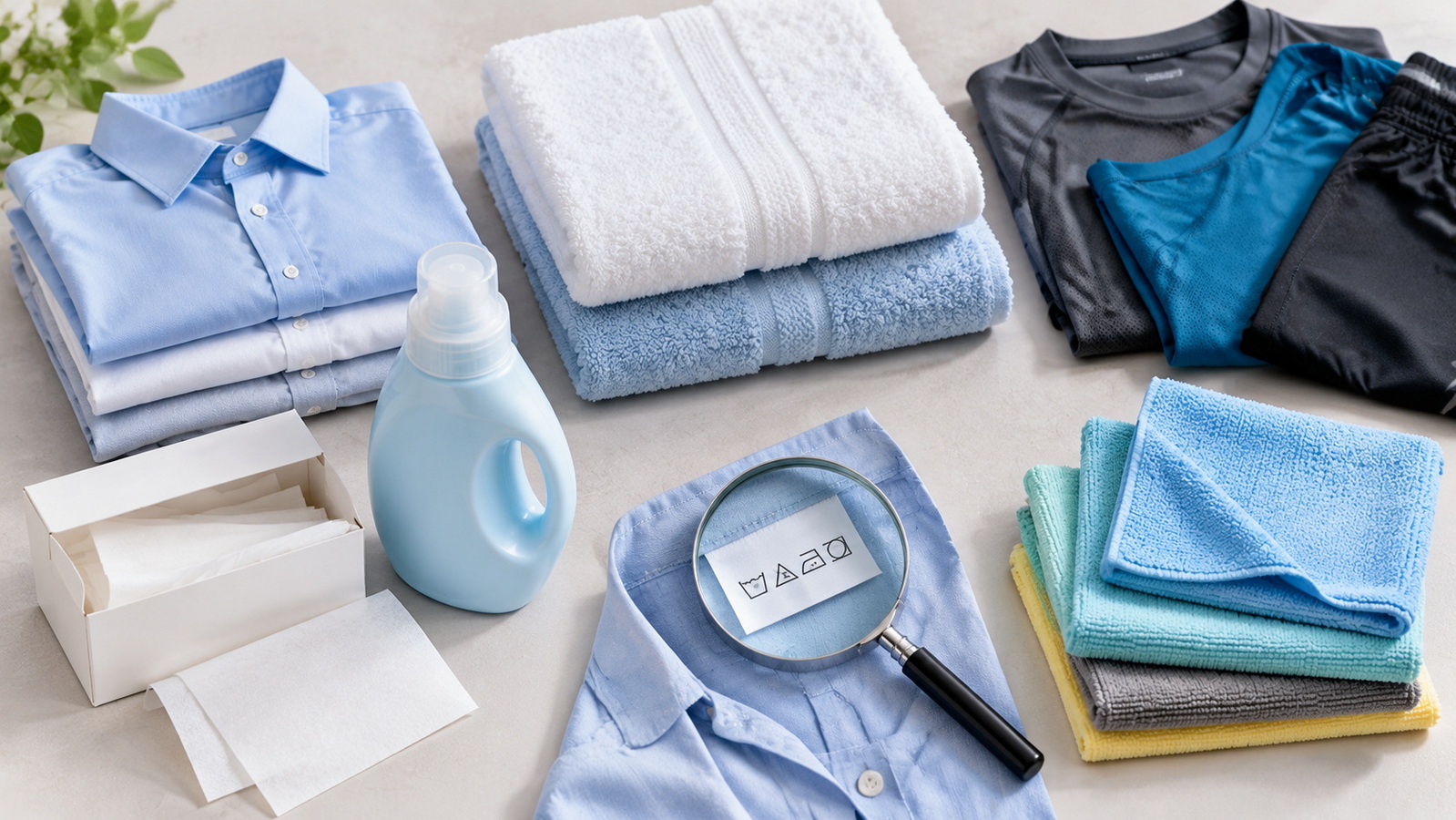
Traditional fabric softeners and dryer sheets can leave conditioning deposits that affect towel absorbency.
When water uptake is the priority, skip both unless the textile manufacturer specifically recommends otherwise. This is particularly important for bath towels, reusable absorbent products, and cleaning textiles.
If towels feel coated or perform poorly, review detergent dosage and washing practices before adding another treatment.
Performance fabrics rely on specific surface properties and fabric structures to move moisture or collect dirt.
Conditioning deposits may interfere with those functions. Follow the garment manufacturer's instructions for moisture-wicking clothing, technical base layers, and microfiber cleaning cloths.
Do not assume a fragrance-free softener is automatically appropriate: removing perfume does not remove the conditioning treatment.
Avoid softening treatments on flame-resistant children's sleepwear and other restricted garments unless the care instructions explicitly permit them.
Specialty finishes require individual assessment. "Machine washable" does not mean "compatible with every laundry additive."
A useful habit is to sort by care requirements before choosing the product—not after the washer is already running.
Neither product category is automatically suitable for everyone with sensitive skin.
Fragrance can be a trigger for some people with eczema or fragrance sensitivity. Fragrance-free products are different from "unscented" products, which may contain ingredients that mask an underlying smell.
A cautious routine includes:
- Choosing fragrance-free, dye-free detergent.
- Considering whether an additional conditioning product is necessary.
- Using a fragrance-free conditioner if appropriate for the individual.
- Stopping a suspected product if irritation develops.
- Seeking medical guidance for persistent or recurring symptoms.
Fragrance-free does not mean guaranteed irritation-free.
For manufacturers, claims such as "hypoallergenic" or "dermatologist tested" require appropriate substantiation. They should not be presented as guarantees that no user will react.
1. Check the garment labels and dryer instructions.
2. Load compatible damp clothing without overfilling the drum.
3. Add the number of sheets specified for that product and load.
4. Select a suitable drying cycle.
5. Remove the used sheets afterward and clean the lint filter as instructed.
Do not keep increasing sheet count to intensify fragrance. Follow any appliance-specific limits, even when a product package suggests a different general dose.
1. Separate items that should not receive conditioning treatment.
2. Check the bottle's dose for the load size and concentration.
3. Measure into the designated softener compartment.
4. Keep below the dispenser's maximum-fill line.
5. Use a cycle that releases the product correctly.
If the washer lacks a dispenser, follow both the product label and appliance instructions. Do not improvise by adding concentrated softener directly to dry garments.
Usually, one suitable conditioning product is enough to begin with.
Some products can be used together according to their labels, but combining formats adds cost and additional conditioning material.
Test one first. Add another only when there is a clear benefit and the garments, appliance, and product instructions permit it.
Instead of judging by fragrance alone, compare the formats under consistent conditions.
This is an informal household assessment, not a laboratory test.
Use similar everyday garments that permit conditioning treatments. Keep the detergent, load size, wash cycle, and drying settings as consistent as possible.
Compare three conditions:
- Detergent only.
- Detergent plus liquid fabric softener.
- Detergent followed by dryer sheets.
Use labeled doses. Exclude towels, technical sportswear, and other restricted items.
Evaluate softness, static, fragrance strength, visible marks, and comfort separately.
Check clothes immediately after drying and again after storage. Ask whether the fragrance remains pleasant rather than merely noticeable.
If possible, have someone assess the samples without knowing which treatment was used. That can reduce the influence of packaging and expectations.
A single load can mislead. Repeat the comparison before changing your routine or committing to a bulk purchase.
For commercial decisions, follow informal screening with controlled testing appropriate to the intended claims.
Package price alone is a poor comparison.
For dryer sheets:
Cost per load = package price ÷ number of loads at the labeled dose.
For liquid fabric softener:
Cost per load = bottle price ÷ number of loads at the labeled dose.
A large sheet count may look economical but provide fewer loads if the recommended dose is multiple sheets. A concentrated liquid may have a higher bottle price but a lower cost per use.
Brands should also compare packaging, shipping weight, leakage risk, storage, and dosing clarity.
Avoid declaring one format universally cheaper or more sustainable. Meaningful comparisons need equivalent performance and a clearly defined assessment boundary.
From our manufacturing perspective, product development should begin with a precise use case.
"Make laundry smell good" is too broad. "Reduce static in compatible tumble-dried everyday garments with a moderate fragrance level" creates a clearer development brief.
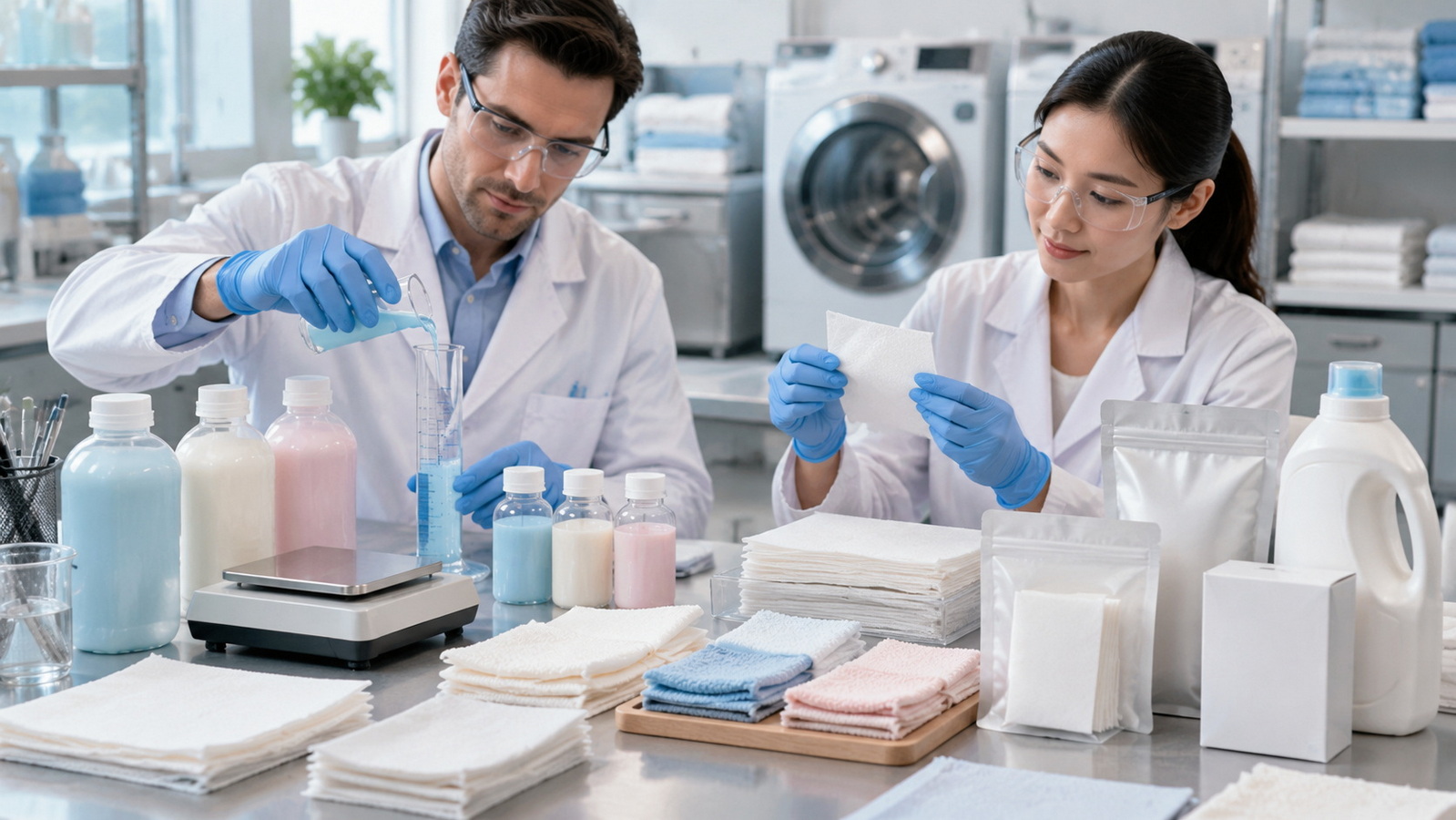
An effective brief specifies:
- Target market and intended laundry routine.
- Suitable fabrics and required exclusions.
- Fragrance profile and intensity.
- Dose per standard load.
- Desired softness and static performance.
- Packaging format and storage expectations.
- Claims requiring supporting evidence.
For dryer sheets, evaluate sheet dimensions, substrate consistency, coating uniformity, and dispensing.
For liquid conditioners, evaluate dose consistency, dispensing behavior, physical stability, and packaging compatibility.
A strong-smelling sample is not enough.
Compare production-representative samples with an untreated control and an appropriate benchmark. Evaluate repeated-use performance, visible deposits, fragrance changes, and any functional trade-offs relevant to the intended fabrics.
Request documented test conditions and acceptance criteria. A result means little without knowing the dose, fabric, cycle, and comparison method.
Foshan Magic Crystal Technology Development Co., Ltd. develops and manufactures dryer sheets, fabric softener, and laundry, household, personal, and pet-cleaning products.
Our company-reported manufacturing footprint includes more than three owned factories, annual production capacity of approximately 30,000–40,000 metric tons, and OEM/ODM service experience supporting more than 300 brands worldwide.
For private-label buyers, the next step is a focused development brief—not simply a fragrance selection.
Contact our team with your target market, preferred format, fragrance requirements, packaging specifications, and expected order volume. Request product options, samples, and relevant documentation so you can assess the proposed solution before approving production.
They belong to the broader fabric-conditioning category, but their delivery methods differ. Dryer sheets work during tumble drying; traditional liquid fabric softener works during rinsing.
No. Dryer sheets condition fabrics and help control static. They do not replace detergent's cleaning function or remove the need to wash dirty clothing properly.
It is the more relevant of these two formats because it conditions suitable fabrics during rinsing. Conventional dryer sheets are designed for tumble drying, not hanging clothes on a drying rack.
For towels where absorbency matters, it is generally better to skip dryer sheets and traditional liquid softener. Conditioning deposits can interfere with water uptake.
No product is guaranteed suitable for every person. Fragrance-free options remove one potential concern, but other ingredients may still cause individual reactions.
Review load size, labeled dosage, fabric mix, and drying time. Overdrying can contribute to static. Adding more sheets is not always the best solution.
1. [So Fresh N So Clean Laundromat — "Dryer Sheets vs. Fabric Softener: Which One Should You Use?"]
Original article, published April 22, 2025. Used to identify the basic comparison and content gaps; this rewritten article adds fabric restrictions, practical evaluation methods, and manufacturing considerations. [sofreshlaundromat]
2. [Whirlpool — "Tips for Using Fabric Softener in Washer"]
Supports explanations of fiber conditioning, rinse-stage application, labeled dosing, dispenser use, and restrictions for absorbent and performance fabrics. [producthelp.whirlpool]
3. [Whirlpool — "How to Wash & Dry Towels to Keep Them Soft"]
Supports the discussion of conditioning deposits and reduced towel absorbency associated with fabric softener and dryer sheets. [whirlpool]
4. [Bounce — "Dryer Sheets for Beginners"]
Manufacturer guidance on heat-activated conditioning, static reduction, load-dependent dosing, and avoiding overfilled dryers. Product-specific claims should not be generalized to every formulation. [bouncefresh]
5. [Downy — "Fabric Softener for Beginners"]
Supports rinse-phase application, the distinction between softener and detergent, and cautions concerning flame-resistant sleepwear and selected fabrics. [downy]
6. [Patagonia — "Moisture Wicking & Wicking Treatments"]
Explains why waxes and softeners in some laundry products can interfere with moisture-wicking performance. [eu.patagonia]
7. [Patagonia — "Customer Care: Garment Care Tips"]
Supports avoiding softeners on moisture-wicking finishes and the relationship between residual fabric moisture and static reduction. [patagonia]
8. [American Academy of Dermatology — "How Can I Find Eczema-Friendly Products?"]
Supports fragrance-free product selection and the distinction between fragrance-free and unscented labeling. [aad]
9. [American Academy of Dermatology — "How Can I Find Eczema Triggers on My Child's Body?"]
Supports fragrance-free, dye-free detergent recommendations and choosing fragrance-free fabric softener when one is used. [aad]
10. [Whirlpool — Electric or Gas Dryer Use and Care Guide]
Demonstrates that appliance-specific sheet limits may apply. The cited manual's instructions are model-specific, not a universal dosing recommendation. [whirlpool]


