
Views: 277 Author: Magic Household Cleaning Publish Time: 2026-09-19 Origin: Site
Content Menu
● What Are Eco Laundry Sheets and Traditional Powder Detergent?
>> How Both Detergent Formats Clean Clothes
● Eco Laundry Sheets vs Traditional Powder Detergent: Side-by-Side Comparison
● Cleaning Performance: Does Format Determine Results?
>> Factors That Influence Laundry Detergent Performance
● Which Laundry Detergent Is More Eco-Friendly?
>> Evaluate the Full Product Lifecycle
>> A More Credible Eco Claim Framework
● Convenience and Consumer Experience
>> Why Pre-Measured Sheets Improve Dosing
● Cost Per Wash and Private-Label Positioning
>> Recommended Market Positioning
● Expert Product Development Checklist for Laundry Brands
>> Ask These Questions Before Development
● Common Mistakes When Comparing Laundry Sheets and Powder
● Eco Laundry Sheets or Powder Detergent?
>> 1. Are eco laundry sheets better than powder detergent?
>> 2. Do laundry detergent sheets work in cold water?
>> 3. Can eco laundry sheets remove tough stains?
>> 4. Is powder detergent more environmentally friendly than liquid detergent?
>> 5. Do laundry detergent sheets contain plastic?
>> 6. Which detergent format is best for private-label brands?
>> 7. How should I choose an OEM laundry detergent sheet manufacturer?
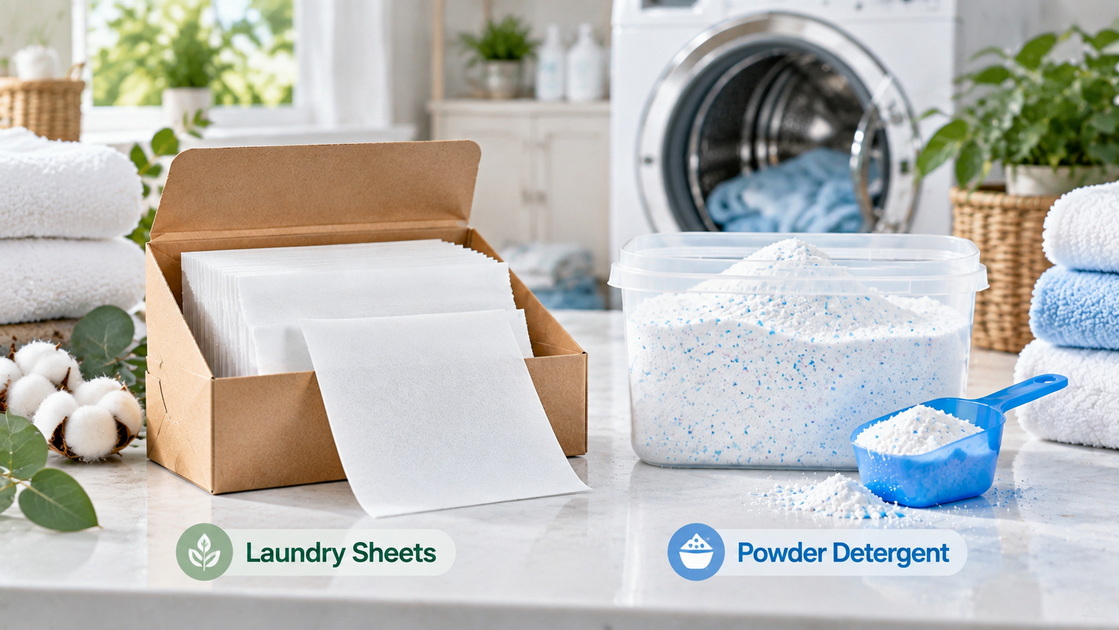
Eco laundry sheets and traditional powder detergent can both clean clothing effectively, but they serve different consumer needs, product-positioning strategies, and sustainability goals. Laundry detergent sheets typically offer convenience, low shipping weight, pre-measured dosing, and plastic-reduction potential, while powder detergent remains a proven, cost-efficient format that can deliver strong performance on heavily soiled loads when formulated and dosed correctly.
For private-label brands, retailers, and distributors, the better product is not simply the "greenest-looking" format. It is the format that delivers verified cleaning performance, clear ingredient communication, reliable dissolution, suitable packaging, and a credible environmental story. As an OEM/ODM manufacturer serving global cleaning-product brands, Foshan Magic Crystal Technology Development Co., Ltd. sees this comparison from both a product-development and market-demand perspective: successful laundry products must balance consumer experience, formulation performance, manufacturing consistency, compliance, and brand differentiation.
Eco laundry sheets are thin, lightweight, pre-measured strips of concentrated detergent. They are designed to dissolve in wash water and release cleaning agents that help lift soils, oils, odors, and stains from fabrics. Depending on the formula, a sheet may contain surfactants, enzymes, builders, fragrance, colorants, anti-redeposition agents, and other functional ingredients.
Many detergent-sheet brands position their products around convenience and less plastic packaging. The format is especially attractive for apartments, travel, e-commerce, subscription businesses, and consumers who dislike measuring liquid or powder detergent.
Traditional powder detergent is a dry, granular or powdered laundry-cleaning product. It is commonly packed in bags, cartons, pouches, tubs, or boxes. Powder formulas can contain surfactants, builders, bleaching agents, enzymes, optical brighteners, fragrance, and water-softening ingredients, depending on the product's market position and intended wash conditions.
Powder detergent has remained relevant because it is familiar, scalable, and often economical on a cost-per-load basis. It can also be formulated for challenging wash conditions, including hard water, white fabrics, odor removal, and heavily soiled workwear.
Both eco laundry sheets and powder detergent rely on chemistry rather than format alone.
The main cleaning mechanism comes from surfactants. These ingredients help loosen oily soils and suspend dirt in wash water so it can be rinsed away. Enzymes may improve the removal of protein-, starch-, or fat-based stains. Builders can support performance by managing minerals in hard water, while anti-redeposition agents help keep loosened soil from settling back onto fabrics.
The practical difference is that a laundry sheet delivers those ingredients through a dissolvable sheet substrate, while powder delivers them in a granular dry format.
That distinction matters because the product format affects:
- Dosing accuracy
- Dissolution behavior
- Packaging choices
- Freight efficiency
- Consumer handling
- Shelf presentation
- Formula flexibility
- Perceived sustainability
Consumer Reports describes detergent sheets as concentrated detergent products held in a dissolvable sheet structure, and notes that sheets are generally low-sudsing and designed to dissolve in both cold and hot water. However, performance can vary significantly by brand and formulation.
| Comparison Factor | Eco Laundry Sheets | Traditional Powder Detergent |
|---|---|---|
| Product form | Thin, pre-measured detergent strips | Loose granules or powder |
| Consumer dosing | Usually simple and consistent | Flexible, but can be over- or under-dosed |
| Storage | Compact and lightweight | Requires more shelf space |
| Travel convenience | Excellent | Less convenient due to loose powder |
| E-commerce shipping | Often efficient because of lower weight and compact packs | Can be heavier and bulkier |
| Packaging options | Often paper-based or low-plastic packs | Bags, boxes, tubs, and pouches |
| Heavy-soil flexibility | Depends strongly on formula and dose | Often strong, especially in specialized formulas |
| Cold-water use | Can work well if dissolution is optimized | Can work well, but some powders may dissolve less easily in very cold water |
| Price positioning | Often positioned as premium or value-added | Often competitive at mass-market price points |
| Consumer familiarity | Growing category, but less familiar in some markets | Highly familiar and established worldwide |
| Manufacturing considerations | Requires sheet-forming and dissolution expertise | Mature, high-volume production technology |
| Sustainability story | Strong potential around packaging and transport efficiency | Can be sustainable, but depends on formula, pack, dose, and supply chain |
The comparison shows why the phrase "eco laundry sheets vs traditional powder detergent" should not be treated as a simple winner-versus-loser debate. Each format creates different commercial opportunities.
For example, an online-first lifestyle brand may benefit from compact detergent sheets because lightweight packs can be easier to store, ship, and market through subscription channels. A value-focused retailer serving families with high laundry volume may prefer powder detergent because it can be sold in larger formats with highly visible price-per-wash messaging.
The short answer is no. A detergent's cleaning performance depends primarily on its formulation, dosage, wash conditions, fabric type, soil type, water hardness, and consumer usage habits.
A well-formulated eco laundry sheet can provide reliable everyday cleaning. A poorly formulated sheet may struggle with heavy soils, greasy stains, or difficult odor removal. The same principle applies to powder detergent.
Independent testing and product reviews have raised an important point for brands: not every laundry sheet performs equally well. Wirecutter reported that some tested detergent sheets did not clean as effectively as stronger traditional detergent alternatives. This does not mean that all sheets are ineffective. It means brands should avoid broad claims and instead validate performance through appropriate testing.
When developing or sourcing laundry detergent sheets or powder detergent, evaluate the following:
- Surfactant system: Determines how effectively the formula lifts dirt and oils.
- Enzyme package: Supports removal of food, sweat, grass, protein, starch, and body-soil stains.
- Water temperature: Cold water may require formulas with strong low-temperature dissolution and activity.
- Water hardness: Minerals can reduce cleaning performance if the formula lacks sufficient builders or chelating support.
- Dosage guidance: One-size dosing can be convenient, but consumers may need extra product for large or heavily soiled loads.
- Wash cycle: Quick cycles, low-water machines, and front-loading machines may require specific formulation optimization.
- Fabric load: Overloaded washing machines can reduce mechanical action and rinse effectiveness.
- Stain pretreatment: Tough stains often need pretreatment regardless of detergent format.
From a manufacturer's point of view, product development should focus on measurable performance, not only attractive sustainability language. Before launch, brands should request or conduct tests for stain removal, dissolution, residue, foam level, odor control, color care, and compatibility with high-efficiency washing machines.

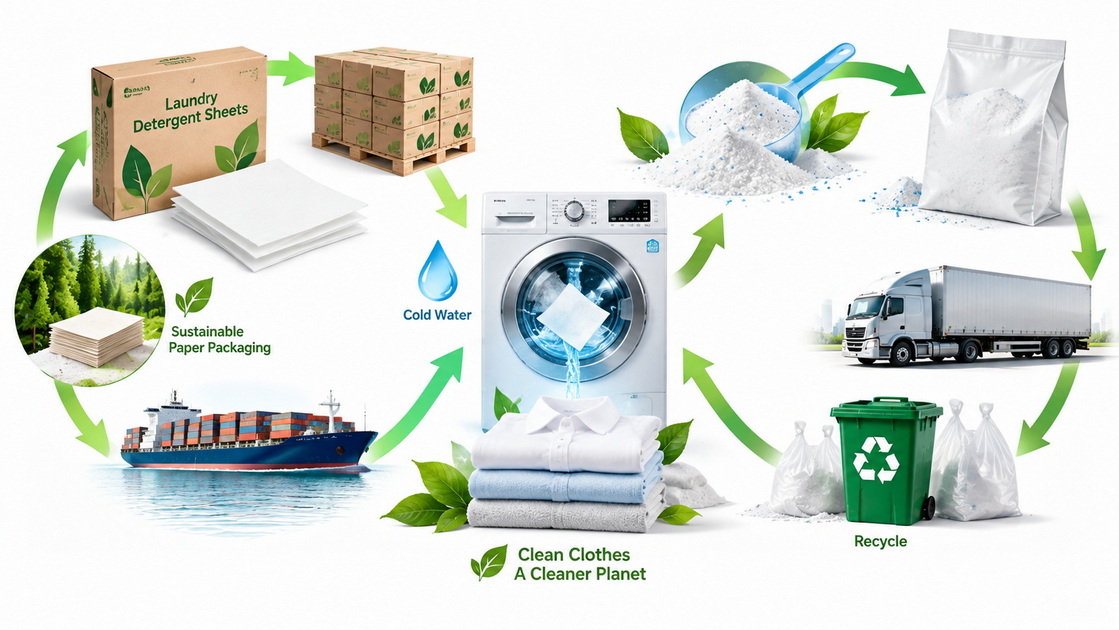
Eco laundry sheets are often marketed as a more sustainable alternative because they can reduce package size, eliminate bulky liquid-water transport, and use paper-forward packaging. However, a credible sustainability comparison must go beyond the package.
A product is not automatically eco-friendly simply because it comes in a sheet. Likewise, powder detergent is not automatically less sustainable just because it is a traditional format.
A responsible comparison should include:
- Formula concentration
- Packaging material and recyclability
- Plastic content
- Product weight per wash
- Shipping distance and freight efficiency
- Manufacturing energy use
- Consumer dosing behavior
- Wash temperature
- Biodegradability and aquatic impact of ingredients
- End-of-life packaging disposal
Laundry sheets can reduce product weight and pack volume compared with many liquid detergents. But the specific advantage over powder detergent may be less dramatic because powder is already a concentrated, water-free format.
This is a key point for B2B buyers and brand owners: the sustainability case for laundry sheets is strongest when compared with bulky liquid detergent, not automatically when compared with concentrated powder.
Powder detergent may still offer strong environmental advantages when it is concentrated, correctly dosed, sold in efficient packaging, and used in cold-water washing.
The American Cleaning Institute notes that approximately 90% of the energy used by a washing machine is associated with heating the water. That means a consumer's decision to wash in cold water can have a larger real-world energy impact than a simple change from powder detergent to laundry sheets.
For an eco laundry sheet brand, avoid vague statements such as "100% green" or "zero impact." Instead, use specific and supportable language, such as:
- "Plastic-free outer packaging," if the packaging claim is accurate and verifiable.
- "Concentrated, pre-measured detergent sheets designed to reduce overdosing."
- "Compact format designed to reduce storage space and shipping volume."
- "Cold-water compatible formulation," when supported by performance testing.
- "Phosphate-free" or "biodegradable ingredients," only where legally and technically substantiated.
For private-label projects, OEM/ODM partners should help brands align claims with local labeling requirements, product documentation, ingredient disclosures, and test evidence.
For many consumers, convenience is the strongest reason to buy eco laundry sheets.
Laundry sheets are easy to carry, simple to store, and generally less messy than measuring powder. A household can keep a small box of detergent sheets in a cabinet, drawer, travel bag, camper, dorm room, or compact apartment.
Traditional powder detergent requires a scoop or measuring cup. This allows flexible dosing, but it can also create spills, product waste, and inconsistent usage. Consumers may use too much powder because they equate more detergent with cleaner clothes.
Pre-measured sheets can make product use easier:
1. Tear or select the recommended sheet amount.
2. Place it in the washing machine according to product instructions.
3. Add clothing.
4. Select the appropriate wash cycle.
5. Use extra sheets only for larger or heavily soiled loads.
Some brands recommend using half a sheet for a small load, one sheet for a standard load, and more product for larger or dirtier loads. The exact instruction should always match the manufacturer's formulation, sheet weight, and performance validation.
For powder detergent, brands should provide highly visible dosage tables for:
- Small, medium, and large loads
- Soft and hard water
- Light and heavy soil levels
- Hand washing, where applicable
- High-efficiency machine use
Clear directions reduce consumer dissatisfaction and help prevent product waste.
The retail price of eco laundry sheets can appear higher than powder detergent because sheets are frequently positioned as a premium, sustainable, travel-friendly product. But the more meaningful comparison is cost per wash, not price per pack.
A small carton of sheets may contain 30, 60, or more washes. A powder detergent bag may have a lower shelf price but require consumers to measure each use. Overdosing can increase the actual cost per load.
For brand owners, pricing strategy should consider more than raw production cost:
- Target retail channel
- Pack size and number of washes
- Consumer income level
- Product claims
- Scent and sensory profile
- Packaging quality
- Certification needs
- Freight cost
- Marketplace fees
- Private-label margins
- Competitor positioning
| Target Market | Better Starting Format | Positioning Opportunity |
|---|---|---|
| E-commerce and subscription brands | Eco laundry sheets | Compact, lightweight, convenient, giftable, repeat-purchase friendly |
| Travel and outdoor retail | Eco laundry sheets | Portable, easy to pack, no powder spill risk |
| Apartments and dormitories | Eco laundry sheets | Small-space storage, no measuring, simple use |
| Family-value retail | Powder detergent | Larger pack sizes, visible cost per wash, flexible dosing |
| Workwear or heavily soiled laundry | Powder detergent or high-performance sheets | Stain-removal and odor-control performance |
| Sensitive-skin segment | Either format | Fragrance-free, transparent ingredients, tested claims |
| Sustainability-focused brands | Eco laundry sheets or concentrated powder | Evidence-based packaging, dosing, and cold-wash story |
For OEM/ODM buyers, the best route is often not choosing one format forever. It is creating a product portfolio. For example, a brand can launch standard eco laundry sheets for online sales and a concentrated powder detergent for value-driven retail distribution.
From an industrial laundry-product development perspective, a successful detergent sheet or powder project should begin with a structured specification rather than a vague request for an "eco detergent."
1. Who is the target consumer?
Define household size, lifestyle, price sensitivity, laundry habits, and preferred fragrance profile.
2. Which markets will the product enter?
Regulations, labeling rules, language requirements, and ingredient restrictions vary by country.
3. What is the desired wash performance?
Specify cold-water use, stain removal, whiteness maintenance, color care, odor control, and hard-water suitability.
4. What pack format supports the brand?
Consider paper cartons, resealable pouches, recyclable materials, individual wrapping, or bulk packs.
5. What claims can be substantiated?
Build claims around test data, ingredient information, packaging evidence, and legal review.
6. What quality tests are required?
Request stability testing, dissolution testing, wash-performance testing, microbial testing where relevant, and package transport testing.
7. What customization matters most?
Options may include sheet color, fragrance, sheet size, formula strength, pack count, outer packaging, and multilingual labeling.
For a manufacturer with multiple self-owned factories and large-scale annual capacity, consistency becomes especially important. Buyers should assess not only sample quality but also batch-to-batch control, raw-material traceability, document support, lead times, compliance capability, and packaging execution.

Many online comparisons oversimplify the decision. Avoid these common mistakes:
- Assuming every laundry sheet is biodegradable, plastic-free, or low-impact without reviewing its ingredients and packaging.
- Assuming powder detergent always leaves residue; residue usually depends on dosage, dissolution, machine conditions, and formulation.
- Comparing pack prices instead of cost per wash.
- Ignoring water hardness and washing-machine type.
- Making "non-toxic," "chemical-free," or "zero-waste" claims without legal and scientific support.
- Promising equal performance on all stains without test data.
- Treating sustainable packaging as more important than cleaning performance.
A detergent that fails to clean clothes can lead consumers to rewash garments, use more product, or rely on additional stain removers. That can reduce the practical environmental benefit of an otherwise appealing product format.
Eco laundry sheets are ideal for convenience-led, compact, travel-friendly, and sustainability-positioned brands. They are particularly attractive for e-commerce, subscription sales, apartment living, and consumers who value simple, pre-measured laundry routines.
Traditional powder detergent remains an excellent choice for value, flexible dosing, familiar usage, and high-performance positioning. It can be especially suitable for large households, high-volume retail, hard-water markets, and intensive laundry needs.
The best product decision depends on your target market, formula quality, claim substantiation, packaging strategy, and cost-per-wash objective.
For brands that want to enter or expand in the laundry-care market, Foshan Magic Crystal Technology Development Co., Ltd. can support OEM/ODM development across laundry detergent sheets, clothing-care products, household cleaners, personal-care products, and pet-cleaning products. With more than three self-owned factories, annual production capacity of approximately 30,000–40,000 tons, and experience serving more than 300 global brands, the company can help transform a product idea into a market-ready private-label solution.
Ready to develop your own eco laundry sheets or powder detergent line? Contact our OEM/ODM team to discuss formulations, fragrance options, packaging concepts, samples, compliance documentation, and scalable production requirements.
Eco laundry sheets are better for consumers who prioritize convenience, compact storage, pre-measured dosing, and lightweight packaging. Powder detergent may be better for shoppers who prioritize lower cost per wash, flexible dosage, and strong performance for large or heavily soiled loads.
Many detergent sheets are designed to dissolve in cold water, but actual performance depends on the formula, sheet construction, water temperature, load size, and washing-machine conditions. Brands should validate cold-water dissolution and cleaning performance through testing.
They can remove everyday dirt and odors when well formulated, but difficult stains may require pretreatment, warm water when fabric care labels allow it, extra dosage, or a stronger enzyme-based formula. Independent reviews have found performance differences among laundry-sheet brands, so testing is essential.
In many cases, powder detergent can have transport and packaging advantages over liquid detergent because it contains less added water. However, its overall environmental profile still depends on formula, dosage, packaging, consumer wash habits, and production practices.
Some detergent-sheet products may use paper-based packaging, but the sheet itself and its binding materials vary by manufacturer. Brands and buyers should review the full ingredient list, substrate material, packaging composition, and supporting documentation before making plastic-free claims.
The best format depends on the brand's target channel and customer. Eco laundry sheets are often suitable for premium e-commerce, travel, and sustainable-lifestyle positioning. Powder detergent is often suitable for mass retail, family-size packs, price-sensitive consumers, and high-volume laundry users.
Evaluate manufacturing capacity, formula-development capability, sample quality, dissolution performance, stain-removal testing, ingredient transparency, quality-control processes, packaging customization, export experience, compliance documents, and lead times. Do not select solely on the lowest unit price.
1. Wirecutter. "Laundry Detergent Sheets Are Poor Cleaners. And Their Sustainability Is Complicated." *The New York Times*. Available at: [https://www.nytimes.com/wirecutter/reviews/laundry-detergent-sheets-sustainability/]. The article discusses detergent-sheet performance variability and notes that heating water accounts for a substantial share of washing-machine energy use. [nytimes]
2. Consumer Reports. "Do Laundry Detergent Sheets Work as Well as Liquid?" Available at: [https://www.consumerreports.org/appliances/laundry-detergents/laundry-detergent-sheets-review-a8916087070/]. The article explains the detergent-sheet format and reports on testing of several eco-friendly sheet brands. [consumerreports]
3. ECOS. "The Ultimate Guide to Laundry Detergent Sheets." Available at: [https://www.ecos.com/live-cleaner/the-ultimate-guide-to-laundry-detergent-sheets-how-they-work-and-why-they-simplify-your-life/]. The guide provides consumer-use guidance for sheet dosage and washing-machine placement. [ecos]
4. TODAY. "Do Laundry Detergent Sheets Really Work? What Experts Say." Available at: [https://www.today.com/shop/do-laundry-detergent-sheets-work-rcna198208]. The article includes expert commentary on how laundry sheets dissolve and how they can be used for different load sizes. [today]
5. American Cleaning Institute. Laundry-energy information cited in Wirecutter's sustainability guidance, emphasizing that cold-water washing can substantially reduce laundry-related energy demand. [nytimes]


