
Views: 279 Author: Magic Household Cleaning Publish Time: 2026-10-22 Origin: Site

Content Menu
● Hypoallergenic Laundry Detergent vs Enzyme Laundry Detergent: Key Differences
● What Is Hypoallergenic Laundry Detergent?
>> What Baby Clothing Brands Should Examine
● What Is Enzyme Laundry Detergent?
● Are Enzyme Laundry Detergents Suitable for Baby Clothes?
>> Understand the Evidence Limitations
>> Keep Manufacturing Exposure Separate
● Comparing Cleaning Performance, Fabric Care, and Customer Experience
● Can Hypoallergenic Laundry Detergent Sheets Contain Enzymes?
>> Questions for an OEM/ODM Supplier
● A Practical Validation Plan for Baby Clothing Brands
>> 1: Define the Intended Customer
>> 2: Compare Meaningful Prototypes
>> 3: Build a Baby-Laundry Test Matrix
>> 4: Evaluate Tolerability Appropriately
>> 5: Approve Claims and Instructions Together
● Compare Cost per Successful Wash, Not Just Factory Price
● Choosing an OEM/ODM Partner for Baby Laundry Products
● Develop Your Baby Laundry Formula with a Clear Brief
>> 1. Is Hypoallergenic Laundry Detergent Always Enzyme-Free?
>> 2. Can an Enzyme Detergent Be Fragrance-Free and Dye-Free?
>> 3. Which Detergent Is Better for Milk and Baby-Food Stains?
>> 4. Does "Dermatologist Tested" Mean Safe for Every Newborn?
>> 5. Are Laundry Detergent Sheets Automatically Gentler Than Liquids?
>> 6. Should Parents Stop Using a Detergent if a Baby Develops a Rash?
Choosing between hypoallergenic laundry detergent vs enzyme laundry detergent for baby clothing brands is not simply a choice between gentleness and cleaning power. These terms describe different product characteristics: "hypoallergenic" describes a positioning claim about allergic-reaction potential, while "enzyme" identifies ingredients that help remove specific stains.
| Comparison factor | Hypoallergenic laundry detergent | Enzyme laundry detergent |
|---|---|---|
| Main purpose | Position the product around reduced allergic-reaction potential | Improve removal of targeted soils |
| What the term describes | A claim requiring appropriate support | A formulation characteristic |
| Enzyme content | May contain enzymes or be enzyme-free | Contains one or more enzymes |
| Fragrance and dyes | Must be checked; the term alone is insufficient | Can be formulated without fragrance or dyes |
| Baby-food stain removal | Depends on the complete formula | Selected enzymes can target protein, starch, and fat |
| Sensitive-skin suitability | Cannot be established from the label alone | Cannot be established from enzyme presence alone |
| Purchasing priority | Finished-product tolerability and claim evidence | Cleaning performance, stability, and tolerability |
Hypoallergenic laundry detergent is marketed as having a lower potential to cause allergic reactions. It does not mean allergy-proof, non-irritating for everyone, or suitable for treating eczema.
Allergy and irritation are also different. An allergic reaction involves an immune response to a particular substance. Irritation can occur without an allergy and depends on factors such as exposure and individual skin condition.
For a sensitive-skin laundry detergent, assess:
- The complete ingredient profile.
- Added fragrance and colorants.
- Surfactant selection and concentration.
- Preservatives, where relevant.
- Recommended dose and rinsing performance.
- The evidence supporting the exact packaging claims.
Dermatology guidance for children with eczema favors fragrance-free, dye-free detergent. That is a more actionable starting point than relying on a "baby" designation or reassuring packaging.
"Unscented" is not necessarily equivalent to "fragrance-free," because an unscented product may contain ingredients used to mask odors.
Do not treat a cosmetic-labeling statement as a universal detergent regulation. For example, the FDA's discussion of "hypoallergenic" specifically concerns cosmetics; it does not establish the regulatory position for every household laundry product.
Brands need a market-specific review of detergent labeling and advertising requirements. Product claims should match the evidence available before launch.
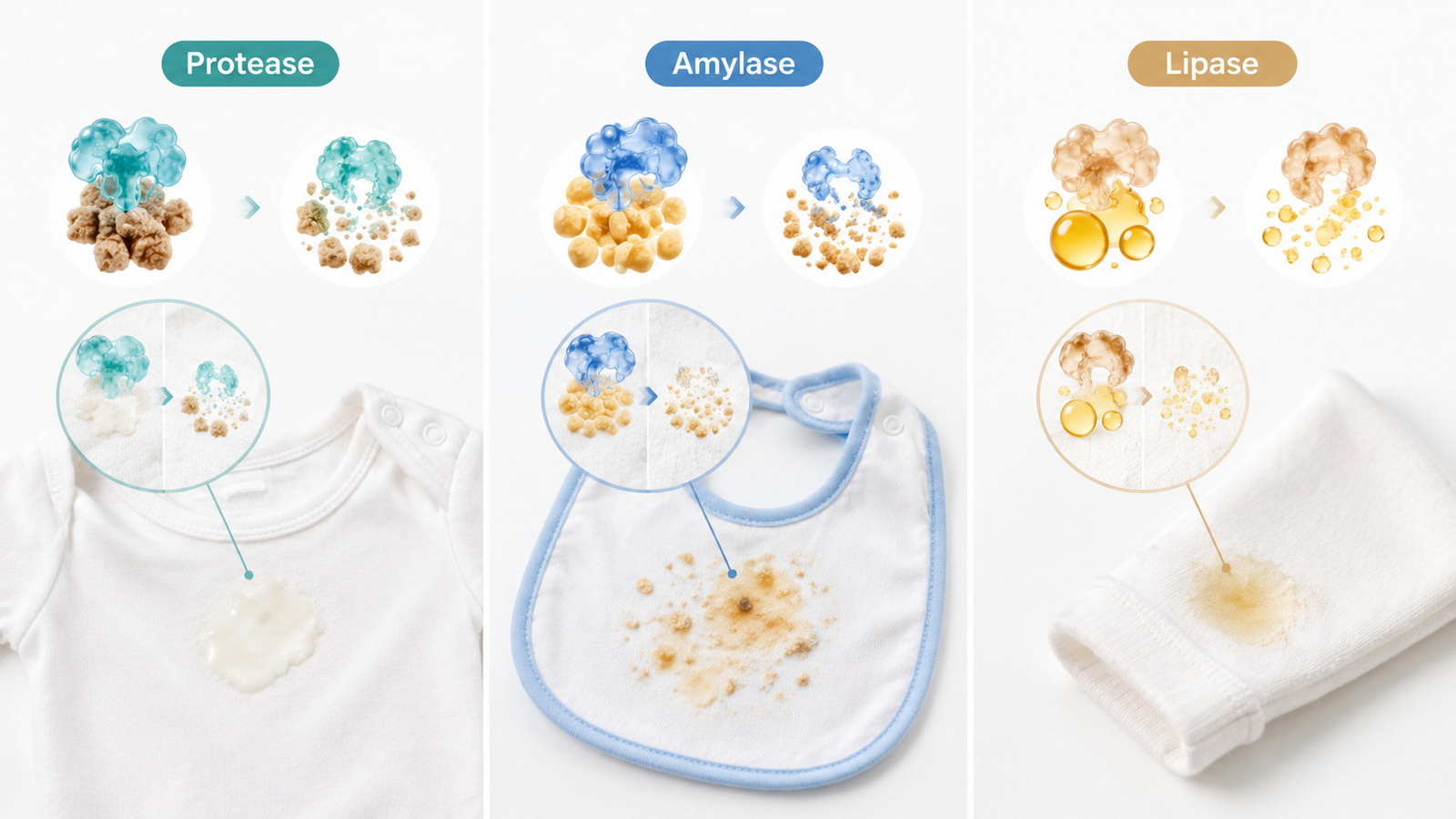
Enzyme laundry detergent contains biological catalysts that help break down particular soils. Different enzymes perform different jobs; "enzyme-powered" does not tell buyers which stains a formula actually addresses.
| Enzyme | Primary target | Relevant baby-laundry example |
|---|---|---|
| Protease | Protein-based soils | Protein components of milk or food stains |
| Amylase | Starch-based soils | Cereal, porridge, and potato-based foods |
| Lipase | Fat-based soils | Food oils and fatty residues |
Baby-food stains are often mixtures. A single stain may contain protein, starch, and fat, so cleaning depends on the enzyme combination and the surrounding detergent system.
Enzymes can help deliver cleaning performance at lower wash temperatures. However, the result still depends on formulation, dose, wash time, water conditions, and stain age.
For a baby clothing brand, that creates a practical opportunity: a fragrance-free detergent with enzymes selected for everyday feeding stains.
It does not justify saying that every enzyme detergent cleans better than every enzyme-free alternative. Comparative claims require comparative testing.
Enzyme presence alone is not a sound basis for declaring a detergent unsuitable for baby clothing.
A published review of consumer-use evidence found that hazards associated with concentrated enzyme raw materials did not translate into the skin-reaction risks sometimes attributed to enzyme-containing laundry products. However, that conclusion is not proof that every formulation suits every infant.
A later laboratory and animal study raised concerns about detergent exposure, skin-barrier damage, and sensitization. Its exposure models do not directly establish the risk from wearing normally washed and rinsed baby clothing.
These findings should not be presented as interchangeable. Consumer-use research and direct laboratory exposure answer different questions.
My recommendation is to evaluate the finished product under realistic conditions while treating sensitive-skin claims cautiously. Neither "enzymes are always harmful" nor "enzymes can never contribute to a problem" is a responsible product-development position.
Handling concentrated enzymes during production is different from wearing washed clothing. Occupational controls remain important even when a finished consumer product has an acceptable safety assessment.
Supplier qualification should therefore cover both finished-product evaluation and appropriate factory handling procedures.
An enzyme-free hypoallergenic laundry detergent can perform well through its surfactants and overall formulation. A well-designed enzyme detergent may provide additional help on targeted food stains.
The fair comparison uses equal conditions: the same fabric, stain preparation, water hardness, machine program, and intended dose.
Baby clothing collections may include cotton, synthetics, wool, or silk. A formula designed for cotton bodysuits should not automatically be promoted for every delicate garment.
Protease-containing products require particular care around protein-based fibers. Follow garment instructions and obtain formula-specific compatibility evidence before making broad fabric-care claims.
Neither "hypoallergenic" nor "enzyme" guarantees residue-free washing.
Brands should evaluate the complete wash process, including dosing, load size, and rinsing. For detergent sheets, dissolution and cleaning are separate questions: a sheet may dissolve successfully without delivering the required stain removal.
Instructions should explain the validated dose rather than assuming every load needs the same quantity.
Yes. Laundry detergent sheets can be developed with enzymes, but feasibility does not prove long-term performance.
For private-label baby laundry detergent sheets, I would ask the manufacturer to demonstrate three things:
1. The finished sheet cleans the intended stains.
2. The product maintains its specified performance throughout the proposed shelf life.
3. The sensitive-skin positioning is supported independently of its cleaning results.
Ask prospective partners:
- Which enzymes are included, and why?
- How is enzyme activity specified and monitored?
- What evidence supports finished-sheet shelf life?
- How does packaging protect the product during storage?
- What wash conditions support the instructions?
- Which reports apply to the exact proposed formula?
A raw-material certificate is useful, but it cannot replace finished-product evidence. Likewise, an existing report should not automatically be transferred to a reformulated or differently packaged product.
The following framework is a proposed development process, not a claim that any named product has passed these tests.

Decide whether the product serves everyday baby laundry, sensitive-skin households, or garments requiring special care.
Avoid combining all three into one unsupported promise. "For everyday cotton baby clothing" is a clearer development brief than "safe for every baby and every fabric."
Consider testing:
- A fragrance-free, dye-free enzyme-free formula.
- A fragrance-free, dye-free enzyme formula.
- A relevant existing product as a benchmark.
This design helps separate the contribution of enzymes from differences in fragrance, surfactants, or dosing.
Include representative food soils, relevant fabrics, fresh and dried stains, and intended washing conditions.
For sheets, add dissolution checks at the proposed dose. Repeat testing sufficiently to distinguish consistent performance from a favorable single result.
Work with qualified safety assessors and testing specialists to select suitable methods.
Adult patch testing, where appropriate, can contribute information. It does not prove that no infant will react, establish suitability for damaged skin, or demonstrate eczema treatment.
Consumer feedback is valuable for usability, but it is not a substitute for scientific substantiation.
The tested dose, packaging claims, and directions must tell the same story. Do not advertise strong cleaning at a lower dose than the one used to generate the supporting results.
Set acceptance criteria before reviewing outcomes rather than choosing favorable measures afterward.
A lower quoted unit price does not necessarily mean a more competitive product.
For internal evaluation, compare total washing cost divided by the number of loads meeting a predefined cleanliness standard. Include the recommended dose, packaging, freight, and any documented need for repeat washing.
Use actual trial results rather than assumed rewash savings. Enzymes may justify additional formulation cost when they deliver a measurable benefit, but that benefit must be demonstrated.
This approach connects purchasing decisions with customer experience: parents buy clean clothing and straightforward use, not enzyme concentration by itself.
Manufacturing capacity matters, but capacity is not evidence of sensitive-skin suitability.
According to company-provided information, Foshan Magic Crystal Technology Development Co., Ltd. operates more than three company-owned factories, has annual production capacity of approximately 30,000–40,000 metric tons, and provides OEM/ODM services to more than 300 brands.
Those figures describe production scale. Buyers should separately verify the facilities, specifications, quality arrangements, and supporting documentation relevant to their project.
For a baby laundry program, request:
- An agreed product specification and ingredient information.
- Relevant performance and stability reports.
- Batch traceability and release criteria.
- Packaging compatibility documentation.
- A written change-control process.
- Clearly assigned responsibility for claim approval.
My preferred approach is to develop a fragrance-free, dye-free baseline first, then determine whether enzymes deliver enough additional performance to support the intended positioning.
Contact Foshan Magic Crystal Technology Development Co., Ltd. with your target market, preferred format, garment types, expected stains, packaging requirements, and proposed claims.
Request a side-by-side development proposal for enzyme-free and enzyme-containing options, including sample evaluation, testing scope, minimum order requirements, and documentation deliverables.
Select the formula that meets the agreed criteria—not simply the one with the most reassuring label.
No. "Hypoallergenic" describes a positioning claim, while "enzyme-containing" describes ingredients. Check the full formulation and the evidence supporting the finished product.
Yes. Enzymes, fragrance, and dyes serve different functions. A manufacturer can develop an enzyme-containing formula without added fragrance or dyes.
A suitable enzyme blend may help because these stains contain different soil types. However, final performance depends on the whole formula and should be verified through controlled washing tests.
No. Ask what was tested, on whom, under which conditions, and with what results. The phrase alone does not establish universal newborn suitability.
No. Format alone does not establish gentleness. Assess ingredients, dose, dissolution, rinsing, and finished-product tolerability rather than assuming sheets are inherently milder.
A rash needs appropriate medical assessment rather than an automatic assumption about enzymes. Parents should discuss suspected product reactions with a healthcare professional, especially when symptoms persist or worsen.
1. American Academy of Dermatology Association. [How can I find eczema friendly products?] Guidance supporting fragrance-free, dye-free detergent selection and the distinction between fragrance-free and unscented products. [aad]
2. American Cleaning Institute. [Ask ACI: Enzymes in Cleaners] Industry explanation of protease, amylase, and lipase functions. [cleaninginstitute]
3. American Cleaning Institute. [The Role of Enzymes in Detergent Products] Technical factsheet covering enzyme functions and lower-temperature cleaning applications. This is an industry source, not an independent clinical assessment. [cleaninginstitute]
4. Basketter, D. A., English, J. S. C., Wakelin, S. H., and White, I. R. [Enzymes, detergents and skin: facts and fantasies]. *British Journal of Dermatology*, 2008. Review addressing enzyme hazards, consumer exposure, and reported skin reactions. [pubmed.ncbi.nlm.nih]
5. *PLOS ONE*. [Laundry detergent promotes allergic skin inflammation and esophageal eosinophilia in mice], 2022. Experimental research discussed with explicit limitations concerning its applicability to normally laundered clothing. [journals.plos]
6. U.S. Food and Drug Administration. ["Hypoallergenic" Cosmetics]. Background on cosmetic claims only; not presented here as detergent-specific law. [fda]
7. Federal Trade Commission. [FTC Policy Statement Regarding Advertising Substantiation]. Basis for having appropriate support before publishing objective advertising claims. [ftc]
8. Federal Trade Commission. [Health Products Compliance Guidance], 2022. Guidance relevant to substantiating health and safety representations. [ftc]
9. Company background supplied for this article: Foshan Magic Crystal Technology Development Co., Ltd. Factory, capacity, and customer figures are company-provided and were not independently verified. The proposed development framework and purchasing recommendations are editorial analysis, not reported company test results.


