
Views: 289 Author: Magic Household Cleaning Publish Time: 2026-11-04 Origin: Site
Content Menu
● Hypoallergenic Laundry Detergent vs Plant-Based Laundry Detergent: Key Differences
● What Is Hypoallergenic Laundry Detergent?
>> Fragrance-Free Is More Useful Than a Vague Gentle Claim
>> What Should Support a Hypoallergenic Claim?
● What Is Plant-Based Laundry Detergent?
>> Ingredient Origin Does Not Establish Safety
>> Understand What Biobased Percentages Measure
● Cleaning Performance: Compare the Finished Formula
>> Build a Relevant Wash-Test Matrix
>> Compare Cost per Successful Wash
● Environmental Claims: Separate Renewable Origin from Proven Outcomes
>> Use Specific Claims Instead of "Eco-Friendly"
>> Separate Dissolution from Biodegradation
● A Practical Private-Label Decision Framework
>> An Illustrative Two-Product Launch
● OEM/ODM Development: Turn Positioning into a Testable Brief
>> 1: Define the Market and Claims
>> 2: Request the Technical Package
>> 3: Validate the Actual Saleable Product
>> 4: Control Changes After Approval
● Working with Foshan Magic Crystal Technology Development Co., Ltd.
>> Start with a Product Brief, Not Just a Price Request
>> Is Hypoallergenic Laundry Detergent Always Plant-Based?
>> Is Plant-Based Laundry Detergent Better for Sensitive Skin?
>> Can Laundry Detergent Sheets Be Both Hypoallergenic and Plant-Based?
>> Does Fragrance-Free Mean No One Can React to the Product?
>> Does USDA Biobased Certification Prove Biodegradability?
>> Which Option Should an Eco-Conscious Private Label Choose?
Choosing between hypoallergenic laundry detergent vs plant-based laundry detergent starts with recognizing that these claims answer different questions. Hypoallergenic positioning concerns skin compatibility and allergy risk. Plant-based positioning concerns ingredient origin. For an eco-conscious private label, the strongest product may combine both—but neither claim alone proves cleaning performance or environmental superiority.
From a product-development perspective, I would begin with the customer's problem rather than the packaging language. Does your audience prioritize sensitive skin, renewable ingredients, convenient dosing, or all three?
The following comparison explains how to turn those priorities into a credible formulation, practical testing plan, and commercially differentiated laundry product.
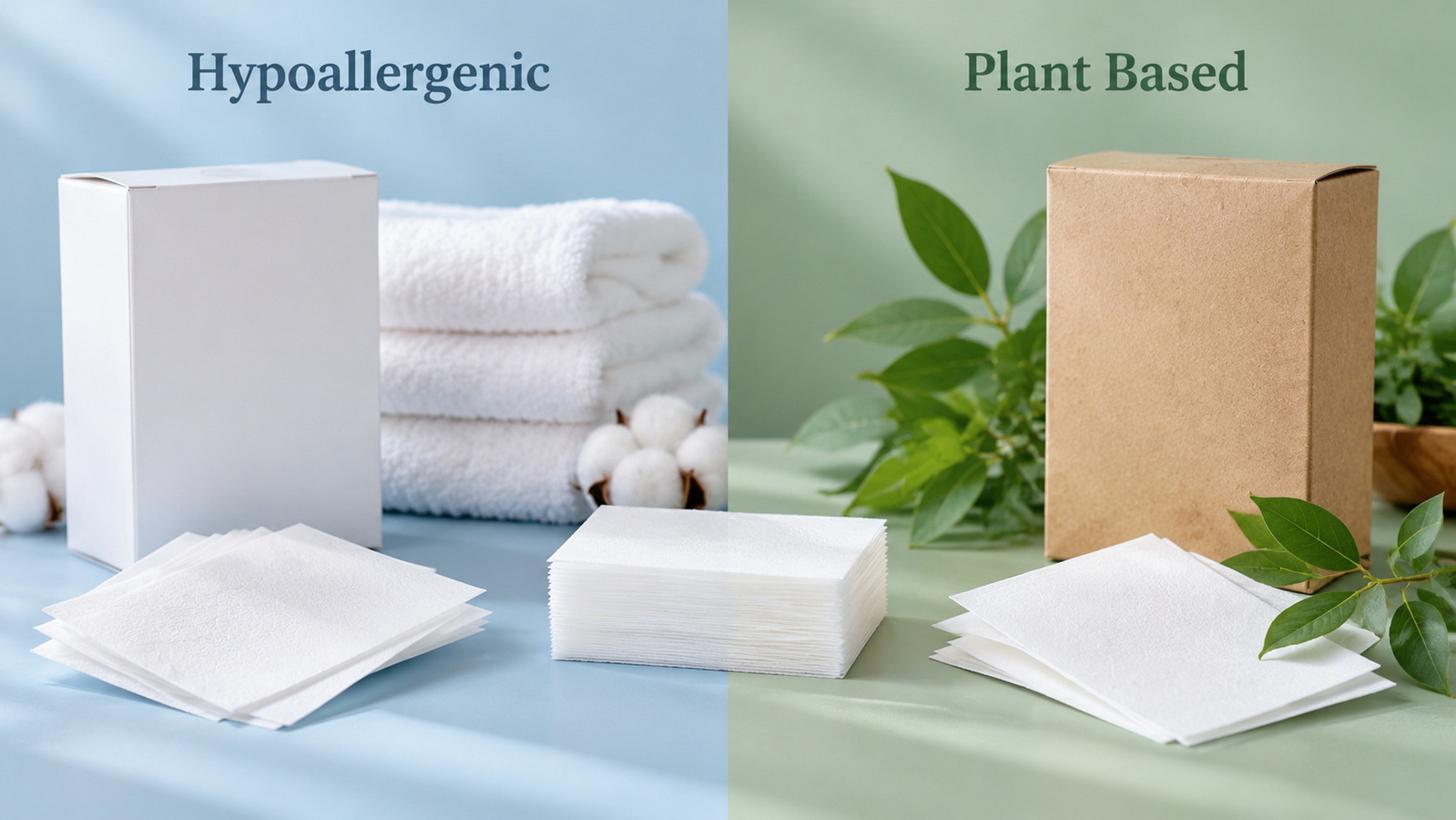
The central distinction is purpose: hypoallergenic describes an intended skin-compatibility benefit, while plant-based describes the origin of some or all ingredients.
These categories overlap. A plant-derived formula can contain fragrance allergens. A hypoallergenic formula can include ingredients derived from nonrenewable sources.
| Comparison factor | Hypoallergenic laundry detergent | Plant-based laundry detergent |
|---|---|---|
| Primary positioning | Reduced allergy-related concerns | Renewable ingredient sourcing |
| Main buyer question | “Is this suitable for my sensitive-skin routine?” | “What are the ingredients made from?” |
| Formulation priorities | Allergen review, fragrance decisions, skin compatibility | Feedstock traceability and defined plant-derived content |
| Essential evidence | Finished-product assessment and claim-specific testing | Supplier documentation and, where appropriate, biobased testing |
| Cleaning performance | Must be demonstrated separately | Must be demonstrated separately |
| Environmental performance | Not established by the claim | Not established by ingredient origin alone |
| Strong private-label application | Sensitive-skin-focused ranges | Ingredient-conscious, renewable-material ranges |
For brands targeting both audiences, a fragrance-free formula with documented plant-derived ingredients creates a coherent development direction. However, every additional promise needs its own evidence.
Hypoallergenic laundry detergent is generally positioned as less likely to trigger allergic reactions. Buyers should not interpret this as "allergy-proof," suitable for every person, or a treatment for eczema.
Allergy and irritation are also different. An allergic response involves the immune system; irritation can occur without an allergy. A useful product assessment considers both rather than treating "gentle" as a complete technical specification.
For a sensitive-skin range, fragrance deserves early attention. Dermatology guidance recommends fragrance-free laundry detergent for people managing certain skin conditions.
"Unscented" is not necessarily equivalent. A product may contain ingredients that mask an odor without producing an obvious scent.
My preferred development brief would therefore specify:
- No added fragrance or masking fragrance.
- No unnecessary dyes.
- Review of preservatives and other potential sensitizers.
- Clear dosing and rinsing instructions.
- Finished-product evidence appropriate to the intended claim.
Removing fragrance does not make a formula universally nonallergenic. It removes one avoidable source of concern.
Ask a prospective manufacturer what was tested, on which formulation, and under what conditions.
A meaningful evidence package should identify the laboratory, protocol, sample, participant population where relevant, results, and limitations. An ingredient review is useful, but it is not the same as evaluating the finished product.
Likewise, "dermatologically tested" describes testing activity; without the report, it does not explain the outcome.
Plant-based laundry detergent contains ingredients derived partly or wholly from plants. The claim may apply to selected surfactants, a broader ingredient system, or a defined portion of the formulation.
That distinction matters commercially. "Made with plant-derived surfactants" communicates something different from "100% plant-based detergent."
A plant-derived ingredient still needs assessment for its intended use. Natural fragrance materials can contain allergens, and renewable sourcing does not automatically establish low irritation or low aquatic toxicity.
Conversely, an ingredient's synthetic manufacture does not by itself establish that it is unsuitable.
I would evaluate each ingredient through four questions:
1. What function does it perform?
2. What evidence supports its safety at the intended exposure?
3. How does it behave after use?
4. Can its origin and quality be documented consistently?
This approach avoids substituting a botanical story for a technical assessment.
The USDA BioPreferred program uses ASTM D6866 to quantify biobased content through the ratio of renewable organic carbon to total organic carbon.
That percentage is not automatically the percentage of the entire formula by weight. Water and inorganic components are excluded from the carbon-based calculation.
A verified biobased percentage supports a sourcing claim. It does not independently certify superior cleaning, skin compatibility, or overall environmental performance.
Neither hypoallergenic nor plant-based positioning predicts stain removal.
Surfactant selection, concentration, supporting ingredients, dose, water conditions, and wash program all influence results. Private-label buyers should compare finished products under matched conditions rather than infer performance from ingredient narratives.
A practical comparison should cover:
- Body oils and everyday soil.
- Food and beverage stains.
- Representative cotton and synthetic fabrics.
- Cold-water and warmer washing.
- Soft and hard water.
- Recommended and realistically foreseeable dosing.
- Visible residue and fabric appearance.
Where enzymes are used, evaluate their contribution to the target stain profile rather than assuming that inclusion or exclusion is inherently better.
For detergent sheets, also test dissolution under the labeled conditions. A sheet that performs well in one machine or temperature may require further evaluation before broader claims are justified.

Unit price can disguise the true commercial difference.
A useful purchasing metric is:
Cost per successful wash=Total detergent cost/Total detergent cost
For an illustrative—not measured—comparison, a cheaper product that regularly requires a second dose may offer worse value than a higher-priced product that succeeds at its recommended dose.
Include packaging, freight, complaints, and potential rewashing when assessing the business case.
An eco-conscious private label needs more than a green-looking ingredient list.
The FTC's environmental marketing guidance emphasizes that claims must be substantiated and appropriately qualified. Broad promises can imply benefits that the available evidence does not establish.
More useful wording identifies the attribute being measured:
- "Made with plant-derived surfactants," when documented.
- A verified biobased-content percentage, with the relevant basis.
- A quantified packaging reduction against a named comparator.
- Cold-water performance supported by a defined test.
Avoid treating "plant-based," "biodegradable," "recyclable," and "compostable" as interchangeable. Each describes a different property and requires different supporting evidence.
For laundry detergent sheets, disappearing in water demonstrates dissolution—not necessarily biodegradation.
If a sheet contains a polymeric binder, request its identity and the evidence supporting any environmental claim. Ask which test was used, what material was tested, and which environmental conditions the result represents.
Also distinguish the detergent from its packaging. Evidence about one does not automatically support a claim about the other.
Rather than declare one category universally better, I would score each candidate against the brand's commercial priorities.
The following weights are an illustrative planning tool, not an industry benchmark.
| Evaluation category | Suggested weight | Evidence to review |
|---|---|---|
| Cleaning and dissolution | 30% | Comparative wash and dissolution reports |
| Skin-compatibility positioning | 25% | Formula review and relevant finished-product testing |
| Environmental substantiation | 20% | Origin records and claim-specific evidence |
| Delivered economics | 15% | Cost per load, freight, and packaging |
| Manufacturing reliability | 10% | Specifications, traceability, and change control |
A sensitive-skin brand might increase the skin-compatibility weighting. A refill-focused retailer might prioritize packaging and delivered economics.
The important discipline is to score evidence rather than presentation quality.
A brand serving distinct customer groups could consider:
1. A fragrance-free, sensitive-skin-focused detergent.
2. A plant-derived detergent with a separately validated fragrance option.
Alternatively, one fragrance-free, plant-derived formula may support a simpler launch.
These are development scenarios, not documented sales outcomes. The right choice depends on customer research, formulation feasibility, and the cost of supporting multiple product lines.
A strong manufacturing brief connects every consumer promise to a specification.
Specify the destination market, customer profile, product format, fragrance policy, target retail price, and proposed pack wording.
Do not finalize claims before confirming how they will be substantiated.
Ask for:
- Ingredient identities and functions.
- Relevant raw-material specifications.
- Safety and regulatory documentation.
- Evidence supporting plant-derived claims.
- Existing test reports and their scope.
- A proposed plan for any missing finished-product testing.
Confidential formulation information can be handled through an appropriate agreement.
Test the formulation, dose, format, and packaging intended for sale.
For sheets, include storage stability, humidity exposure, sheet consistency, dissolution, cleaning, and packaging compatibility in the agreed validation plan.
Require documented review before changes to raw materials, suppliers, fragrance, sheet composition, or packaging.
A report on an earlier formula should not automatically be treated as evidence for a modified product.
According to the company information supplied for this article, Foshan Magic Crystal Technology Development Co., Ltd. develops, manufactures, and sells laundry detergent sheets alongside clothing-care, household, personal-care, and pet-cleaning products.
The supplied profile reports more than three company-owned factories, annual production capacity of 30,000–40,000 metric tons, and OEM/ODM service for more than 300 brands worldwide.
That scale provides a relevant starting point for a manufacturing discussion. Buyers should still verify product-specific capability, available capacity, testing arrangements, and documentation for their intended market. Company-wide capacity is not proof that a particular formulation or certification is available.

Contact Foshan Magic Crystal Technology Development Co., Ltd. with your target market, expected order volume, preferred format, fragrance requirements, proposed claims, and benchmark product.
Request a sample-development proposal covering formulation options, validation needs, packaging, lead times, and quotation assumptions. This creates a clearer basis for comparing suppliers and moving toward a defensible private-label launch.
No. Hypoallergenic positioning concerns allergy-related suitability, while plant-based positioning concerns ingredient origin. A formula can support either claim, both claims, or neither.
Not automatically. Fragrance, individual ingredients, exposure, dosing, and personal sensitivities matter. Assess the complete formula rather than relying on its plant-derived content.
Yes, these positions are compatible. However, supporting one does not prove the other. Review the sheet's full composition and obtain evidence appropriate to each proposed claim.
No. Fragrance-free removes fragrance-related exposure, but individuals may react to other ingredients. Avoid absolute promises such as "allergy-free" or "safe for everyone."
No. It verifies biobased content within the program's scope. Biodegradability, cleaning performance, and skin compatibility require separate assessment.
Choose according to the audience and evidence available. A fragrance-free formula with documented plant-derived ingredients can bridge both priorities, provided performance and all marketing claims are independently supported.
1. American Academy of Dermatology. "[How to Treat Eczema at Home]." Supports fragrance-free laundry recommendations and the distinction between fragrance-free and unscented products. [aad]
2. ECARF Institute. "[Criteria for Allergy-Friendly Laundry Products]." Provides an example of criteria addressing laundry-product allergens, including fragrances and certain proteins. These criteria are not presented as universal legal requirements. [ecarf-institute]
3. United States Department of Agriculture, BioPreferred Program. "[Frequently Asked Questions]." Explains biobased-content measurement, excluded components, and why higher biobased content does not necessarily establish superior safety, performance, or environmental impact. [biopreferred]
4. United States Department of Agriculture, BioPreferred Program. "[ASTM D6866—Frequently Asked Questions]." Defines the renewable-organic-carbon basis of biobased-content measurement. [biopreferred]
5. Federal Trade Commission. "[Environmental Claims: Summary of the Green Guides]." Explains substantiation and qualification principles for renewable-material, degradable, and other environmental claims. [ftc]
6. United States Environmental Protection Agency. "[Safer Choice Standard and Criteria]." Describes ingredient assessment and the program's additional fragrance-free criteria. Reference to this program does not imply that the company or products discussed hold certification. [epa]


