
Views: 258 Author: Magic Household Cleaning Publish Time: 2026-09-23 Origin: Site
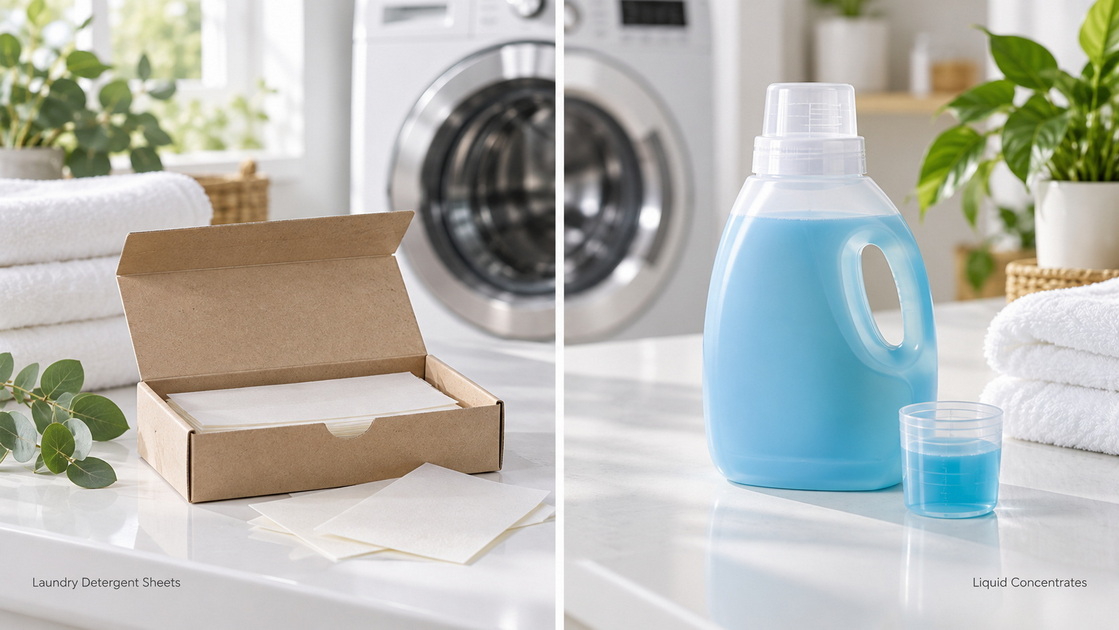
Content Menu
● What Are Washing Detergent Sheets and Liquid Concentrates?
>> What are washing detergent sheets?
>> What are liquid laundry concentrates?
● Washing Detergent Sheets vs Liquid Concentrates at a Glance
>> Liquid concentrates offer greater formula flexibility
>> Detergent sheets must solve dissolution and active-delivery challenges
>> performance claims must be specific
>> Why consumers choose detergent sheets
>> Why liquid concentrates remain practical
● Look Beyond "Plastic-Free" Claims
>> Potential environmental advantages of detergent sheets
>> Potential environmental advantages of liquid concentrates
>> Sustainability requires evidence, not assumptions
● Safety, Sensitive Skin, and Ingredient Transparency
>> What matters most for laundry detergent safety?
>> Safety communication for OEM/ODM brands
● How to Choose the Right Format for Your Brand
>> 1: Define your target consumer
>> 2: Define your primary product promise
>> 3: Validate performance before launch
>> 4: Match packaging to the actual user journey
● Product Development Is a System
● Detergent Sheets or Liquid Concentrates?
● FAQ
>> 1. Are washing detergent sheets better than liquid concentrates?
>> 2. Do laundry detergent sheets dissolve in cold water?
>> 3. Can detergent sheets remove tough stains?
>> 4. Are liquid concentrates more environmentally friendly than regular liquid detergent?
>> 5. Are laundry detergent sheets safe for sensitive skin?
>> 6. Which format is better for private-label detergent brands?
>> 7. Can one manufacturer produce both detergent sheets and liquid concentrates?
Washing detergent sheets vs liquid concentrates is no longer simply a packaging decision. For private-label brands, retailers, and consumers, the choice affects cleaning performance, dosing accuracy, transport efficiency, sustainability claims, user experience, formula flexibility, and repeat-purchase potential.
As a manufacturer of laundry detergent sheets, clothing-care products, household cleaners, personal-care products, and pet-cleaning solutions, Foshan Magic Crystal Technology Development Co., Ltd. works with global OEM/ODM customers to evaluate exactly these trade-offs. With more than three self-owned factories, annual production capacity of approximately 30,000–40,000 tons, and OEM/ODM support for over 300 brands, we see one key reality: neither format wins in every use case.
Laundry detergent sheets often provide a compelling lightweight, plastic-reducing, travel-friendly proposition. Liquid concentrates generally offer more formulation flexibility, more adjustable dosing, and potentially stronger performance for certain heavy-soil or specialty-laundry needs. The best choice depends on the target market, formula design, consumer behavior, claim substantiation, and product positioning.
Before comparing performance, it is important to define the two formats accurately.
Washing detergent sheets, also called laundry detergent sheets, detergent strips, laundry sheets, or detergent squares, are pre-portioned or tearable sheets containing concentrated detergent ingredients. They are designed to dissolve in wash water and release cleaning agents during the wash cycle.
A typical laundry sheet may include:
- Surfactants for soil and oil removal
- Builders or water-softening ingredients
- Enzymes for protein-, starch-, or fat-based stains
- Fragrance or fragrance-free options
- Chelating agents
- Fabric-care ingredients
- A dissolvable binder or film-forming material
According to the American Cleaning Institute, polyvinyl alcohol (PVA) is used in some unit-dose detergent products, including sheets, to hold concentrated detergent ingredients together; it is designed to dissolve in water and release the detergent ingredients.
For brands, the attraction is clear: a compact detergent sheet can turn routine laundry into a cleaner, simpler, more portable experience.
Liquid laundry concentrates are highly concentrated detergent liquids formulated to deliver cleaning performance with less product per wash than conventional liquid detergents. They may be sold in smaller bottles, refill pouches, bulk containers, dosing pumps, or large commercial formats.
Compared with a standard liquid detergent, a liquid concentrate generally contains:
- Less added water per wash dose
- A higher active-ingredient concentration
- A smaller recommended dose
- More formulation options for stain-removal systems
- Greater ability to vary dosage by load size or soil level
Concentrated detergent products can reduce package size because less detergent may be needed for the same wash process.
Important distinction: "Concentrated" does not automatically mean "better." A product's real value depends on active content, dosage instructions, wash performance, rinse behavior, ingredient selection, and whether its claims are supported by testing.
| Comparison Factor | Washing Detergent Sheets | Liquid Concentrates |
|---|---|---|
| Product format | Dry, thin, pre-portioned or tearable sheets | Highly concentrated liquid in bottles, pouches, or refill systems |
| Consumer convenience | Very easy to store, carry, and dose | Familiar format, but measuring may be required |
| Dosing flexibility | Limited unless sheets are designed to tear precisely | High; users can adjust dose for load size and soil level |
| Spill risk | Very low | Higher risk of dripping, leaking, or overdosing |
| Packaging potential | Often plastic-reduced or plastic-free carton formats | Usually plastic bottle or refill pouch, although refill systems can reduce packaging |
| Shipping efficiency | Excellent due to low weight and low water content | Better than conventional liquid, but heavier than sheets |
| Heavy-stain flexibility | Depends heavily on formula and enzyme system | Often strong potential because of formulation versatility |
| Cold-water performance | Can be effective if fast-dissolving | Generally easy to disperse, depending on viscosity and formulation |
| Private-label differentiation | Strong for eco, travel, minimalist, subscription, and convenience brands | Strong for performance, premium care, refill, family-size, and specialty products |
| Best-fit consumer | Convenience-focused, travel-minded, storage-conscious, eco-curious buyers | Users who prefer adjustable dosing, familiar liquid use, and targeted performance |
Bottom line: detergent sheets are often strongest as a convenience-led and packaging-led format, while liquid concentrates are often strongest as a flexible, performance-led format.
The most important question for buyers is simple: Do laundry detergent sheets work as well as liquid concentrates?
The honest answer is that performance is formula-specific, not format-specific. A well-designed laundry sheet can outperform a weak liquid concentrate, while a high-performance liquid concentrate can outperform an under-formulated sheet.
However, the two formats present different formulation and use challenges.
Liquid concentrates can make it easier to build product variations for different market needs, including:
- Heavy-duty laundry detergents
- Baby-laundry detergents
- Sensitive-skin or fragrance-free detergents
- Color-protection formulas
- Sportswear and odor-removal detergents
- Delicate and wool-care detergents
- Commercial or institutional laundry products
- Enzyme-rich stain-removal formulas
Because liquids can accommodate different ingredient systems, viscosities, fragrance loads, and dosing instructions, they can offer a broad development platform for OEM/ODM brands.
For example, a premium liquid concentrate may be designed around a multi-enzyme system that targets common household stains:
- Protease for protein stains such as grass, blood, dairy, and sweat
- Amylase for starchy stains such as sauces and pasta residues
- Lipase for oils, body soils, and greasy food stains
- Cellulase for fabric-care effects and appearance improvement
The presence of an ingredient category alone does not guarantee performance. The concentration, stability, wash temperature, pH, surfactant system, water hardness, and consumer dosage all matter.
Laundry detergent sheets need to dissolve efficiently and distribute actives evenly in the wash. The product must be engineered to perform across different real-world conditions:
- Cold-water washing
- Short wash cycles
- HE washing machines
- Front-load and top-load machines
- Hard-water regions
- Full or overloaded drums
- Handwashing applications
Consumer Reports tested laundry detergent sheets using challenging stains including blood, body oil, chocolate, coffee, dirt, grass, and salad dressing. Its test results found that the tested laundry sheets, as a group, performed below liquid detergents and pods in that particular evaluation, with coffee stains identified as a notable challenge.
This does not mean all laundry sheets are ineffective. It means brands should not rely on format-based marketing claims alone. They should invest in formula development, controlled performance testing, dissolution testing, and honest claim language.
From an OEM/ODM product-development perspective, avoid generic claims such as:
- "Works better than all liquid detergents"
- "Removes every stain"
- "Perfect in every water condition"
These claims are difficult to defend and may create consumer dissatisfaction.
A stronger approach is to make testable, clear claims, such as:
- "Designed for everyday stains and cold-water washing"
- "Fast-dissolving formula for HE and standard machines"
- "Formulated with enzymes for food and body-soil stains"
- "For heavily soiled loads, pre-treat stains or use the recommended enhanced dose"
Trust grows when the packaging promise matches the actual wash result.
For many consumers, laundry is not a technical decision. It is a weekly habit. The product that feels easiest to use is often the product they buy again.
Laundry sheets create a highly intuitive routine:
1. Take one sheet or the recommended fraction of a sheet.
2. Place it directly into the empty washer drum.
3. Add clothing.
4. Start the wash cycle.
This is especially attractive for:
- Apartment residents with limited storage
- Students
- Travelers
- RV users
- Subscription-box customers
- Consumers who dislike bulky detergent bottles
- Users concerned about spills and drips
- Households seeking simplified laundry routines
A dry sheet format can also reduce the mess associated with detergent caps, sticky bottle necks, leaking packages, and overpoured liquid.
Liquid concentrate users benefit from flexible dosing. This can be especially useful when wash needs vary.
For instance, consumers can increase the dose for:
- Large loads
- Muddy children's clothing
- Kitchen towels
- Gym clothing
- Work uniforms
- Pet bedding
- Hard-water conditions
They can also lower the dose for lightly soiled clothing or smaller loads.
However, dosage flexibility has a downside: consumers may use too much product. Excess detergent can contribute to rinse issues, residue, oversudsing, unnecessary cost, and avoidable chemical discharge. One consumer guide advises users of liquid concentrates to start with the minimum recommended dose, then adjust according to load size, water hardness, and soil level.
For a brand launch, product format should match consumer behavior.
| Brand Positioning | Better Starting Format |
|---|---|
| Plastic-reduced, compact, travel-friendly | Washing detergent sheets |
| Family-size value and adjustable dosage | Liquid concentrates |
| Subscription and direct-to-consumer | Washing detergent sheets |
| Heavy-duty stain care | Liquid concentrates or high-performance sheets with validated testing |
| Eco-focused refill model | Liquid concentrate refill system |
| Giftable, minimalist, social-media-friendly packaging | Washing detergent sheets |
| Commercial laundry or professional-use markets | Liquid concentrates |
Sustainability is one of the most important reasons brands explore laundry detergent sheets. But responsible sustainability communication requires a full lifecycle perspective.
Because sheets are dry and lightweight, they may offer several logistical benefits:
- Lower shipping weight compared with water-heavy liquid products
- Less warehouse space per wash load
- Potentially lower packaging material use
- Easier carton-based packaging
- Reduced risk of product leakage during transport
- A potentially lower transport burden per wash, depending on formula, shipment distance, and package design
These are meaningful advantages, particularly for direct-to-consumer brands shipping individual orders.
Liquid concentrates can also improve on conventional liquid detergent by reducing water content and package volume. The key sustainability benefit comes from delivering more washes in a smaller container.
For example, a concentrated liquid detergent may allow a brand to:
- Use less plastic per wash than a non-concentrated liquid
- Offer refill pouches or reusable bottle systems
- Reduce transportation weight compared with conventional liquid detergent
- Support bulk purchasing and institutional use
- Improve cost efficiency per load
A carton is not automatically sustainable. A refill pouch is not automatically sustainable. A sheet is not automatically biodegradable. A plant-derived ingredient is not automatically low impact.
Brands should assess:
- Formula biodegradability
- Aquatic-toxicity profile
- Packaging material and recyclability
- Recycled-content percentage
- Product-to-package ratio
- Shipping distance and transport mode
- Water content per use
- Manufacturing energy
- Waste-management realities in the target market
The U.S. Environmental Protection Agency's Safer Choice program helps purchasers identify cleaning products that perform while containing ingredients considered safer for human health and the environment. Brands targeting the U.S. market can consider whether the program's ingredient and performance expectations align with their product-development strategy.
Safety is a critical comparison point, but it must be discussed carefully. Neither a detergent sheet nor a liquid concentrate is automatically safer merely because of its physical format.
The primary questions are usually:
- Is the formula appropriate for its intended use?
- Are ingredients disclosed clearly where required?
- Are fragrance and dye choices suitable for the target audience?
- Is the product tested for stability and compatibility?
- Are safety labels, warnings, and directions clear?
- Can consumers avoid accidental misuse?
- Does the product have appropriate child-safety packaging where needed?
For sensitive-skin positioning, brands commonly consider fragrance-free or low-fragrance formulas, no added dyes, carefully selected surfactants, and transparent ingredient communication.
Some laundry sheet products have obtained EPA Safer Choice certification. For example, Seventh Generation states that its Free & Clear laundry detergent sheets are EPA Safer Choice Certified, free from dyes and fragrances, hypoallergenic, and designed to dissolve in all water temperatures.
That example illustrates an important point: certifications apply to a specific product and formula—not to all detergent sheets or all liquid concentrates.
A credible private-label detergent brand should prepare:
- Safety Data Sheets where applicable
- Ingredient documentation
- Product specifications
- Stability-test records
- Microbiological control records for liquid products
- Batch traceability
- Correct labeling for each destination market
- Child-safety and storage warnings
- Claims substantiation files
For brands selling across multiple countries, regulatory and label requirements can differ significantly. Product development should therefore begin with the target market, not with a generic global claim.
The best way to decide between washing detergent sheets and liquid concentrates is to use a structured product-selection process.
Ask:
- Do they live in apartments, houses, dorms, or mobile lifestyles?
- Do they prioritize convenience, stain removal, low waste, or premium scent?
- Are they price-sensitive?
- Are they purchasing online or in physical stores?
- Do they wash in cold water?
- Do they use HE machines?
- Do they have children, pets, sensitive skin, or high-volume laundry needs?
A travel-oriented consumer may value a dry, compact laundry sheet. A large household with variable load sizes may prefer liquid concentrate dosing flexibility.
Choose one primary promise, then support it with evidence.
Possible positioning directions include:
- Everyday convenience: fast-dissolving laundry sheets for daily washing
- Eco-conscious storage: compact detergent sheets in reduced-plastic packaging
- Premium cleaning: enzyme-based liquid concentrate for everyday stains
- Sensitive skin: fragrance-free, dye-free formula with clear ingredient positioning
- Sportswear care: odor-targeting formula for activewear
- Family value: concentrated liquid with many washes per bottle
- Travel and portability: lightweight laundry sheets for trips and small spaces
Trying to promise everything at once can weaken the brand message.
Before commercialization, test the product under relevant conditions:
- Cold-water dissolution
- Standard-water dissolution
- HE machine compatibility
- Soil and stain removal
- Foam control
- Rinse behavior
- Fabric appearance
- Fragrance retention, if applicable
- Product stability
- Packaging compatibility
- Shipping and heat stability
For detergent sheets, include both full-sheet and partial-sheet dosing tests. Consumers may tear sheets for small loads, so the sheet must remain practical and dose-consistent after tearing.
For sheets, consider:
- Moisture protection
- Easy tear-off access
- Child-safety considerations
- Clear "sheet first, clothes second" directions
- Carton durability for e-commerce shipping
For liquid concentrates, consider:
- Controlled-pour cap or dosing pump
- Leak resistance
- Refill compatibility
- Clear dosage marking
- Ergonomic handling
- Child-resistant or safety-oriented packaging where appropriate
The strongest laundry brands do not only choose a detergent format. They design a complete product system.
That system includes:
- Formula performance
- Consumer instructions
- Packaging design
- Claim substantiation
- Production consistency
- Quality control
- Market-specific compliance
- Fulfillment and shipping requirements
- Brand storytelling

At Foshan Magic Crystal Technology Development Co., Ltd., OEM/ODM development can begin with the commercial goal rather than a fixed formula. For example, a customer may request:
- Laundry detergent sheets for an eco-focused U.S. e-commerce brand
- Fragrance-free sheets for a sensitive-skin product line
- High-fragrance sheets for a lifestyle or gifting brand
- Concentrated liquid detergent for a family-value retail concept
- Pet-safe cleaning products designed for specific household-cleaning needs
- Coordinated household-cleaning ranges that share a unified fragrance identity
The manufacturing partner should be able to discuss not only ingredients and packaging, but also wash behavior, claims, target users, packaging durability, compliance documentation, and production scalability.
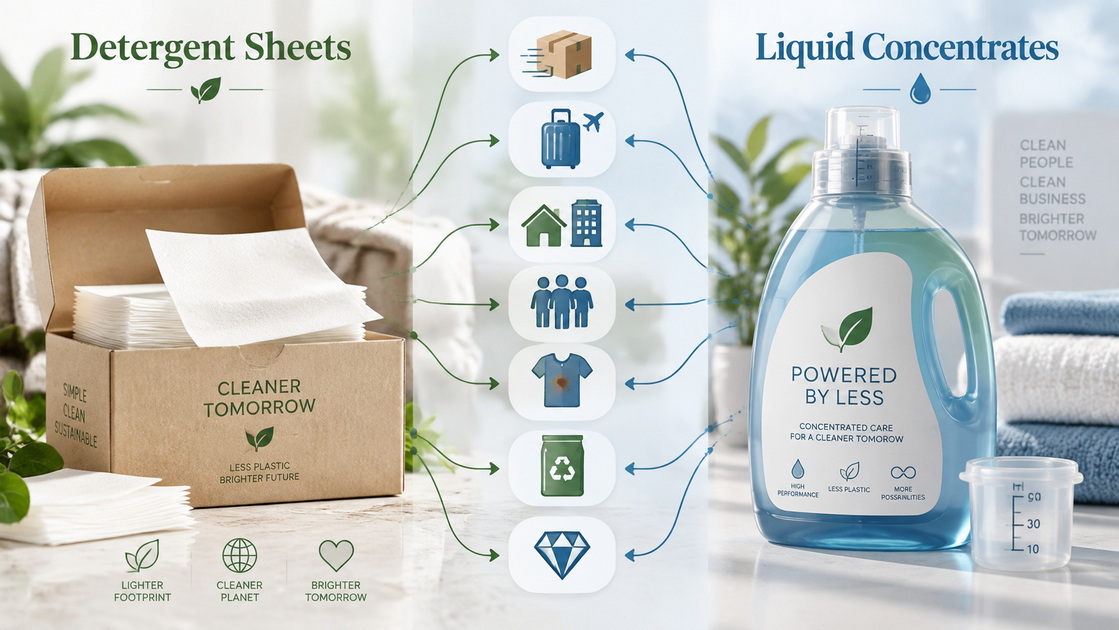
Choose washing detergent sheets when your brand needs portability, simple dosing, compact storage, e-commerce efficiency, and a strong reduced-plastic packaging story. They are particularly suitable for convenience-led, travel-focused, minimalist, and subscription-based brands.
Choose liquid concentrates when your brand requires greater dosing flexibility, broader formulation options, heavy-duty or specialty-laundry positioning, refill opportunities, or familiar household usage.
For many product portfolios, the most strategic answer is not "sheets versus liquids." It is sheets and liquids for different consumer needs.
A premium brand may launch detergent sheets for travel and everyday laundry while offering liquid concentrate for high-soil family loads, stain-treatment support, or refill-focused customers. This dual-format approach can broaden the audience without forcing one product to solve every laundry problem.
Looking to develop private-label laundry detergent sheets or liquid concentrates? Work with an experienced OEM/ODM manufacturer to evaluate formula options, target-market requirements, packaging formats, performance testing, and scalable production before your product launch.
Not universally. Washing detergent sheets are often better for convenience, lightweight shipping, compact storage, and pre-measured use. Liquid concentrates are often better when consumers want adjustable dosage, a familiar liquid format, or specialized performance options.
Many laundry detergent sheets are designed to dissolve in both cold and warm water, but actual performance depends on the sheet formulation, water volume, wash-cycle length, and machine loading. Brands should validate cold-water dissolution before making a cold-water claim. Seventh Generation, for example, states that its laundry sheets dissolve in all water temperatures.
They can remove everyday stains when formulated well, but difficult stain removal depends on the active system, including surfactants, enzymes, water hardness, wash temperature, and proper dosing. Independent testing has found that some detergent sheets underperform compared with liquid detergents on difficult stains, so brands should conduct product-specific testing and avoid unsupported broad claims.
They can be. Because liquid concentrates use less water and may require smaller packaging than conventional liquid detergents, they can reduce package volume and shipping weight per wash. The actual environmental outcome still depends on formula, packaging materials, refill systems, transport, and consumer dosage behavior.
Some can be, especially fragrance-free and dye-free products developed for that market. However, safety and skin compatibility depend on the specific formula, not the sheet format itself. Look for transparent ingredients, appropriate testing, clear directions, and relevant certifications where available.
Laundry sheets are often ideal for brands pursuing e-commerce, travel, compact storage, and sustainability-oriented packaging. Liquid concentrates are often ideal for mass-market, family, refill, heavy-duty, and specialty-care positioning. A manufacturer with both capabilities can help brands choose based on consumer demand and go-to-market strategy.
Yes. A capable OEM/ODM cleaning-product manufacturer may support multiple product formats, including laundry sheets, liquid detergent concentrates, household cleaners, personal-care products, and pet-cleaning products. Brands should confirm factory capacity, quality systems, formulation capabilities, packaging options, documentation support, and export experience before selecting a supplier.
1. U.S. Environmental Protection Agency. "[Safer Choice]." Explains the EPA program for identifying products that perform and contain ingredients safer for human health and the environment. [epa]
2. U.S. Environmental Protection Agency. "[Search Products That Meet the Safer Choice Standard]." Product-search resource for Safer Choice-qualified cleaning products. [epa]
3. American Cleaning Institute. "[Unit Dose Detergents]." Explains that PVA can be used in unit-dose detergents, including sheets, to hold concentrated detergent ingredients together and dissolve in water. [cleaninginstitute]
4. Consumer Reports. "[Do Laundry Detergent Sheets Work as Well as Liquid?]." Independent review discussing detergent-sheet performance on difficult stains relative to other detergent forms. [consumerreports]
5. National Center for Biotechnology Information. "[Laundry Products – Cleaning Products Fact Sheet]." Discusses concentrated laundry products and comparative assumptions about product amounts and exposure. [ncbi.nlm.nih]
6. Seventh Generation. "[Laundry Detergent Sheets – Free & Clear]." Product example describing EPA Safer Choice certification, a fragrance-free and dye-free positioning, and dissolution claims. [seventhgeneration]
7. Homecourt. "[How to Wash With Laundry Concentrate: A Beginner's Guide]." Consumer-oriented guidance on reading labels, measuring concentrated detergent, and adjusting dose by laundry conditions. [homecourt]


