
Views: 255 Author: Magic Household Cleaning Publish Time: 2026-09-07 Origin: Site
Content Menu
● What Are Shaped Laundry Beads?
● Standard Beads vs. Shaped Beads
● Why Shaped Beads Cost More to Manufacture
>> 1. Custom Tooling and Forming Equipment
>> 2. More Demanding Formula Engineering
>> 3. Lower Yield and Higher Scrap Risk
>> 4. More Protective Packaging
● When Shaped Laundry Beads Are Worth It
>> Premium Brand Differentiation
>> Seasonal and Limited-Edition Products
>> Social Commerce and Visual Retail
● When Standard Laundry Beads Are the Better Choice
● How to Calculate Shaped Bead ROI
>> 1: Measure the Incremental Cost
>> 2: Define the Premium Price Potential
>> 3: Estimate Commercial Lift
>> 4: Test Before Full-Scale Rollout
● Expert Manufacturing Checklist for OEM/ODM Buyers
>> Product Development Questions
>> Quality and Compliance Questions
● Final Verdict: Are Shaped Laundry Beads Worth It?
● FAQ
>> 1. Do shaped laundry beads smell stronger than regular laundry beads?
>> 2. Are custom-shaped laundry scent beads more expensive?
>> 3. What shapes are easiest to manufacture for laundry scent beads?
>> 4. Can shaped laundry beads be used in front-load and top-load washing machines?
>> 5. Can shaped scent beads contain encapsulated fragrance?
>> 6. Are shaped laundry beads suitable for private-label brands?
>> 7. What should brands test before ordering shaped laundry beads in bulk?
For private-label brands, retailers, and laundry-care product developers, the question is not simply whether shaped laundry beads look better than standard crystals. The real question is whether the higher manufacturing cost of shaped laundry scent beads creates enough commercial value through stronger shelf appeal, clearer differentiation, improved dosing perception, and repeat purchase potential.
In many cases, shaped laundry beads can justify their added cost—but not for every product position. A heart-shaped, flower-shaped, star-shaped, or custom-logo scent booster needs to do more than look attractive in a transparent bottle. It must maintain fragrance performance, dissolve reliably, survive packing and transport, meet safety and labeling requirements, and support a price point that the target market will accept.
For OEM/ODM buyers, the best decision depends on brand positioning, channel strategy, production scale, packaging format, formula design, and the consumer experience the finished product promises to deliver.
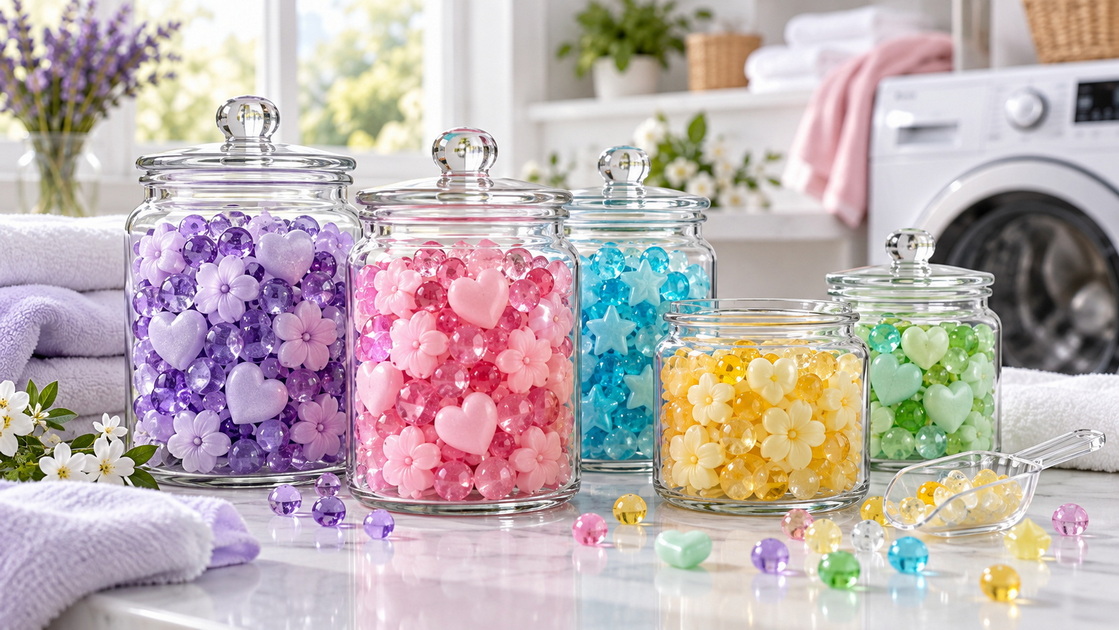
Shaped laundry beads are in-wash fragrance booster particles manufactured in non-standard forms rather than conventional round beads, irregular crystals, or simple granules. Depending on the formula and manufacturing process, they may be molded, extruded, cut, granulated, coated, or formed into decorative shapes.
Common formats include:
- Heart-shaped laundry scent beads
- Flower-shaped scent booster beads
- Star-shaped laundry fragrance beads
- Bear-shaped or cartoon-shaped beads
- Capsule-like or tablet-style scent boosters
- Custom brand-symbol beads
- Multi-color mixed-shape laundry beads
These products are generally added directly into the washing drum before clothes. Their primary purpose is to provide a stronger and longer-lasting fragrance experience than detergent alone.
A scent booster can contain a solid carrier, free fragrance, encapsulated fragrance, or a combination of fragrance-delivery systems. Patent literature describes solid scent boosters as compositions that may use fragrance-loaded carriers, spray-dried particles, encapsulated perfume, and drying or shaping processes such as extrusion and granulation.
The important distinction is this: shape is a product-design feature, not automatically a performance feature. A shaped bead only becomes commercially valuable when its visual identity supports a better consumer experience or a more profitable brand position.
The table below shows the practical differences between conventional laundry scent beads and custom-shaped scent beads from a manufacturing and market perspective.
| Comparison Factor | Standard Round or Crystal Beads | Shaped Laundry Beads |
|---|---|---|
| Manufacturing complexity | Lower; simpler production control | Higher; requires tighter forming, cooling, cutting, or molding control |
| Tooling investment | Usually limited | May require customized molds, dies, cutters, or forming systems |
| Production speed | Generally faster and more consistent | Can be slower, especially for intricate shapes |
| Breakage risk | Lower because round formats have fewer weak points | Higher for thin, pointed, hollow, or irregular designs |
| Appearance on shelf | Familiar and functional | More distinctive, giftable, and social-media-friendly |
| Consumer perception | Basic value or mainstream product | Premium, playful, customized, or brand-led product |
| Formula flexibility | Usually easier | More restricted because shape stability must be maintained |
| Packaging requirements | Standard bottles, pouches, or tubs | May need protective packaging to reduce damage and shape loss |
| Best market position | Mass-market, bulk, value-focused | Premium retail, seasonal launches, kids’ concepts, gifting, private label differentiation |
| Unit cost | Lower | Higher, depending on shape complexity and production volume |
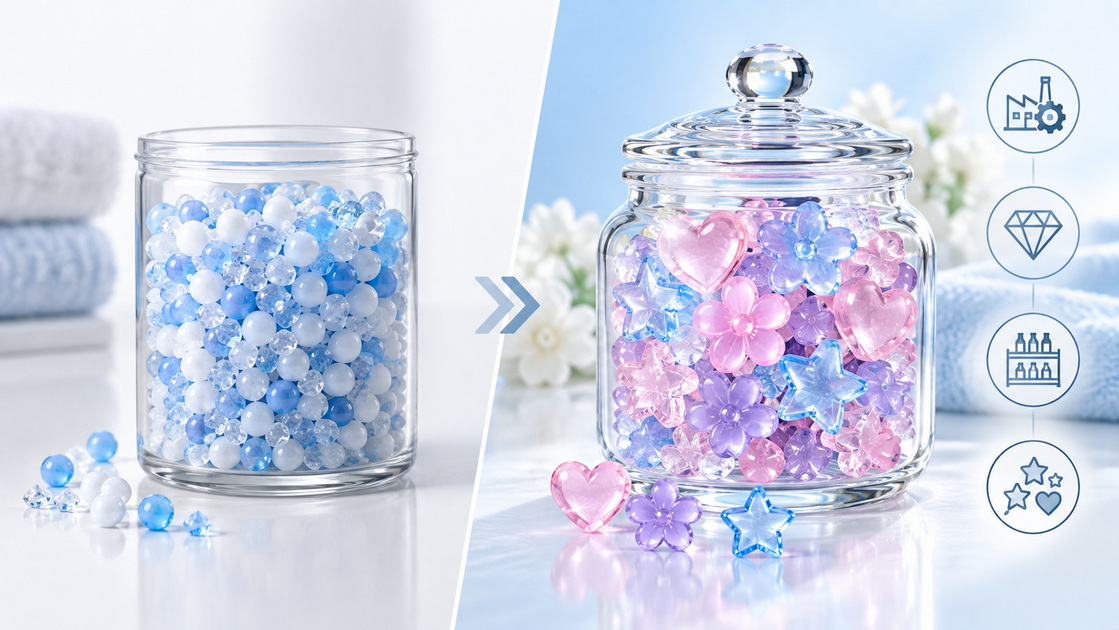
The business case is strongest when the shape gives the buyer a reason to choose the product over a visually similar competitor.
For example, a basic lavender laundry scent booster sold in an opaque refill pouch may gain little value from custom flower shapes. By contrast, a transparent PET jar containing pastel heart-shaped beads can create a more premium appearance for a Valentine's Day promotion, a young-family retail line, or a social-commerce product launch.
The higher manufacturing cost of shaped laundry beads is not caused by a single factor. It is the combined result of equipment setup, formula control, production efficiency, scrap management, quality inspection, and packaging protection.
Standard beads can often be produced with relatively efficient forming or granulation methods. Shaped products require the manufacturer to control the final geometry more precisely.
Depending on the desired bead design, production may involve:
- Custom extrusion dies
- Specialized molding equipment
- Rotary cutting systems
- Cooling or setting controls
- Shape-specific screens and sorting equipment
- Additional anti-breakage handling systems
- Customized quality-inspection criteria
A simple oval or capsule format may require only modest process adaptation. However, a detailed flower, heart, star, animal, or logo shape can need more specialized tooling and more frequent maintenance.
The more detailed the shape, the more expensive the process tends to become.
Sharp corners, narrow edges, thin arms, holes, embossed logos, and hollow areas can all increase the risk of deformation. Those defects may not affect fragrance chemistry, but they can damage the premium visual message that justified the product's higher price in the first place.

A laundry bead formula must be balanced carefully. It needs to carry fragrance, remain stable during storage, retain its visual appearance, dissolve or disperse appropriately during washing, and avoid excessive stickiness, crumbling, clumping, or fragrance loss.
For shaped beads, the formula must also hold its form.
That creates several formulation challenges:
- The product needs enough structural strength to preserve the shape.
- It cannot be so hard that dissolution becomes poor.
- Fragrance loading cannot destabilize the bead matrix.
- Colorants must remain visually uniform.
- Moisture must be controlled to prevent softening or agglomeration.
- The product must withstand temperature changes during warehousing and transport.
- Encapsulated fragrance particles must remain compatible with mixing and shaping conditions.
Industry and patent sources show that scent booster compositions may use solid carriers, granulated powders, free perfume, and perfume microcapsules. They may also be manufactured through processes including extrusion, spray-drying, fluidized-bed processing, granulation, and drying.
This means a supplier cannot simply take an existing round-bead formula and press it into a heart mold. Successful shaped-bead production requires a formula-process match.
Production yield is one of the most important hidden cost factors.
With conventional round beads, small visual imperfections may be less noticeable. With shaped scent beads, defect standards are higher because consumers can immediately see when a flower petal is incomplete, a heart is cracked, or a star point has broken off.
Common causes of yield loss include:
- Incomplete shape formation
- Warping after cooling
- Fracture during screening
- Surface roughness
- Uneven color distribution
- Shape-to-shape size variation
- Beads sticking together
- Damage during filling and transportation
If a brand wants a highly decorative bead mix, it should expect more intensive quality control. That can include visual inspection, particle-size sorting, density checks, moisture testing, dissolution testing, fragrance-content verification, and transit simulation.
Standard laundry scent beads can be relatively tolerant of bulk handling. Custom shapes are often more vulnerable, especially if they contain thin edges or complex geometry.
To protect appearance, a manufacturer may recommend:
- Stronger PET jars or HDPE containers
- Inner seals with better moisture protection
- Reduced headspace movement
- Rigid cartons for export shipment
- Dividers or optimized pallet stacking
- Lower filling-drop heights
- More controlled freight handling
This can increase packaging and logistics costs. However, it can also reduce consumer complaints caused by crushed or powdery beads.
A useful rule for private-label buyers is: the more decorative the bead, the more important the packaging system becomes.
Shaped laundry beads are usually worth the higher manufacturing cost when they support a clear commercial purpose. They are not simply a decoration; they should function as a branded asset.
In crowded laundry-care categories, many products make similar claims: long-lasting freshness, floral fragrance, odor control, softness perception, or fabric care. Shape gives a brand a visual feature that shoppers can recognize in seconds.
A unique shape can help consumers remember:
- A signature fragrance collection
- A seasonal product launch
- A child-friendly or family-oriented concept
- A luxury home-care range
- A giftable laundry-care set
- A retailer-exclusive private-label product
For transparent packaging, the difference can be especially meaningful. Consumers can see the product before purchase, which can make the beads feel more tangible and premium.
Custom-shaped fragrance beads are particularly effective for limited-time promotions.
Examples include:
| Campaign Theme | Recommended Bead Shapes | Potential Fragrance Direction |
|---|---|---|
| Valentine’s Day | Hearts, roses, pink crystals | Rose, peony, berry, musk |
| Spring Collection | Flowers, butterflies, pastel beads | Sakura, freesia, fresh linen |
| Holiday Collection | Stars, snowflakes, trees | Vanilla, cedarwood, winter floral |
| Back-to-School | Smiling faces, stars, colorful shapes | Clean cotton, citrus, fresh breeze |
| Baby Laundry Range | Clouds, bears, hearts | Gentle powder, soft floral, cotton |
| Pet Textile Care | Paw shapes, bones, circles | Fresh linen, deodorizing clean scent |
Seasonal products can justify higher costs because brands often sell them at a premium price, in smaller volumes, or as promotional bundles. The shape itself becomes part of the campaign story.
Consumers increasingly discover household products through short-form video, livestreaming, creator content, and product unboxing. A visually distinctive bead is easier to show, explain, and remember than a standard white or blue crystal.
A clear bottle filled with pastel flower-shaped laundry beads can create visual interest in:
- Product listing images
- TikTok and Instagram content
- Live-commerce demonstrations
- Retail displays
- Gift boxes
- Sampling kits
- Influencer unboxing videos
This does not mean every shaped product will go viral. But it does mean shape can improve the product's content potential, particularly when paired with strong packaging and a recognizable fragrance story.
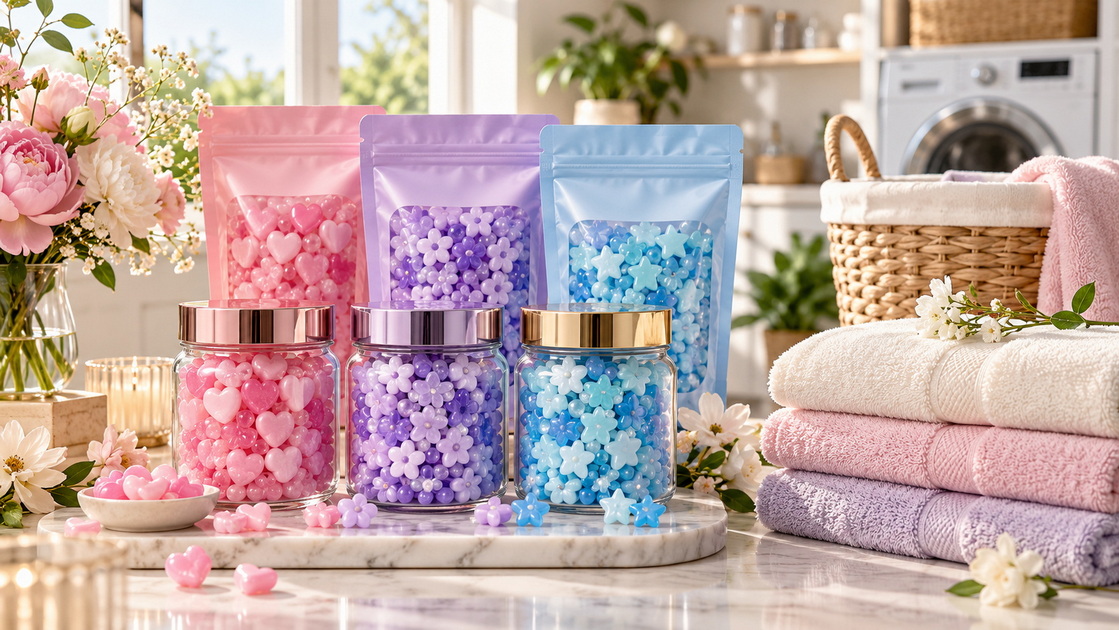
The answer is not always shaped beads. Standard round, crystal, or granule formats remain a smart choice for many private-label programs.
Choose conventional laundry scent beads when your priority is:
- Lowest possible unit cost
- Large-scale mass-market production
- Fast product launch timelines
- High-volume supermarket distribution
- Refill-pouch programs
- Value-driven consumer segments
- Simple fragrance-led positioning
- Markets where transparent packaging is not central to the purchase decision
A standard bead can still feel premium if the brand invests in fragrance quality, color consistency, strong packaging design, reliable dissolution, and persuasive product claims.
For many OEM buyers, the best strategy is not choosing one format forever. It is creating a two-tier product portfolio:
1. A standard scent booster bead for core, value-oriented volume.
2. A shaped scent bead for premium, seasonal, or retailer-exclusive programs.
This approach protects manufacturing efficiency while giving the brand room to test higher-margin innovation.
Before investing in custom-shaped laundry scent beads, brands should calculate return on investment beyond the factory price.
Use this practical decision framework.
Calculate the extra cost per unit from:
- Tooling or mold development
- Formula adjustment
- Slower production speed
- Higher scrap rate
- Extra inspection
- Protective packaging
- Freight and handling changes
Ask whether the shape enables:
- A higher retail price
- A larger gross margin
- A more premium packaging format
- A stronger retailer pitch
- A limited-edition launch
- Higher average order value
- Better gift-set potential
Measure likely gains in:
- Click-through rate for online listings
- Conversion rate on product pages
- Shelf attention in physical retail
- Repeat purchase rate
- Social-media engagement
- Retailer acceptance
- Brand recognition
A responsible OEM/ODM launch often starts with a controlled pilot.
Recommended pilot process:
1. Select one simple but distinctive shape, such as a heart or flower.
2. Develop two or three fragrance/color combinations.
3. Test physical stability, dissolution, and fragrance retention.
4. Produce small-batch samples for retailer or consumer feedback.
5. Compare consumer preference with a standard-bead control product.
6. Confirm packaging protection through transport testing.
7. Scale only after cost, quality, and demand targets are met.
Do not judge shaped-bead success only by "looks." Measure whether it improves the commercial metrics that matter to your brand.
When selecting a shaped laundry bead manufacturer, ask detailed questions before approving the project.
- Can the supplier produce the requested shape consistently at commercial scale?
- What bead size range is realistic for the design?
- What shapes have already been validated for low breakage?
- Can the supplier create custom color combinations?
- Can the shape be protected during high-speed filling?
- Is the design compatible with the selected fragrance loading?
- Does the product dissolve acceptably in the intended wash conditions?
- Can the supplier produce samples before tooling investment?
- Is there a documented fragrance specification and safety review?
- Can the supplier provide an IFRA certificate or applicable fragrance compliance documentation?
- Are fragrance allergens assessed for the destination market?
- What quality tests are performed for moisture, appearance, particle size, odor, dissolution, and storage stability?
- Is batch-to-batch color and shape consistency controlled?
- Can the supplier support destination-market labeling requirements?
- What documentation is available for private-label registration or retailer review?
The International Fragrance Association states that IFRA Standards are scientifically developed guidelines intended to support the safe use of fragrance ingredients worldwide. The organization's Standards Library includes documentation for the 51st Amendment.
For products sold in the European market, fragrance allergen labeling requirements also matter. European Commission guidance notes that fragrance allergens in detergents sold to the public may need to be declared when added above applicable thresholds, and that regulatory transition periods related to expanded allergen labeling apply to detergents as well as cosmetics.
For U.S.-focused "safer chemistry" positioning, the EPA Safer Choice program requires ingredient disclosure for products carrying its label and evaluates ingredients under its criteria. Brands should not claim Safer Choice status unless the specific finished product has been reviewed and approved under the program.
Yes—shaped laundry beads are worth the higher manufacturing cost when they create a premium product story that consumers can see, understand, and pay for.
They are especially valuable for transparent packaging, seasonal collections, premium private-label programs, gift sets, social-commerce launches, retailer exclusives, and brands seeking stronger visual differentiation.
However, shaped beads are not automatically the right choice for every business. If the product is competing mainly on price, sold in refill pouches, or positioned as a high-volume basic scent booster, standard beads may offer better margins and operational simplicity.
The most successful strategy is to match the bead design with the brand's target consumer, sales channel, packaging format, fragrance concept, and expected retail price.
At Foshan Magic Crystal Technology Development Co., Ltd., we support global brands with OEM/ODM development for laundry scent beads and a broad range of laundry, home-care, personal-care, and pet-cleaning products. With more than three self-owned factories, annual production capacity of approximately 30,000–40,000 tons, and service experience across more than 300 brands, we can help evaluate whether a shaped laundry bead program fits your commercial goals.
Contact our product-development team to discuss custom shapes, fragrance concepts, packaging options, sample development, and scalable OEM/ODM manufacturing for your next laundry scent booster collection.
Not necessarily. Fragrance strength depends mainly on the fragrance formula, fragrance dosage, carrier system, encapsulation technology, storage stability, dosage instructions, and fabric-deposition performance. A shaped bead may feel more premium visually, but shape alone does not guarantee stronger scent.
Yes, they are usually more expensive than standard round or crystal beads. The additional cost may come from customized tooling, slower forming speed, higher scrap risk, more complex quality control, and stronger protective packaging.
Simple rounded shapes such as hearts, flowers with thick petals, oval capsules, discs, and smooth stars are generally easier to manage than intricate logos, thin snowflakes, hollow shapes, or designs with long narrow points. Final feasibility depends on the exact formula, size, fragrance load, and process.
In most cases, laundry scent booster beads are designed to be added directly into the empty drum before clothes, but brands should validate use instructions based on their exact formula, machine conditions, and target market. The final label should include clear dosage and usage guidance.
Yes. Shaped beads can be formulated with free fragrance, encapsulated fragrance, or a combination of both, provided the capsule system is compatible with mixing, shaping, storage, dissolution, and regulatory requirements. Patent literature describes scent booster systems containing perfume microcapsules and solid carrier materials.
Yes. They can be highly effective for private-label brands that want a distinctive product identity. They are especially suitable for premium retail lines, limited editions, seasonal promotions, transparent-packaging concepts, and online-first product launches.
Brands should test appearance consistency, breakage resistance, fragrance retention, dissolution, color stability, moisture resistance, compatibility with packaging, transport durability, safety documentation, destination-market labeling, and consumer acceptance.
1. European Patent Office. "Solid Scent Booster Composition." Patent EP3601516. [View the patent document]. [data.epo]
2. Google Patents. "EP3601516A1: Solid Scent Booster Composition." Includes examples of solid carriers, perfume microcapsules, spray-dried particles, extrusion, fluidized-bed processing, and drying methods. [View the patent]. [patents.google]
3. Google Patents. "US20240409849A1: Scent Booster for Laundry." Describes scent boosters formed into small units and possible shaping methods including extrusion, granulation, molding, and bead formation. [View the patent]. [patents.google]
4. International Fragrance Association. "IFRA Standards Documentation." Information on the 51st Amendment to IFRA Standards. [View IFRA documentation]. [ifrafragrance]
5. International Fragrance Association. "IFRA Standards Library." Public access point for fragrance safety standards and associated documents. [Visit the IFRA Standards Library]. [ifrafragrance]
6. European Commission. "Questions and Agreed Answers Concerning the Correct Implementation of Regulation (EC) No 648/2004 on Detergents." Includes guidance relating to fragrance allergen labeling in detergents. [View the European Commission document]. [ec.europa]
7. U.S. Environmental Protection Agency. "Frequently Asked Questions on Safer Choice." Includes fragrance disclosure and fragrance-free product information. [Read the EPA FAQ]. [epa]
8. U.S. Environmental Protection Agency. "Learn About the Safer Choice Label." Explains ingredient review under the Safer Choice program. [Read about the Safer Choice label]. [epa]
9. IMARC Group. "Laundry Scent Booster Manufacturing Plant Cost." Provides broad manufacturing cost context, including raw-material and utilities shares. [View the market report page]. [imarcgroup]


