
Views: 278 Author: Magic Household Cleaning Publish Time: 2026-08-08 Origin: Site
Content Menu
● Is Dish Soap Safe for Hardwood Floors?
>> The Real Risk Is the Cleaning System
● Why Dish Soap Can Create Problems on Wood Floors
>> 1. Residue Can Make Floors Look Dull
>> 2. Extra Water Is a Greater Threat Than Most People Realize
>> 3. Every Finish Has Different Requirements
● A Safer Hardwood Floor Cleaning Routine
>> 1: Remove Dry Soil Before Adding Moisture
>> 2: Confirm Cleaner Compatibility
>> 3: Use the Minimum Effective Amount of Solution
>> 4: Mop With a Well-Wrung Microfiber Pad
>> 5: Inspect the Surface After It Dries
● How to Choose Floor Cleaning Sheets for Wood-Floor Programs
>> Product-Development Checklist for Buyers
● Turning a Customer Complaint Into a Better Cleaning Protocol
● What Not to Do on Hardwood Floors
● FAQ
>> 1. Can I use a little dish soap on hardwood floors?
>> 2. What is the safest way to mop hardwood floors?
>> 3. Why does my wood floor look streaky after mopping?
>> 4. Are floor cleaning sheets suitable for hardwood floors?
>> 5. Can I use a steam mop on engineered wood flooring?
>> 6. How often should hardwood floors be cleaned?
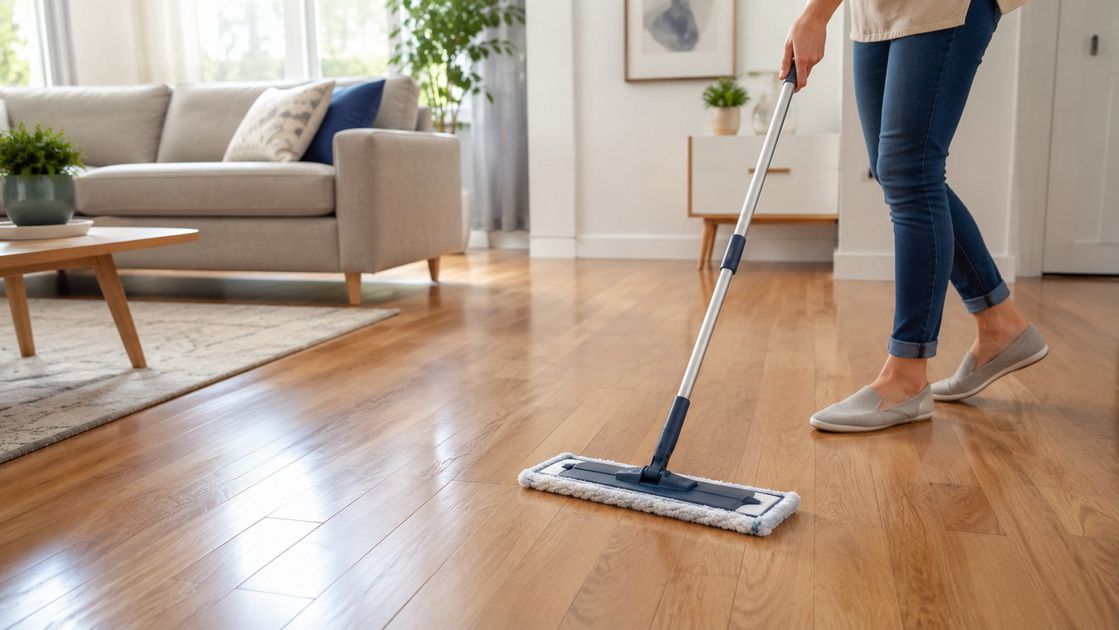
Can you use dish soap to mop hardwood floors? In most cases, it is not the preferred routine. A small amount of diluted dish soap may seem harmless, but it is formulated primarily to remove grease from dishes—not to maintain a wood-floor finish. On hardwood, the larger issue is often not one ingredient alone. It is the combination of excess water, repeated residue buildup, aggressive scrubbing, and using a product that was never designed for the specific finish.
For homes, hotels, retail spaces, and facility managers, wood flooring is a long-term surface investment. A safer approach is simple: remove dry grit first, use as little moisture as possible, choose a cleaner compatible with the floor's finish, and leave no visible film behind. The National Wood Flooring Association (NWFA) likewise advises routine sweeping or vacuuming, prompt spill cleanup, avoidance of wet and steam mops, and use of a cleaner made for the floor finish.
This article explains why dish soap can be a poor fit for hardwood floors, how to clean wood floors correctly, and what buyers should evaluate when sourcing floor cleaning sheets or other low-residue cleaning formats.
Occasional use is not the same as best practice. If a flooring manufacturer specifically permits a mild detergent solution, follow its dilution instructions exactly. But as a general maintenance method, dish soap is a less reliable choice than a dedicated cleaner approved for the floor's coating or finish.
Dish soap can leave a surfactant film when it is over-dosed or insufficiently removed. That film may make the surface look dull, attract soil more quickly, or create streaks—especially on dark, glossy, or high-traffic floors. More importantly, mixing it in a bucket often encourages overly wet mopping, which increases the chance of moisture entering seams and edges.
Wood is hygroscopic: it responds to changes in moisture. Excess water can contribute to swelling, cupping, gaps, finish damage, or discoloration over time. NWFA specifically warns that wet mops and steam mops can damage both the finish and the wood, particularly with repeated use.
A single, carefully controlled clean is rarely the entire story. Damage tends to develop when a routine repeatedly combines:
- Too much solution or a soaking-wet mop
- A cleaner that leaves residue
- Grit left on the floor before mopping
- Prolonged drying time
- Unknown floor finish compatibility
- No rinse or wipe-back procedure when residue appears
The goal is therefore not merely to choose a "gentle" liquid. It is to build a low-moisture, low-residue cleaning process.
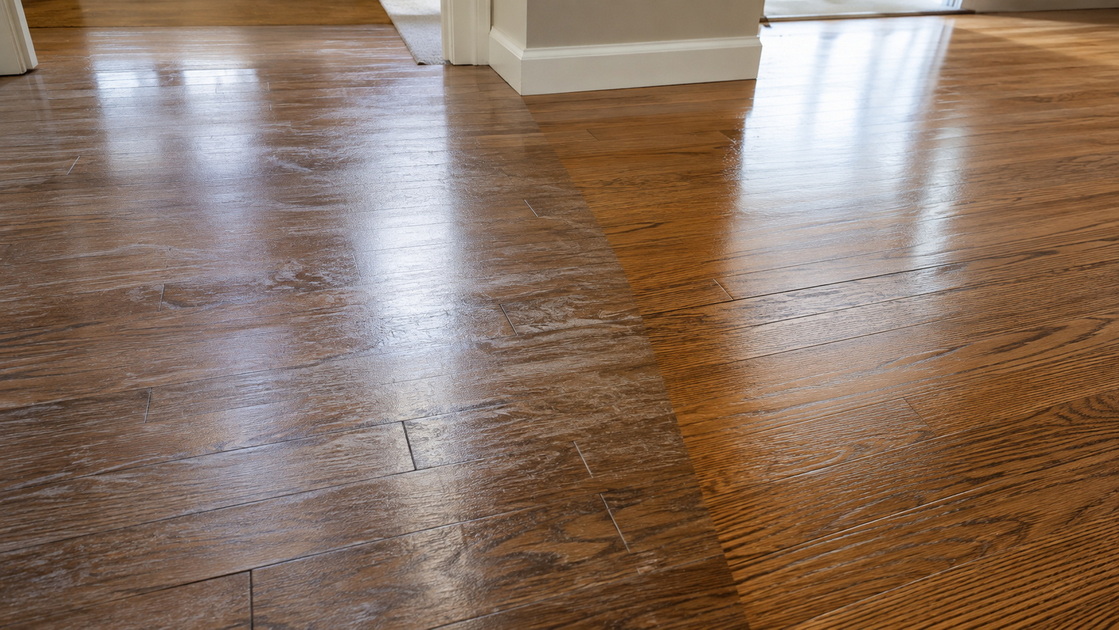
Dishwashing liquids are engineered to lift food oils and grease. Their surfactant systems can be highly effective in a sink, where items are thoroughly rinsed under running water. A wood floor does not receive that same rinse.
When too much product is mixed into the water, a thin film can remain after drying. This may cause haze, smears, visible footprints, or faster resoiling. Users sometimes respond by applying more cleaner or using more water, creating a cycle that worsens the appearance.
Practical sign: If a floor looks cleaner immediately after mopping but becomes streaky or tacky after it dries, review product dosage, mop moisture, and whether the cleaner is compatible with the finish.
Wood floors should not be saturated. Water can move into joints, perimeter gaps, scratches, and worn sections of a finish. Even engineered wood can be vulnerable at edges and seams.
A damp—not wet—microfiber pad gives the operator much more control. It should feel barely moist, not release water when pressed. Work in small sections and ensure the surface dries quickly. NWFA recommends a dry or slightly damp cloth for spills and cautions against wet mops and steam mops.
"Hardwood floor" is not one universal surface. A site may contain:
| Floor or finish type | Main cleaning concern | Best practice |
|---|---|---|
| Polyurethane-finished wood | Haze, residue, excess moisture | Use a finish-compatible, low-residue cleaner |
| Waxed or oiled wood | Finish removal or uneven appearance | Follow the floor maker’s specific system |
| Engineered wood | Moisture at seams and edges | Use minimal liquid; never flood the surface |
| Pre-finished flooring | Manufacturer warranty restrictions | Check care instructions before selecting a cleaner |
| Unknown existing floor | Unknown coating and prior product buildup | Test in a hidden area and consult a professional if needed |
A cleaner that performs well on ceramic tile or vinyl may not be appropriate for wood. NWFA also advises avoiding tile or vinyl cleaning products on wood flooring and notes that polishes, waxes, and restorers can create dullness or slipperiness.
A professional-looking result depends more on process discipline than on using more chemical. Use the following five-step routine for normal maintenance.
Sweep with a soft broom, use a dry microfiber mop, or vacuum with the bare-floor setting. Sand, dust, pet hair, and tracked-in particles can act like abrasives when trapped under a damp pad.
For commercial sites, place entry mats at doors and establish a dry-cleaning schedule before wet cleaning begins. This helps protect both appearance and coating life.
Read the flooring manufacturer's care guidance. Then read the cleaner label, including dilution directions, intended surfaces, and warnings. A product marketed for "floors" is not automatically suitable for every wood finish.
If the floor's coating is unknown, test the diluted product on an inconspicuous area. Let it dry fully, then check for cloudiness, tackiness, color change, or reduced sheen.
Whether using a concentrated liquid, pre-measured pod, or floor cleaning sheet, follow the specified dose. Over-concentration does not necessarily improve cleaning; it often increases the chance of residue.
For sheet-format products, the operational advantage is dosage consistency. A correctly formulated sheet can help reduce measuring errors, simplify transport, and support private-label brands seeking compact, water-light packaging. However, "sheet format" alone is not proof of wood-floor compatibility—formula, pH, residue profile, and use instructions still matter.
Use a microfiber mop that is damp rather than wet. Clean in small sections, following the grain direction where practical, and replace dirty pads frequently. Avoid letting liquid pool near walls, transitions, joints, or damaged areas.
Do not use a steam mop unless the floor manufacturer expressly allows it. Heat and moisture can challenge finishes and wood construction over time.
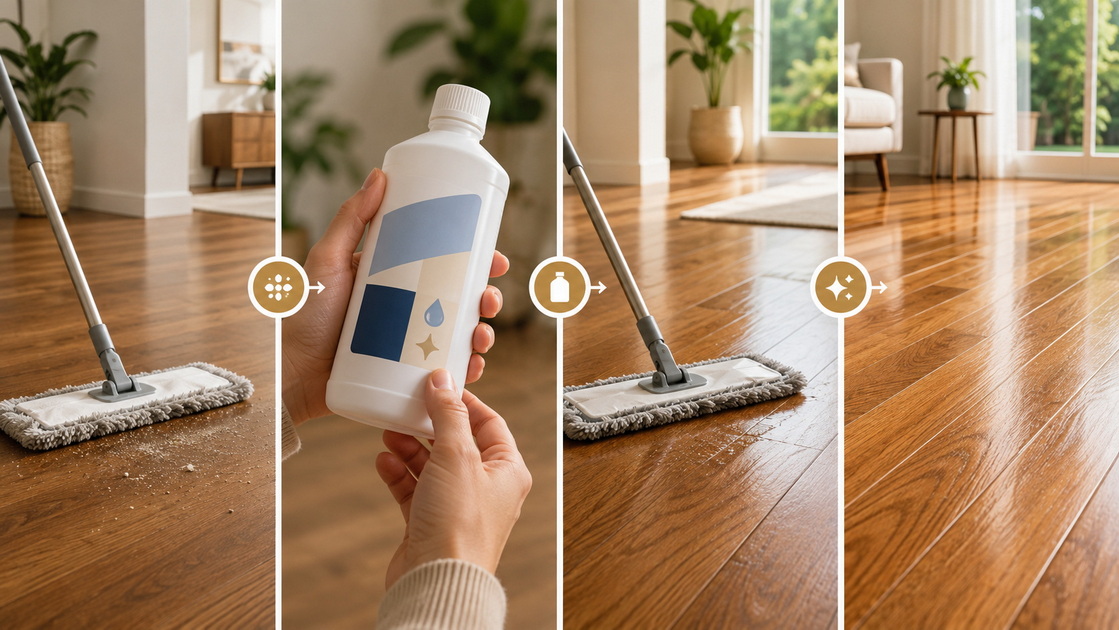
Look at the floor from a low angle under natural or side lighting. Check for streaks, sticky spots, haze, or footprints. If residue is visible, stop adding product. Reclean the affected area with a barely damp pad and the correct approved procedure.
For persistent dullness, do not immediately apply a "shine restorer." Identify whether the problem is residue, abrasion, coating wear, or an incompatible prior product. A flooring professional can help determine the cause.
For distributors, private-label owners, and purchasing teams, a floor cleaning sheet is more than a consumer convenience product. It is a formulation, packaging, instructions, and compliance project. The right brief should focus on outcome—not just fragrance or dissolution speed.
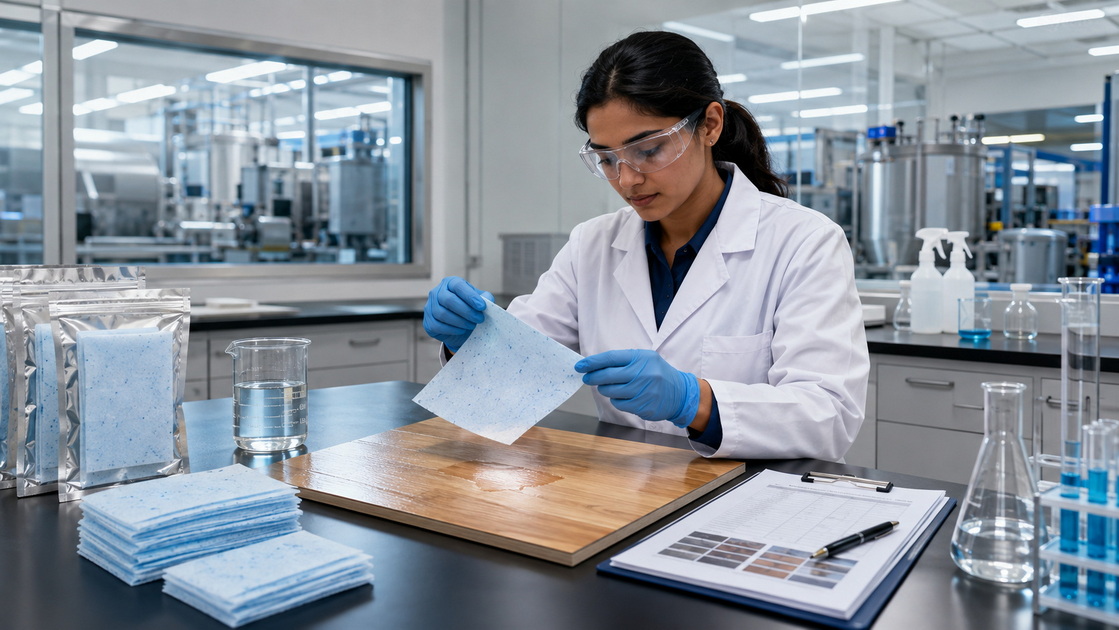
Ask an OEM/ODM supplier these questions before finalizing a wood-floor cleaning-sheet project:
1. What surface types is the formula designed for? Request a clear compatibility statement rather than a vague "multi-surface" claim.
2. What is the recommended dilution and mop method? Instructions should emphasize controlled moisture for wood.
3. What residue testing or internal evaluation supports the formula? Ask for test conditions, substrate, and product version.
4. Can you provide TDS, SDS, ingredient disclosure appropriate to the market, and regulatory documentation?
5. Which claims are substantiated? Antibacterial, biodegradable, hypoallergenic, and "safe for pets" claims should be backed by relevant evidence and market-specific compliance review.
6. Can packaging prevent overdosing? Clear sheet count, water volume, and use icons reduce customer misuse.
7. What quality-control system is used across production? Review batch traceability, incoming-material controls, and finished-product inspection standards.
Foshan Magic Crystal Technology Development Co., Ltd. develops, manufactures, and supplies laundry-care, home-care, personal-care, and pet-cleaning products, including floor cleaning sheets. With more than three self-owned factories, stated annual capacity of 30,000–40,000 metric tons, and OEM/ODM service for over 300 brands, the company can support formulation, packaging, and scale-up discussions for global private-label programs. Product claims should always be finalized only after confirming the exact formula, target market, and supporting documentation.
Consider a common complaint: "My wood floor looks cloudy after I mop."
The instinct may be to change the mop or apply a gloss product. A better diagnostic sequence is:
1. Stop using additional cleaner for the moment.
2. Check whether the pad was saturated or whether the dose exceeded the label instruction.
3. Determine whether a prior polish, wax, or tile cleaner was used.
4. Wipe a small test area with a clean, barely damp microfiber pad.
5. Let it dry and compare the area under side lighting.
6. If cloudiness remains, contact the flooring manufacturer or a qualified flooring professional before using stronger chemicals.
This process is useful because it separates cleaning residue from actual coating damage. It also gives customer-service teams a repeatable troubleshooting script instead of relying on broad claims or guesswork.
Avoid these shortcuts, even when the floor looks dirty:
- Do not flood-mop a wood floor.
- Do not use steam as a default cleaning method.
- Do not mix multiple cleaners in the same bucket.
- Do not assume dish soap, vinegar, bleach, ammonia, or tile cleaner is universally safe.
- Do not use abrasive pads or harsh scrubbing on a coated surface.
- Do not apply wax, polish, or "restorer" products without verifying finish compatibility.
- Do not ignore recurring stickiness, cupping, discoloration, or lifted edges.
NWFA recommends regular dry cleaning, immediate spill cleanup, and a wood-floor cleaner appropriate to the specific finish; it also notes that moisture can cause wood to swell or shrink.
Dish soap may be convenient, but convenience does not make it the best hardwood floor cleaner. For routine care, prioritize minimal moisture, finish-compatible chemistry, controlled dosage, and clean microfiber tools.
For brands developing floor cleaning sheets, the strongest product position is not an unsupported promise that one format solves every flooring problem. It is a transparent, tested, well-instructed solution designed for the intended surface and cleaning method. That approach protects users, supports retailer confidence, and creates a more credible private-label product.
Looking for an OEM/ODM floor cleaning sheet program? Contact Finice to discuss target floor types, formula options, packaging formats, testing documentation, and claim substantiation for your market before product launch.
A small, heavily diluted amount may be permitted by some flooring manufacturers, but it is generally not the preferred routine. Use the flooring manufacturer's guidance first, and avoid leaving residue or excess water on the surface.
Remove dry debris first, then use a lightly damp microfiber mop with a cleaner compatible with the floor finish. The floor should not be visibly wet or left with standing liquid.
Common causes include overusing cleaner, a dirty mop pad, hard-water deposits, old polish buildup, or insufficient drying. Reduce the dose, use a clean microfiber pad, and test a small area before applying more product.
They can be, provided the formula is designed for the relevant wood-floor finish and used according to its dilution and moisture-control instructions. Always check the label and test a hidden area if compatibility is uncertain.
Do not assume it is safe. Many wood-floor care guidelines advise against wet and steam mops because moisture and heat may damage finishes and wood over time. Check the specific flooring manufacturer's instructions.
Dry dust removal can be done as needed, especially in high-traffic spaces. For deeper cleaning, use a finish-compatible cleaner only when required by soil level and according to the flooring manufacturer's maintenance recommendations.
1. National Wood Flooring Association. "[Maintenance]." Guidance on dry cleaning, spill response, avoiding wet/steam mops, and selecting finish-appropriate cleaners. [woodfloors]
2. National Wood Flooring Association. "[Spring Cleaning: Top Tips for Caring for Wood Floors]." Guidance on microfiber dust mopping, vacuuming, appropriate cleaning products, and avoiding unsuitable products. [woodfloors]
3. National Wood Flooring Association. "[Homeowner's Handbook to Real Wood Floors]." Homeowner guidance on moisture control and routine cleaning. [woodfloors]
4. National Wood Flooring Association. "[School's Out—Protect Your Investment]." Explanation of risks associated with standing water, including warping, cracking, and finish degradation. [woodfloors]
5. National Wood Flooring Association. "[Here's Exactly How to Maintain Wood Floors]." Guidance on humidity, moisture, and practical wood-floor maintenance. [woodfloors]
6. Finice. "[The Truth About Floor Cleaning: Why Dish Soap Damages Wood Surfaces]." Original page used as the restructuring baseline; numerical performance and cost claims should be retained only where supported by product-specific evidence. [finicecleaning]


