
English
Views: 248 Author: Magic Household Cleaning Publish Time: 2026-10-03 Origin: Site

Content Menu
● What Are Detergent Sheets and Laundry Capsules?
● Detergent Sheets vs Laundry Capsules at a Glance
>> Why Laundry Capsules Often Support Premium Cleaning Claims
>> Why Detergent Sheets Can Deliver Strong Everyday Cleaning
● Dosing Convenience and User Experience
>> Detergent Sheets Offer More Flexible Portion Control
>> Laundry Capsules Provide Fast, Familiar Simplicity
● Packaging, Logistics, and Storage Comparison
>> Why Detergent Sheets Are Strong for Shipping Efficiency
>> Why Laundry Capsules Need Stronger Protective Packaging
● A Critical Difference for Brands
>> Safety Priorities for Laundry Capsule Brands
>> Safety Priorities for Detergent Sheet Brands
>> Potential Sustainability Strengths of Detergent Sheets
>> Potential Sustainability Strengths of Laundry Capsules
● How to Choose the Right Product Format
>> Choose Detergent Sheets When Your Brand Needs
>> Choose Laundry Capsules When Your Brand Needs
>> Consider Launching Both Formats When
● OEM/ODM Development Checklist for Laundry Brands
● Detergent Sheets vs Laundry Capsules
>> Develop Your Private-Label Laundry Product
>> 1. Are detergent sheets better than laundry capsules?
>> 2. Do detergent sheets work in cold water?
>> 3. Can laundry capsules be used in the detergent drawer?
>> 4. Are laundry capsules safe around children?
>> 5. Are detergent sheets really more sustainable?
>> 6. Can detergent sheets be customized for private-label brands?
>> 7. Which format is better for an online laundry-detergent business?
Detergent sheets vs laundry capsules is now one of the most important product-format comparisons for private-label laundry brands, retailers, and consumers. Both formats offer pre-measured convenience, but they differ substantially in formulation design, dosing flexibility, packaging needs, safety communication, cost structure, consumer positioning, and OEM/ODM development potential.
For brands choosing between laundry detergent sheets and laundry detergent capsules, the right answer is rarely "one format is always better." The best format depends on target customers, washing habits, price positioning, local compliance needs, sustainability claims, and the brand's desired sensory experience.
At Foshan Magic Crystal Technology Development Co., Ltd., we develop and manufacture laundry detergent sheets, home-care products, personal-care products, and pet-cleaning products for global OEM/ODM customers. With more than three self-owned factories and annual production capacity of approximately 30,000–40,000 metric tons, we see a clear market pattern: sheets often win on portability and low-packaging storytelling, while capsules remain highly attractive for premium cleaning performance and familiar consumer habits.
Laundry detergent sheets, also called detergent strips or laundry sheets, are thin, pre-portioned sheets of concentrated detergent. Users usually tear or place one or more sheets directly into the washing-machine drum before adding clothes.
The sheet disperses in wash water and releases surfactants, builders, enzymes, fragrance, or other functional ingredients depending on the formulation. Many brands position detergent sheets as a lightweight, travel-friendly alternative to traditional liquid detergent bottles and bulky powder cartons.
Common detergent-sheet selling points include:
- Pre-measured dosing
- Compact storage
- No liquid leakage
- Reduced shipping weight
- Paper-based outer packaging options
- Easy use for travel, apartments, dorms, and laundromats
However, sheet quality can vary dramatically. A high-quality sheet must balance detergent loading, sheet strength, moisture resistance, tearability, dissolution speed, fragrance retention, and cleaning performance.
Laundry capsules, also called laundry pods, pacs, packs, or unit-dose capsules, are water-soluble film pouches containing concentrated liquid or gel detergent. Some capsules include multiple chambers for detergent, stain-removal ingredients, fragrance boosters, fabric-care additives, or brightening systems.
Laundry capsules are normally placed at the bottom of the empty washing-machine drum before clothes are loaded. The water-soluble outer film dissolves during the wash cycle and releases the concentrated formula.
Common laundry-capsule benefits include:
- Convenient single-load dosing
- Premium visual appearance
- Strong fragrance opportunities
- Multi-chamber formula options
- High active-ingredient concentration
- Consumer familiarity in many markets
The American Cleaning Institute notes that liquid laundry packets contain highly concentrated detergent and should be used and stored carefully, particularly around children and pets.
| Comparison Factor | Detergent Sheets | Laundry Capsules |
|---|---|---|
| Product form | Thin, dry, dissolvable detergent sheet | Water-soluble pouch with liquid or gel detergent |
| Main user benefit | Lightweight, compact, easy to store | Premium convenience and concentrated cleaning |
| Typical packaging | Paper envelope, carton, resealable pouch | Child-resistant bag, tub, pouch, or rigid container |
| Dosing flexibility | Often easier to tear for small loads | Usually fixed per capsule |
| Formula format | Generally dry or semi-dry sheet matrix | Liquid, gel, or multi-chamber liquid formula |
| Fragrance experience | Can be lighter or more controlled | Often stronger and longer-lasting |
| Heavy-stain potential | Depends heavily on active loading and enzymes | Often suitable for complex high-active formulas |
| Shipping efficiency | Usually very favorable because of low weight | Better than liquid bottles, but heavier than sheets |
| Moisture sensitivity | Sheets can clump or stick in humid conditions | Capsules can stick, rupture, or dissolve with wet handling |
| Child-safety considerations | Still requires secure storage | Requires particularly clear safety measures because of concentrated liquid contents |
| Premium positioning | Minimalist, eco-conscious, travel-friendly | Performance-led, sensory, premium convenience |
| OEM/ODM complexity | Sheet substrate and dissolution technology are critical | Film, filling, chamber design, sealing, and safety packaging are critical |
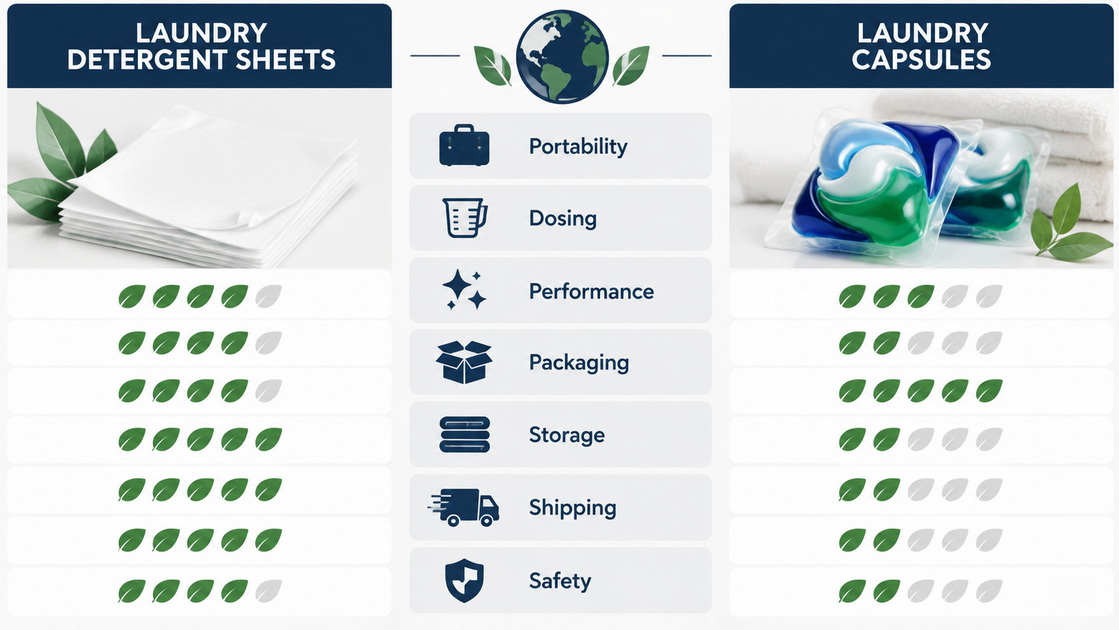
detergent sheets are often strongest for lightweight, minimalist, and sustainability-oriented positioning. Laundry capsules are often strongest for high-performance, premium, multi-benefit laundry propositions.
The most accurate answer is: the formula matters more than the format.
A sheet can clean very well if it contains an effective surfactant system, builders, enzymes, chelating agents, anti-redeposition ingredients, and appropriate fragrance or deodorizing technology. A capsule can also underperform if it has insufficient active matter, poor low-temperature dissolution, or a formula that is not matched to local water hardness and washing behavior.
Still, each format has practical formulation advantages.
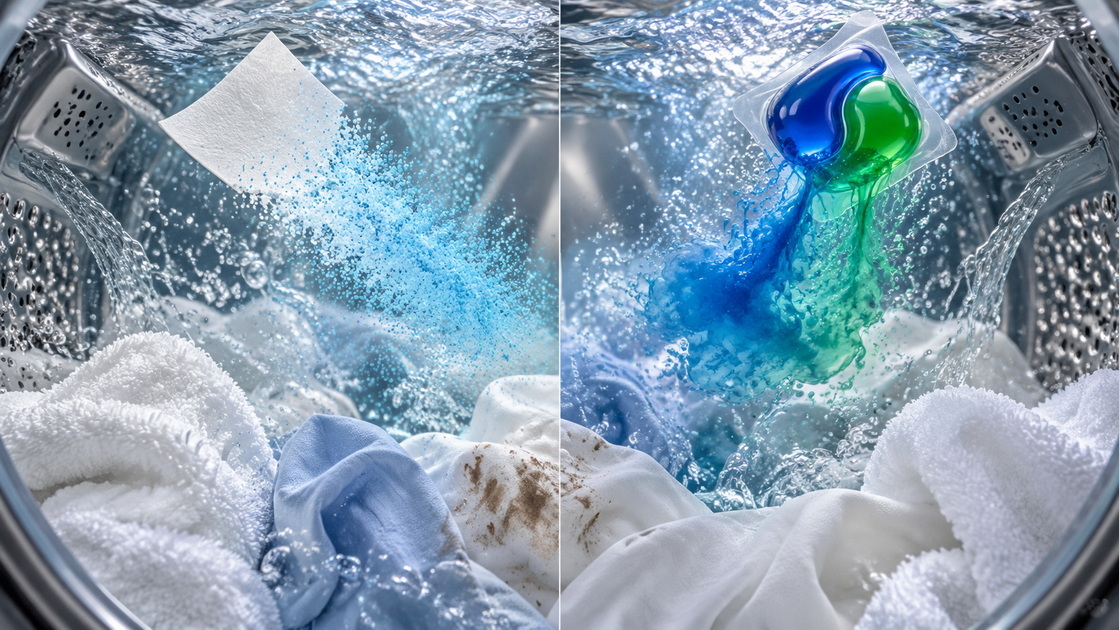
Laundry capsules can hold a concentrated liquid or gel formula. This gives manufacturers flexibility to use multiple ingredient phases and, in some designs, separate incompatible ingredients until the wash starts.
For example, a multi-chamber capsule may separate:
- Main detergent surfactants
- Enzymes for protein, starch, or fat-based stains
- Oxygen-based stain-removal components
- Fabric-care polymers
- Fragrance boosters
- Color-care ingredients
This makes capsules appealing for brands that want to market "deep clean," "stain removal," "long-lasting fragrance," "color protection," or "all-in-one laundry care."
However, brands should not make cleaning claims based only on the capsule format. Claims should be validated through standardized wash testing, including tests for sebum, food stains, mud, grass, makeup, body odor, and different water temperatures.
Detergent sheets are especially suitable for routine laundry, daily clothing, lightweight garments, travel laundry, and consumers who value simple handling. A well-designed detergent sheet can contain surfactants, enzymes, water-softening agents, fragrance, and odor-control components.
The challenge is maximizing performance within a thin sheet while maintaining reliable dissolution.
For a sheet formula, manufacturers should carefully optimize:
1. Active ingredient loading to ensure each sheet provides enough detergency.
2. Dissolution time in cold, warm, and high-efficiency washing conditions.
3. Sheet uniformity so every portion contains a consistent dose.
4. Moisture protection to prevent sticking during transport and storage.
5. Residue control to reduce the risk of visible fragments on dark garments.
Expert OEM insight: A detergent sheet should not be evaluated only by how quickly it disappears in water. It should also be tested for cleaning power, foam behavior, rinseability, color protection, fragrance carryover, and compatibility with different washing machines.
For consumers washing a very small load, hand-washing a few items, or traveling, detergent sheets can be easier to adjust. A user may use one sheet, half a sheet, or multiple sheets depending on product instructions and load size.
This makes sheets attractive for:
- Small households
- College students
- Apartment residents
- RV and travel users
- Laundromat customers
- Light-load or hand-wash users
- Subscription-box brands
However, brands must provide clear dosage instructions. "One sheet per wash" may not be enough information if customers have hard water, heavily soiled clothing, large loads, or high-capacity machines.
European detergent rules require consumer detergent labels to provide recommended dosage information for standard washing machines. Brands selling internationally should build dosage guidance into pack design from the beginning.
Capsules are extremely simple for a standard load: place the capsule in the drum, add clothes, and start the wash. Consumers do not need to measure liquid, handle powder, or tear a sheet.
This format works especially well for busy families and consumers who prefer a familiar unit-dose experience.
The limitation is that dosing is often less flexible. A small laundry load may still require one full capsule, while a very large or heavily soiled load may require two. This can increase cost per wash and create concern among consumers who prefer precise control over detergent use.
Detergent sheets are typically lightweight and compact because they contain little or no bulk water. This can reduce transportation volume compared with conventional liquid detergent.
For private-label and export brands, this creates several advantages:
- More units per shipping carton
- Lower storage-space requirements
- Easier e-commerce fulfillment
- Reduced risk of liquid leakage
- Convenient sample-pack development
- Strong fit for subscription models
- Easier travel-size positioning
A paper carton or paper-envelope concept can also support a lower-plastic packaging narrative. But brands should avoid broad environmental claims unless they have reviewed the complete lifecycle, including formula ingredients, transport, packaging materials, production energy, consumer use, and disposal.
Capsules require packaging that protects them from moisture, pressure, accidental opening, and consumer misuse. The outer pack must also support responsible safety communication.
Capsules can be vulnerable to:
- Sticking together in humid conditions
- Film damage during transit
- Leakage after puncture
- Softening if handled with wet hands
- Loss of fragrance if packaging is poorly sealed
The American Cleaning Institute advises users to handle single-load liquid laundry packets with dry hands, place them in the washing-machine drum before clothes, keep them in original containers, and store them out of the reach and sight of children.
For capsule brands, the packaging is not just a marketing asset. It is a safety and product-quality system.
All detergent products should be stored safely and used according to their labels. But concentrated liquid capsules require particularly careful safety design and communication.
The American Academy of Pediatrics warns that even small amounts of laundry detergent in a child's mouth or eyes can cause serious harm. It recommends keeping laundry products in original containers, stored closed and out of sight and reach of children and pets.
Capsule brands should consider:
- Child-resistant or child-deterrent packaging where applicable
- Clear hazard statements and first-aid information
- Strong resealable closures
- Opaque packaging that reduces product visibility
- Clear "keep out of reach of children" messaging
- Instructions to handle capsules only with dry hands
- Instructions not to puncture, cut, or use capsules for hand washing
- Market-specific regulatory review before launch
Detergent sheets may be less visually similar to candy than colorful liquid capsules, but they are still concentrated cleaning products. Brands should not imply that sheets are harmless simply because they are dry or thin.
Detergent-sheet labels should clearly state:
- Keep away from children and pets
- Avoid eye contact
- Do not ingest
- Store in a dry place
- Keep packaging sealed after use
- Follow the recommended dose
- Do not mix detergent with other cleaning chemicals
Best practice: Build safety messaging into packaging, product pages, retailer listings, and customer-service training—not only into small print.
Both formats are frequently marketed as environmentally preferable alternatives to traditional liquid detergent. But sustainability claims require nuance.
Detergent sheets may offer advantages such as:
- Lower shipping weight
- Smaller storage footprint
- Potential reduction in plastic bottle use
- Easier paper-based packaging options
- No bulky liquid bottle to transport
- Lower risk of liquid leakage in e-commerce delivery
These benefits may be meaningful, especially where products replace large water-heavy liquid-detergent bottles. Still, brands should avoid automatic claims such as "zero waste," "plastic-free," "non-toxic," or "eco-friendly" unless they can substantiate them for the specific product and market.
Capsules can reduce detergent overdosing because they are pre-portioned. They may also reduce the packaging volume associated with large liquid bottles.
However, capsule packaging, water-soluble film, formula concentration, transport distance, and consumer dosing behavior all affect the product's environmental profile.
A major discussion point is polyvinyl alcohol (PVA or PVOH), a water-soluble polymer used in some detergent sheets and capsules. Industry sources, including the American Cleaning Institute, state that detergent-grade PVA dissolves and biodegrades under wastewater-treatment and environmental conditions. A 2026 A.I.S.E. summary of peer-reviewed research similarly states that water-soluble PVOH films used in laundry capsules met biodegradability criteria in OECD screening tests.
At the same time, some environmental researchers and commentators have raised concerns about the extent and speed of PVA removal in real-world wastewater systems.
Responsible brand position: Do not treat PVA as a simple "good" or "bad" issue. Use verified supplier documentation, material specifications, biodegradability testing, regional regulations, and substantiated claims. Be transparent about what the product contains and what your evidence supports.
- A lightweight, compact product format
- Travel or subscription-box appeal
- Paper-forward packaging concepts
- Flexible dosing for light loads
- Strong e-commerce logistics efficiency
- A minimalist or sustainability-led visual identity
- A product suitable for small homes and limited storage
- Premium positioning
- Complex multi-benefit formulas
- High-impact fragrance storytelling
- A familiar unit-dose experience
- Strong stain-removal and fabric-care messaging
- Multi-chamber product differentiation
- A product range designed around convenience and performance
A brand serves different consumer segments. For example:
- Detergent sheets for online subscriptions, travel retail, eco-focused consumers, and entry-level products.
- Laundry capsules for supermarkets, premium retailers, family users, fragrance-led collections, and stain-removal positioning.
This two-format strategy can help brands cover more price points and purchasing occasions without forcing one product to solve every consumer need.

Before selecting detergent sheets or laundry capsules, ask your manufacturer the following questions:
1. What stain-removal and wash-performance testing has been completed?
2. Does the product dissolve reliably in cold water and high-efficiency washing machines?
3. What dosage is recommended for soft water, hard water, large loads, and heavily soiled loads?
4. Can the manufacturer provide ingredient documentation, SDS files, COA records, and stability-test reports?
5. What packaging options are available for moisture protection, child safety, and sustainability goals?
6. Can the formula be customized for fragrance, color, enzymes, antibacterial claims, sensitive skin, baby laundry, or pet textiles?
7. What markets can the product support from a labeling and compliance perspective?
8. Can the supplier produce samples and support private-label packaging development?
9. What minimum order quantity, lead time, and annual production capacity are available?
10. How will the manufacturer control batch consistency, fragrance retention, dissolution, and transport stability?
For global brands, a strong OEM/ODM supplier should support more than production. The supplier should help translate a product concept into a commercially viable formula, compliant packaging system, clear consumer instructions, and repeatable quality standard.
Detergent sheets are ideal for brands that prioritize portability, compact packaging, flexible dosing, e-commerce efficiency, and a modern minimalist identity. They can be highly effective when their formulation and dissolution performance are professionally developed and validated.
Laundry capsules are ideal for brands that prioritize concentrated cleaning, premium sensory experience, familiar user behavior, and multi-chamber innovation. They can support powerful all-in-one laundry propositions, but safety packaging and clear consumer education are essential.
The strongest product choice is not based on trend alone. It comes from matching the format to your customer, sales channel, regulatory market, brand claims, and performance target.
Looking for a reliable laundry detergent sheet manufacturer or laundry capsule OEM/ODM supplier?
Foshan Magic Crystal Technology Development Co., Ltd. supports global brands with customized laundry detergent sheets, clothing-care products, home cleaning products, personal-care products, and pet-cleaning solutions. With more than three self-owned factories, annual capacity of approximately 30,000–40,000 metric tons, and service experience supporting over 300 brands, we can help turn your product concept into a scalable private-label solution.
Contact our team to discuss custom formula development, fragrance options, packaging design, samples, MOQ, and OEM/ODM cooperation.
Neither format is universally better. Detergent sheets are often better for lightweight storage, travel, e-commerce shipping, and flexible use. Laundry capsules are often better for premium, concentrated, multi-benefit formulations. The final decision should depend on formula quality, target market, and brand positioning.
Many detergent sheets are designed to dissolve in cold water, but performance depends on the formula, sheet thickness, washing-machine type, water flow, and wash cycle. Brands should conduct dissolution and wash-performance testing in relevant cold-water conditions before making claims.
Generally, no. The American Cleaning Institute recommends placing single-load liquid laundry packets directly in the bottom of the washing-machine drum before adding clothes, rather than putting them in the dispenser drawer.
Laundry capsules can pose a serious risk if swallowed or if their contents contact a child's eyes. They should be stored in their original, tightly closed packaging and kept out of sight and reach of children and pets.
They may reduce shipping weight and allow compact, paper-forward packaging, but no product format is automatically sustainable. The full environmental profile depends on formula ingredients, water-soluble materials, packaging, transport, production, dosage, and disposal. Brands should use evidence-based claims.
Yes. An experienced OEM/ODM manufacturer can customize sheet size, detergent loading, fragrance, color, enzyme system, packaging, positioning, and claims strategy. Brands should also request stability, dissolution, and performance testing during product development.
Detergent sheets are often highly suitable for online sales because they are lightweight, compact, easy to ship, and less likely to leak than liquid products. Capsules can also work well online, but they require robust moisture-resistant and safety-focused packaging.
1. U.S. Environmental Protection Agency. "Safer Choice." Explains that the Safer Choice program helps consumers and purchasers identify products that perform and contain ingredients considered safer for human health and the environment. [EPA Safer Choice] [epa]
2. U.S. Environmental Protection Agency. "Safer Choice Standard and Criteria." Includes criteria related to product ingredients and fragrance-free certification. [EPA Safer Choice Standard] [epa]
3. American Cleaning Institute. "Liquid Laundry Packet Safety Tips." Provides handling, storage, and use guidance for liquid laundry packets, including use with dry hands and placement in the washing-machine drum. [ACI Laundry Packet Safety Tips] [cleaninginstitute]
4. American Academy of Pediatrics, HealthyChildren.org. "Laundry Room and Detergent Safety." Provides child-safety guidance and warnings related to exposure to laundry detergents and detergent packets. [Laundry Room and Detergent Safety] [healthychildren]
5. EUR-Lex. "Safer Detergents for European Consumers." Summarizes labeling and dosage-information requirements under the EU Detergents Regulation. [EU Detergent Consumer Safety Rules] [eur-lex.europa]
6. Health and Safety Executive, Great Britain. "Detergents in Great Britain." Outlines detergent labeling and ingredient-information requirements, including disclosure of surfactants, fragrances, enzymes, and preservatives. [HSE Detergent Guidance] [hse.gov]
7. American Cleaning Institute. "Get the Facts About PVA and Detergent Pods." Presents the industry position that detergent-grade PVA dissolves and biodegrades in wastewater-treatment systems and the environment. [ACI PVA Information] [cleaninginstitute]
8. A.I.S.E. "Research on the Biodegradability of Polyvinyl Alcohol-Based Film." Summarizes peer-reviewed research on the biodegradability of PVA/PVOH films commonly used in laundry detergent capsules. [A.I.S.E. PVA Film Research] [detergentseurope]
9. Nontoxic Nook. "Laundry Detergent Sheets: The PVA Microplastic Debate." Provides a summary of concerns and debate surrounding PVA biodegradation under real-world wastewater conditions. [PVA Microplastic Debate] [nontoxicnook]


