
Views: 266 Author: Magic Household Cleaning Publish Time: 2026-08-21 Origin: Site

Content Menu
● What Are High-Density and Low-Density Fragrance Beads?
● High-Density vs Low-Density Fragrance Beads at a Glance
● High-Density Fragrance Beads: Benefits and Limitations
>> Key advantages of high-density beads
>> Potential challenges of high-density beads
● Low-Density Fragrance Beads: Benefits and Limitations
>> Key advantages of low-density beads
>> Potential challenges of low-density beads
● Does Higher Density Mean Stronger or Longer-Lasting Fragrance?
● How Density Affects Dissolution and Wash Performance
>> What actually controls dissolution?
>> Practical test protocol for private-label buyers
● Packaging, Freight, and Cost Implications
● Which Fragrance Bead Density Is Right for Your Brand?
● Expert Checklist for OEM/ODM Scent Bead Development
● Create a Better Laundry Scent Bead Product
● FAQ
>> 1. What is the main difference between high-density and low-density fragrance beads?
>> 2. Are high-density fragrance beads more concentrated?
>> 3. Do low-density laundry scent beads dissolve faster?
>> 4. Which fragrance bead density is better for export?
>> 5. Can a manufacturer customize fragrance bead density?
>> 6. How should brands test laundry scent beads before launch?
>> 7. Are laundry fragrance beads detergent?
When developing laundry scent beads, density is not merely a production specification. It can influence dissolution behavior, fragrance distribution, dosage perception, transport efficiency, packaging design, and the consumer's wash-day experience. For private-label brands, retailers, and importers, choosing between high-density and low-density fragrance beads should be a formulation-and-positioning decision—not simply a cost decision.
At Foshan Magic Crystal Technology Development Co., Ltd., we develop and manufacture laundry scent beads and other home, personal-care, and pet-cleaning products for global OEM/ODM customers. With more than three proprietary factories, annual production capacity of approximately 30,000–40,000 tonnes, and experience serving over 300 brands, we see a consistent reality: the "better" bead density depends on the target market, washing conditions, fragrance concept, and brand promise.
Laundry fragrance beads—also called laundry scent boosters, in-wash scent beads, scent crystals, or fragrance booster beads—are concentrated products placed directly into the washing-machine drum before clothing. They are designed to dissolve during the wash and deposit or release fragrance on textiles.
In practical manufacturing terms, density refers to the mass of a bead material per unit of volume. It is often expressed as bulk density for loose, packed beads, while a formulation team may also assess the density of the individual bead or crystal.
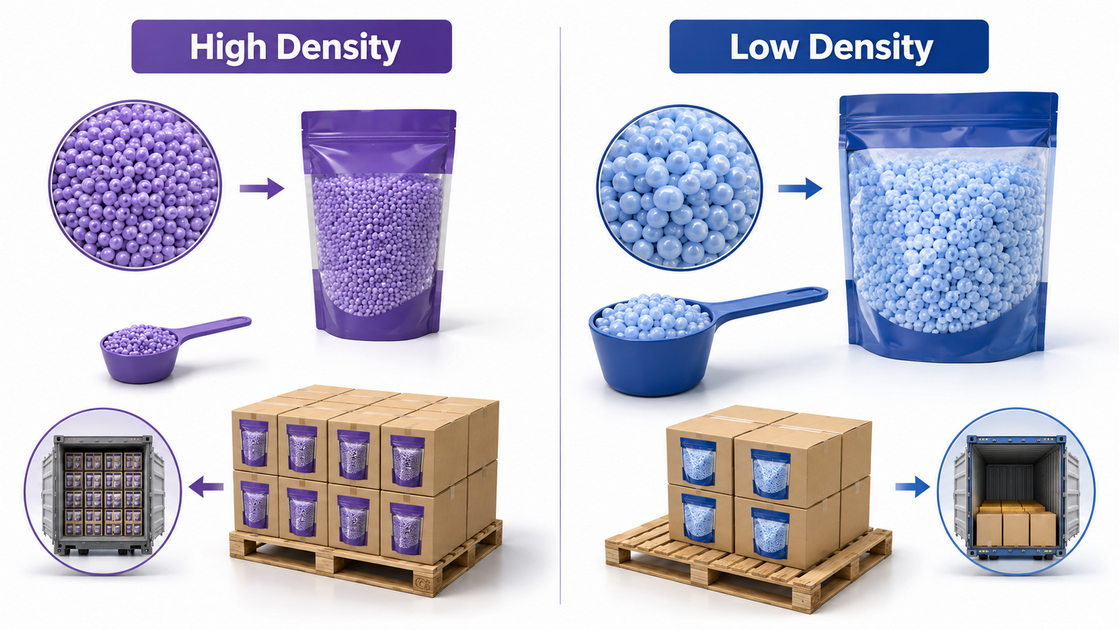
- High-density fragrance beads contain more mass in the same physical volume. They usually feel heavier, more compact, and less voluminous per kilogram.
- Low-density fragrance beads contain less mass in the same volume. They may appear larger, lighter, more porous, or more visually abundant in a jar or pouch.
- Density can be influenced by the carrier system, fragrance loading, moisture control, processing temperature, bead structure, particle-size distribution, and the inclusion of functional materials.
A published Chinese patent for laundry fragrance-retaining beads reported tested bead densities around 1.10–1.14 g/cm³ for its examples, versus 1.35 g/cm³ for a comparative sample. The patent associated density closer to water with easier mixing and faster dissolution in its specific formulation—not a universal rule for every scent-bead system.
| Comparison factor | High-density fragrance beads | Low-density fragrance beads |
|---|---|---|
| Physical feel | Heavier and more compact | Lighter and more voluminous |
| Volume per kilogram | Lower | Higher |
| Jar-fill appearance | May look less full at the same net weight | Can create a fuller visual presentation |
| Packaging efficiency | Often favorable by volume | May require more package volume for the same weight |
| Dose perception | Consumers may perceive a smaller scoop as concentrated | Consumers may prefer a visibly fuller scoop |
| Dissolution behavior | Depends on formula, bead size, carrier, and wash conditions | Depends on formula, bead size, carrier, and wash conditions |
| Shipping economics | Can reduce cubic-volume demand for a given product mass | Can increase cubic-volume demand |
| Brand positioning | “Concentrated,” “premium,” or “professional” | “Generous,” “easy-to-dose,” or “visual sensory” |
| Development focus | Flowability, dispersion, controlled release, compact dosing | Anti-caking, dust control, volume stability, consumer handling |
The critical point is that density alone does not determine fragrance longevity. Long-lasting scent depends on the fragrance composition, carrier compatibility, encapsulation or deposition technology, wash conditions, dosage, textile type, and storage stability.
High-density laundry scent beads can be a strong option when a brand wants a compact, concentrated-looking product or needs to optimize freight and storage volume. They are particularly relevant for brands selling in rigid containers, warehouse clubs, e-commerce channels, or markets where logistics costs are sensitive.
- More compact product format: More product mass can fit into a defined container volume.
- Potential logistics advantage: A denser product may make better use of pallet, warehouse, and container space when comparing equivalent product mass.
- Premium concentration story: Brands can communicate controlled dosing and concentrated performance when substantiated through testing.
- Stable visual consistency: Compact beads can support a polished, uniform "crystal" appearance.
- Reduced packaging-volume pressure: A lower volume-per-kilogram requirement may support more efficient packaging formats.
For example, a 500 g fragrance-bead SKU can look very different depending on bulk density. A high-density product may occupy a smaller internal volume and leave more headspace in a standard jar, while a lower-density version can make the same jar look fuller. Neither option is inherently better; the right option depends on whether the brand sells net weight, visible fill, convenience, or concentration.
A high-density formula must still dissolve and distribute evenly under realistic conditions. If the product is overly compact, has an unsuitable carrier, or is formulated with an unfavorable particle-size profile, brands may encounter concerns such as:
- Slow dissolution in cold-water or short wash cycles.
- Product settling in a dosing cap or on the bottom of a container.
- Inconsistent fragrance release between light and heavy laundry loads.
- Consumer confusion if a small dose appears visually "insufficient."
- Higher risk of an overly intense fragrance experience if dosing instructions are unclear.
A scent booster patent describes bead-based products as solids at room temperature that dissolve during washing, using a dispersant and solubility agents as part of the formulation. This highlights why density cannot be evaluated separately from the overall carrier and dissolution system.
Low-density fragrance beads are often selected for their visual impact and easy-to-handle appearance. They can create a more generous-looking product, particularly in transparent jars, stand-up pouches, and retail formats where consumers judge value partly by what they see before purchase.
- Higher perceived fill: The same net weight can occupy more package space.
- More visually expressive product: Larger-volume or more aerated beads may strengthen color, texture, and sensory shelf appeal.
- Consumer-friendly dosing appearance: A visible scoop of beads can make the usage ritual feel more intuitive.
- Potentially faster wetting: Depending on the carrier and structure, some lower-density formats may contact and disperse in wash water efficiently.
- Differentiated retail presentation: A fuller jar can support an accessible, lifestyle-oriented brand story.
Low-density does not automatically mean weak or diluted. A well-designed low-density laundry scent bead can deliver high fragrance impact if the fragrance system, carrier matrix, and dosage instructions are engineered together.
The trade-off is usually physical volume. A product with lower bulk density can occupy more space for the same sellable weight, affecting packaging and freight calculations.
Brands should also validate:
- Dust and breakage resistance during filling, transport, and consumer use.
- Caking resistance in humid storage environments.
- Consistent bulk density across production batches.
- Accurate fill-weight control when packaging by volume.
- Fragrance stability over the intended shelf life.
- Performance in both top-load and front-load washing machines.
No. A higher-density fragrance bead is not automatically stronger, longer-lasting, or more effective. Density measures a physical property; fragrance performance is a multi-variable outcome.
The factors that typically matter more include:
- Fragrance oil quality and concentration.
- Fragrance stability in the chosen carrier.
- Use of perfume microcapsules or other controlled-release technologies.
- Compatibility with detergent, water hardness, and wash temperature.
- Fragrance deposition on different textile fibers.
- Particle size and dissolution rate.
- Recommended dosage per wash load.
- Packaging barrier properties and storage conditions.
Consumer testing also reinforces that dosage affects scent intensity. Wirecutter notes that scent-bead products are added directly to the washer drum and that using more beads delivers more fragrance. It also describes PEG as a water-soluble polymer used to help deliver fragrance to textiles in some scent booster systems.
For OEM/ODM buyers, the correct question is not "Which density is strongest?" Instead, ask: "Which density and formulation combination delivers the desired sensory experience at the target dosage, price point, and wash condition?"
Dissolution performance is a major quality factor because visible residue can damage consumer trust, especially in cold-water washing, quick cycles, overfilled drums, or high-efficiency machines that use less water.
Density is only one part of the equation. A robust development program should examine:
1. Carrier solubility: The bead base must soften, disperse, or dissolve appropriately in intended wash conditions.
2. Particle size distribution: Smaller particles often present more surface area, but excessively fine particles can increase dust.
3. Bead compactness and porosity: Internal structure can affect water penetration.
4. Water temperature: Cold-water performance requires dedicated validation.
5. Mechanical agitation: Top-load and front-load machines create different mixing conditions.
6. Dosage and load size: Overdosing can increase the risk of incomplete dissolution.
7. Water hardness: Minerals can influence the behavior of some formulation systems.
A useful industry benchmark is to test the same product across multiple scenarios rather than relying on a single warm-water cycle. This may include cold, ambient, and warm wash conditions; short and standard cycles; synthetic and cotton loads; soft and hard water; and both low and high product dosages.
Before approving an OEM scent-bead formula, request a documented validation plan:
1. Define target machine types and wash temperatures for the sales market.
2. Test dissolution using the maximum recommended consumer dosage.
3. Assess residue on dark fabrics, drum surfaces, and dispenser areas.
4. Evaluate fragrance intensity immediately after drying and after storage.
5. Conduct accelerated stability testing under high temperature and humidity.
6. Confirm bulk-density tolerance, particle size, color, moisture, and fragrance specifications for every production batch.
This process turns "high density vs low density" from a vague marketing phrase into a measurable product-development standard.

Density can have a significant commercial impact because scent beads are commonly sold by net weight but are packaged in volume-based containers such as PET jars, HDPE bottles, pouches, and refill bags.
| Commercial question | High-density bead implication | Low-density bead implication |
|---|---|---|
| How full will the pack look? | May require packaging design to manage headspace | Naturally supports higher visible fill |
| How much space is needed? | Less volume per kilogram | More volume per kilogram |
| Which pack format fits? | Compact jars, refill packs, concentrated formats | Wide-mouth jars, larger pouches, sensory retail displays |
| What should be tested? | Dissolution, dose clarity, perceived value | Caking, breakage, fill-weight accuracy, transport volume |
| What is the brand message? | Concentration and efficiency | Generosity and easy sensory use |
For export-focused brands, freight should be calculated using both gross weight and cubic volume. A low-density product may appear attractive at retail but occupy more container space. A high-density product may save cubic volume but need stronger design work to avoid a "half-empty" visual impression.
The global in-wash scent booster market is projected by Future Market Insights to grow from USD 0.8 billion in 2026 to USD 1.6 billion by 2036, with beads estimated to account for approximately 48% of the market in 2026. Market estimates should be treated as directional rather than as audited sales data, but they underline why differentiated product design and packaging matter.
The best choice depends on your commercial strategy and target consumer.
Choose a high-density fragrance bead when your brand prioritizes:
- Compact packaging and container utilization.
- A concentrated or premium positioning.
- Export efficiency and warehouse optimization.
- Smaller-dose product storytelling.
- A refined, uniform crystal-like appearance.
Choose a low-density fragrance bead when your brand prioritizes:
- Strong visible fill in transparent retail packaging.
- A more tactile and expressive consumer experience.
- Larger-looking bead formats or colorful designs.
- A "generous value" shelf presentation.
- Easy visual dosing for first-time consumers.
For many OEM/ODM projects, a tailored middle ground is more effective than either extreme. We may adjust the carrier system, particle size, fragrance profile, color design, bulk density, and packaging format together to meet a defined performance brief.
A capable fragrance-bead manufacturer should not present density as an isolated number. Ask for a full technical and commercial evaluation.
- What is the target bulk-density range and allowable production tolerance?
- What are the individual bead density and particle-size specifications?
- Does the product dissolve in cold-water and quick-wash cycles?
- What fragrance-release approach is used?
- How is scent performance tested after washing and drying?
- What packaging options protect fragrance during storage and export?
- Can the formulation be adapted for regional requirements and consumer preferences?
- What batch-level quality-control records are available?
- Can the supplier provide samples in multiple density options for side-by-side consumer testing?
- Is the final product designed around target cost, target retail price, or target performance?
High-density and low-density fragrance beads can both succeed when they are developed around a clear product brief. The strongest private-label products balance fragrance impact, cold-water dissolution, packaging appearance, cost control, logistics, regulatory readiness, and consumer ease of use.
Foshan Magic Crystal Technology Development Co., Ltd. supports global brands with customized laundry scent bead OEM/ODM solutions. Whether you need a compact high-density scent booster for efficient export packaging or a low-density visual bead format for standout retail presentation, our R&D and manufacturing teams can help develop the right formula, fragrance, color, and pack configuration.
Contact us to request fragrance-bead samples, discuss your target density range, and build a private-label laundry scent booster designed for your market.

High-density fragrance beads contain more mass in the same volume and typically feel more compact. Low-density fragrance beads are lighter or more voluminous for the same weight, which can create a fuller package appearance.
Not necessarily. Density and fragrance concentration are different properties. A high-density bead may be physically compact, but actual scent strength depends on fragrance loading, carrier design, controlled-release technology, dosage, and textile deposition.
They can, but this is not guaranteed. Dissolution depends on carrier solubility, bead size, porosity, water temperature, agitation, product dosage, and washing-machine type. Every OEM formula should be tested under real target-market wash conditions.
High-density beads can offer advantages when reducing packaging volume and container cube is a priority. However, low-density beads may be commercially preferable when retail appearance and visible package fill are more important. The best option should be calculated using both freight and retail objectives.
Yes. An experienced OEM/ODM manufacturer can adjust formulation architecture, particle size, processing conditions, fragrance system, color, and pack format to target a suitable bulk-density range while maintaining dissolution and stability requirements.
Brands should test dissolution, residue, fragrance intensity, storage stability, caking, color stability, and packaging compatibility. Testing should include relevant water temperatures, wash cycles, textile types, dosage levels, and machine types used by the target customers.
No. Laundry fragrance beads are generally an in-wash fragrance additive rather than a complete detergent. They are typically used with a suitable laundry detergent and should be placed in the drum according to the product's instructions.
1. Google Patents. "Scent Booster for Laundry," US20240409849A1. Discusses scent-booster bead composition, including dispersant and solubility-agent processing. [https://patents.google.com/patent/US20240409849A1/en]
2. Google Patents. "Washing Fragrance Retaining Bead and Preparation Method Thereof," CN109234043B. Includes density testing methodology and example density results for laundry fragrance-retaining beads. [https://patents.google.com/patent/CN109234043B/en]
3. The New York Times Wirecutter. "The Best-Smelling Laundry Products and Scent Boosters." Provides consumer-use context for in-wash scent boosters, dosage, and PEG as a water-soluble fragrance-delivery carrier in some products. [https://www.nytimes.com/wirecutter/reviews/best-smelling-laundry-products/]
4. Future Market Insights. "In-Wash Scent Booster Market." Provides market-size and segment estimates for the in-wash scent booster category. [https://www.futuremarketinsights.com/reports/in-wash-scent-booster-market]
5. Fact.MR. "Laundry Scent Booster Market Size, Demand & Growth 2023." Discusses the role of laundry scent boosters as additive products intended to provide lingering fragrance on textiles. [https://www.factmr.com/report/477/laundry-scent-booster-market]


