
Views: 255 Author: Magic Household Cleaning Publish Time: 2026-10-28 Origin: Site
Content Menu
● What Are Laundry Scent Boosters?
● How to Use Laundry Scent Boosters Step by Step
>> 1. Check the Product and Fabric Instructions
>> 2. Measure the Recommended Amount
>> 3. Add Beads to the Washer Drum
>> 4. Add Laundry and Detergent
>> 5. Choose a Suitable Cycle and Dry Properly
● How Much Laundry Scent Booster Should You Use?
● Can You Use Scent Beads in Cold Water and HE Washers?
● Why Are Laundry Scent Beads Not Dissolving?
● How Long Does Laundry Fragrance Really Last?
● Are Laundry Scent Boosters Suitable for Sensitive Skin?
● Safe Storage Around Children and Pets
● A Manufacturer's Perspective: What Makes Better Laundry Scent Beads?
>> Evaluate the Finished Wash Experience
>> Turn Customer Feedback Into Actionable Evidence
>> Match Product Claims to Documentation
● Developing Private-Label Laundry Scent Boosters With Magic Crystal
>> Can I Use Laundry Scent Boosters Without Detergent?
>> Do Scent Beads Go Before or After Clothes?
>> Can Laundry Scent Beads Go in the Dryer?
>> Are Scent Boosters the Same as Fabric Softener?
>> Can I Use Scent Boosters on Towels?
>> Will More Scent Beads Make Clothes Cleaner?
>> Are All Laundry Scent Boosters Septic-Safe?
Knowing how to use laundry scent boosters starts with one simple distinction: fragrance is not the same as cleaning. Laundry scent beads add scent to a wash, while detergent handles the cleaning. For most in-wash products, measure the recommended amount, pour it into the empty washer drum, add your clothes, and wash with detergent.
That sounds straightforward. Yet questions about dosage, cold-water washing, sensitive skin, and undissolved beads can make the process confusing.
This guide explains how to use scent boosters effectively, troubleshoot disappointing results, and evaluate products beyond their fragrance in the bottle. It also introduces a manufacturer's perspective on what makes laundry scent beads practical for households and private-label brands.
Laundry scent boosters are fragranced beads, crystals, or granules designed to dissolve during washing and leave fragrance on fabrics.
They are an optional laundry additive—not a replacement for detergent, stain treatment, or proper drying.
Formulations differ. Some use salt-based carriers; others use ingredients such as polyethylene glycol. Fragrance delivery systems also vary, so appearance alone cannot tell you how a product will dissolve or perform.
A useful way to understand the category is to separate three jobs:
| Laundry Product | Main Purpose | What Not to Assume |
|---|---|---|
| Laundry detergent | Clean fabrics and remove soils | Strong fragrance proves better cleaning |
| Laundry scent booster | Add fragrance to washed fabrics | It removes stains or disinfects clothing |
| Fabric softener | Soften fabrics and help control static | It performs the same function as scent beads |
Some boosters make additional odor-control claims. Evaluate those claims for the specific formula rather than applying them to every product.
The most important instruction is to follow your current product label. Measuring caps and recommended amounts are not interchangeable between brands.
Confirm that the booster is suitable for your washing machine and intended laundry.
Read garment care labels, particularly for specialist textiles or items with restrictions on laundry additives. A general statement about washable fabrics should not override an item's specific care requirements.
Use the supplied cap or measuring guide.
For your first load, choose the lowest recommended amount suitable for that load size. This gives you a sensible starting point without immediately committing to a strong fragrance.
Avoid copying a "full cap" recommendation from another brand. Cap sizes and formulas differ.
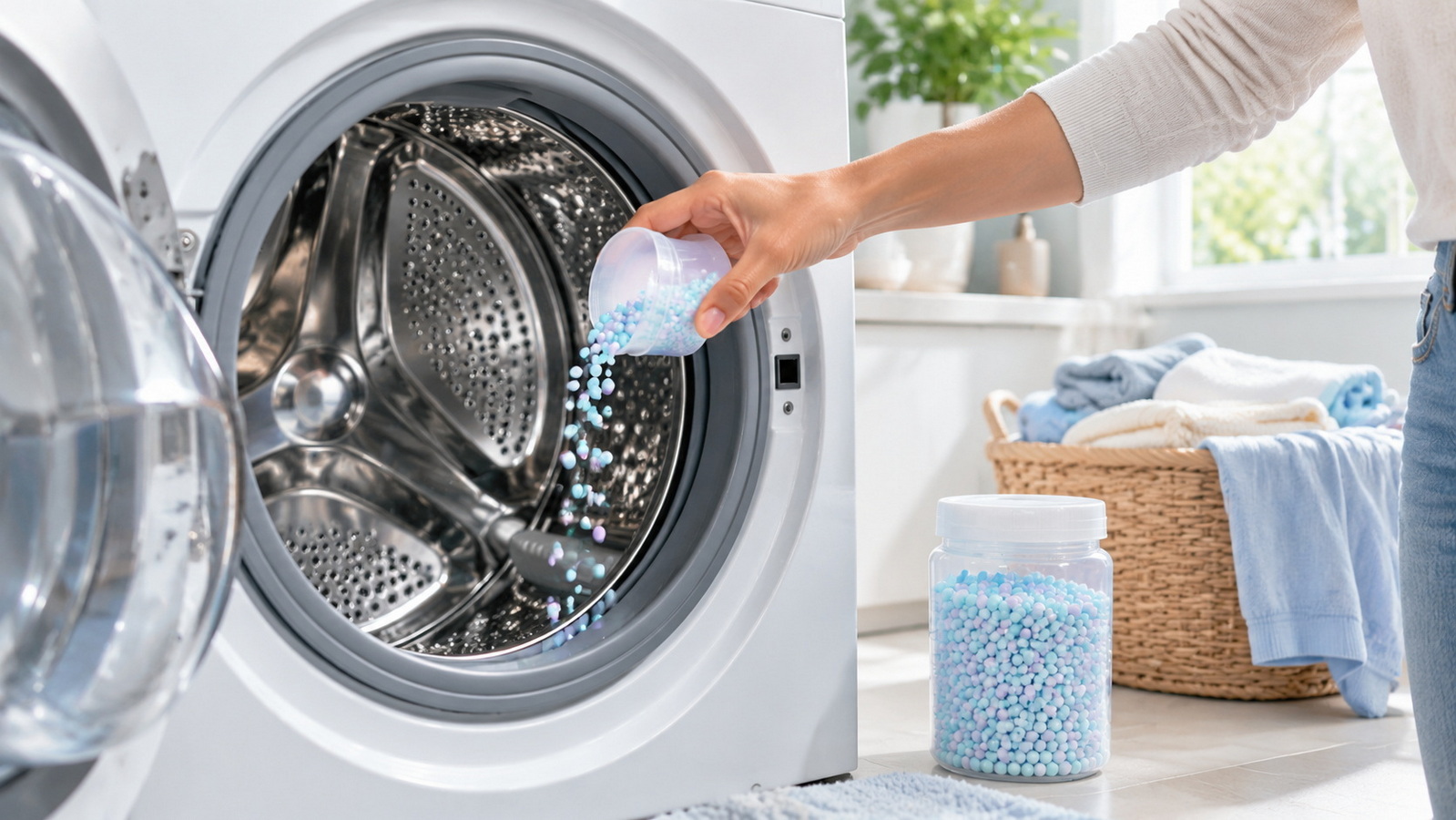
Most conventional laundry scent beads go directly into the empty drum before clothing.
Do not put them in the detergent drawer or fabric-softener compartment unless the product specifically instructs you to do so.
Drum placement is the standard direction for the major in-wash products discussed here, but your own package instructions remain the final reference.
Load clothes without tightly packing the drum, then add detergent according to its directions and your machine's instructions.
Keep using detergent even when the booster smells powerful. Fragrance does not substitute for cleaning ingredients.
Select the cycle and temperature appropriate for the garments and booster.
After washing, check for visible granules before drying. If residue remains, address it first rather than assuming dryer heat will dissolve it.
Never add in-wash scent beads directly to a dryer. They are designed for wash water, not hot air.
There is no reliable universal dose for all brands.
The right amount depends on the product's instructions, load size, and your fragrance preference. More beads may create a stronger scent, but that does not mean cleaner clothing.
Use a controlled approach:
1. Measure the label-recommended starting amount.
2. Wash a typical load using your normal detergent.
3. Evaluate the fragrance after the laundry is fully dry.
4. Adjust the next comparable load within the label's directions.
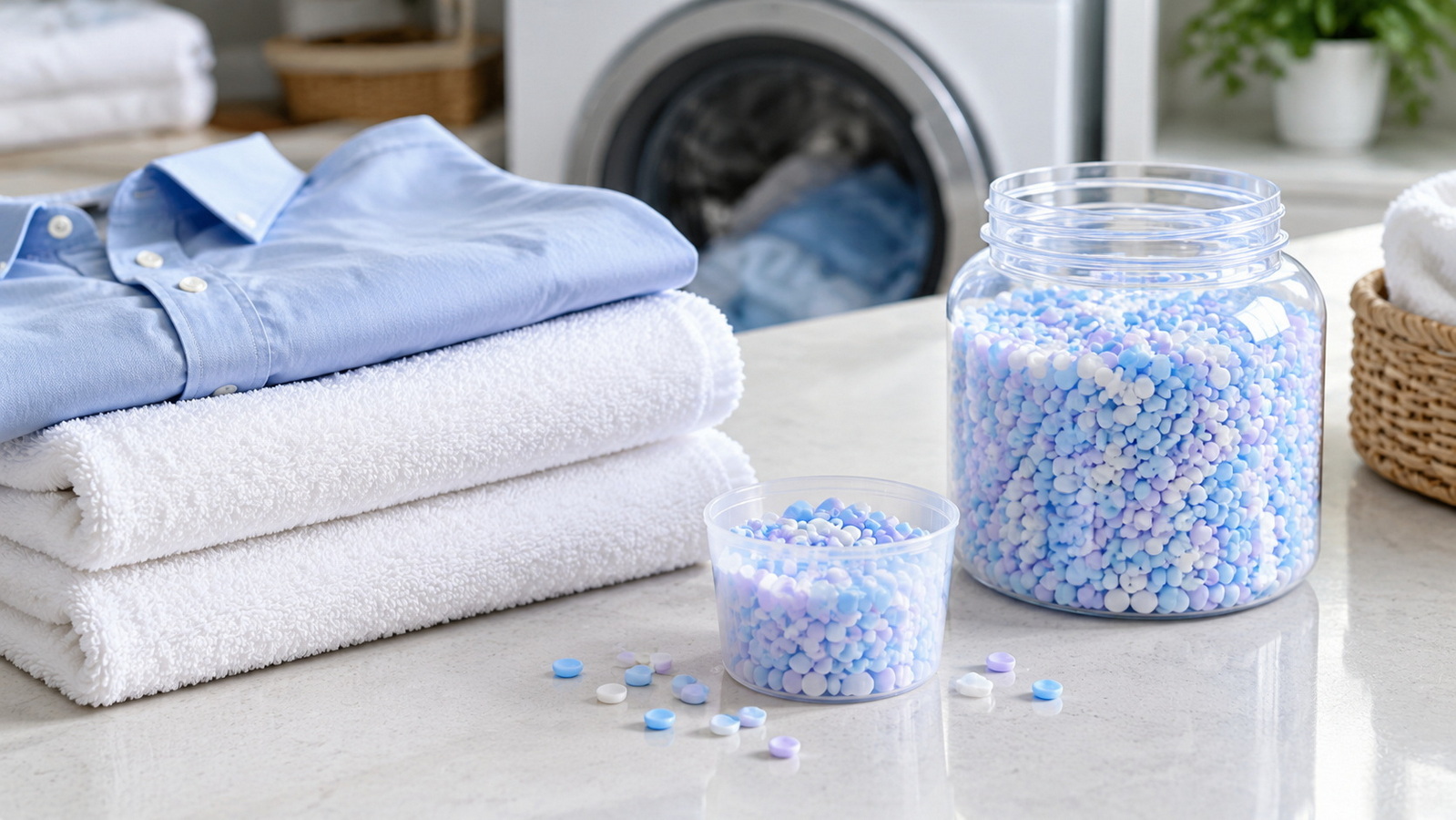
Judge scent on the fabric, not only in the bottle or on wet clothing.
For shared households, consider everyone using the towels, bedding, or clothing. A fragrance level one person enjoys may feel excessive to someone else.
From a practical perspective, the goal is a comfortable result—not the largest possible dose.
Many scent boosters are labeled for cold water and high-efficiency machines. However, compatibility is product-specific.
Check for explicit instructions covering:
- Front-loading or top-loading machines.
- High-efficiency washers.
- Cold-water washing.
- Recommended dosing.
- Any cycle restrictions.
A product labeled for cold water should still be used as directed. That claim is not permission to disregard loading instructions or assume every unusually short cycle will deliver identical results.
For front-load washers, add compatible beads to the drum as directed before loading clothing. Do not move them into the dispenser simply because that is where you usually put detergent.
For brands developing a product, cold-water compatibility should be demonstrated through testing under defined conditions—not inferred from a competitor's packaging.
Undissolved beads are a reason to review the process, not automatically increase the temperature or add more product.
Check the label, dose, placement, loading, and selected cycle before drawing conclusions.
| What You Notice | What to Review | Practical Next Step |
|---|---|---|
| Granules remain after washing | Dose, loading, cycle, product directions | Correct the setup and rewash affected items as appropriate |
| Product collects in a dispenser | Placement instructions | Use the drum if directed by the label |
| Fragrance is weaker than expected | Dose and expectations | Assess dry laundry before adjusting |
| Fragrance feels overwhelming | Amount used | Reduce the next dose within instructions |
| Musty odor remains | Cleaning, drying, and washer condition | Address the odor source rather than adding fragrance |
If granules remain on clothing, do not use the dryer as a troubleshooting tool.
Rewash according to the garment's care instructions, without adding more booster. Contact the product manufacturer if residue continues or fabric appearance changes.
For a useful customer-service report, record the product name, batch number, dose, machine type, cycle, and photographs. These details are more actionable than "the beads did not work."
Some products advertise fragrance lasting for weeks. Those statements need context.
A stored towel and a shirt worn during exercise do not represent the same conditions. The source article itself describes an "up to 12 weeks" claim as freshness from wash to wear—not a promise covering repeated use.
When comparing products, ask:
- Was the fabric stored or worn?
- Was fragrance assessed immediately after drying or later?
- What dose and fabric were used?
- How were the items stored?
- Was performance judged by people, instruments, or both?
For household use, focus on whether you enjoy the scent when you actually use the item.
For private-label purchasing, request the test method behind longevity claims. A statement without defined conditions is difficult to compare fairly.
A useful fragrance is not necessarily the strongest or longest-lasting one. It is one that fits the intended customer's routine.
Fragrance is optional, and it is not suitable for everyone.
People with fragrance sensitivity, eczema, or previous reactions to laundry products should be cautious about adding a fragranced booster. A lighter scent should not automatically be treated as a sensitive-skin solution.
Likewise, "natural," "essential oil," and "few ingredients" do not independently establish that a product will suit a particular person.
For households managing skin concerns, fragrance-free laundry products are a more appropriate starting point to discuss with a healthcare professional.
If irritation develops after introducing a booster, stop using it and seek medical advice when needed. Do not assume that reducing the dose resolves an allergy.
The same care applies to baby clothing and shared bedding. Washable fabric compatibility is different from personal tolerance.
Laundry scent beads can look colorful and smell appealing. Keep them in their original, closed packaging, out of children's and pets' reach.
Never transfer them into food jars, bowls, or unmarked containers. Avoid displaying loose beads where someone could mistake them for sweets.
Wash hands after handling them.
If a child swallows a product, obtain product-specific advice from a poison center. In the United States, call 1-800-222-1222. Do not induce vomiting.
For a pet exposure, contact a veterinarian or animal poison service promptly and keep the packaging available.
Do not use laundry beads as room fragrance, carpet treatment, or pet-bedding additives outside their labeled instructions.
A pleasant bottle fragrance is only one part of product development.
For manufacturers and private-label buyers, the more useful question is: does the product deliver a consistent, understandable experience under its intended conditions?
A practical evaluation should examine:
- Dissolution under the claimed washing conditions.
- Fragrance character after drying.
- Consistency between production batches.
- Visible residue under the test conditions.
- Packaging performance during storage and transport.
- Clarity of instructions and measuring marks.
These are proposed evaluation criteria, not claims that every product has passed identical tests.
Customer feedback is most useful when it connects a complaint with the conditions of use.
For example, a report of "too little fragrance" should prompt questions about dose, load size, drying, and the customer's expectations. A residue complaint calls for a different investigation.
Brands should classify feedback by issue rather than treating every low rating as a request for more perfume.
Without verified customer reviews, there is no basis for inventing testimonials or claiming that users consistently prefer a particular formula.
Before approving packaging, request evidence supporting claims such as cold-water performance, fragrance longevity, or machine compatibility.
Confirm ingredient information, safety documentation, destination-market labeling requirements, and agreed quality specifications.
A supplier's production capacity matters, but capacity alone does not establish how a specific formula performs.

Foshan Magic Crystal Technology Development Co., Ltd. develops, manufactures, and sells laundry scent beads alongside household, personal, and pet cleaning products.
According to company-provided information, the business operates more than three company-owned factories, has annual production capacity of approximately 30,000–40,000 metric tons, and provides OEM/ODM services to more than 300 brands worldwide.
For buyers, these figures provide company context. Product approval should still depend on samples, specifications, relevant documentation, and verified performance for the intended market.
An effective development brief should define:
- Target customers and preferred fragrance strength.
- Intended machines, temperatures, and washing routines.
- Pack size, measuring method, and retail positioning.
- Required claims and supporting tests.
- Packaging, labeling, and order requirements.
Contact Magic Crystal with your target market, fragrance direction, packaging needs, and expected order volume to discuss sample development and an OEM/ODM project brief.
Not as a substitute for washing. Scent boosters primarily add fragrance, while detergent provides cleaning. Use both according to their separate instructions when fragrance is desired.
Most conventional in-wash beads go into the empty drum before clothing. Always check the current package because instructions can differ between products.
No. In-wash beads dissolve in wash water and should not be added directly to a dryer. Use only products specifically labeled for dryer use there.
No. Scent boosters primarily add fragrance. Fabric softeners are designed to soften fabrics and help reduce static. Do not assume either product provides the other's benefits.
Many products permit use on washable towels. Check both labels, use the recommended amount, and address musty odors through proper washing and drying rather than fragrance alone.
No. Increasing fragrance does not establish better soil removal. Adjust detergent and washing practices for cleaning problems, and keep booster dosing within its instructions.
Do not generalize across the category. Look for a septic-compatibility statement on the specific product and seek guidance from its manufacturer if the instructions are unclear.
1. [ARM & HAMMER — How to Use Scent Boosters to Get Fresh Smelling Laundry]. Original article; supports basic usage, product distinctions, machine compatibility, and the context of fragrance-duration claims. Brand-specific statements should not be generalized to all formulations. [armandhammer]
2. [Downy — Scent Beads for Beginners: What They Do and How to Use Them]. Supports the definition of scent beads and standard empty-drum placement instructions. [downy]
3. [Poison Control — Laundry Fragrance Booster Pellets and Kids]. Supports formulation context, child-safe storage, handwashing, and poison-center guidance following ingestion. [poison]
4. [Missouri Poison Center — Laundry Scent Booster]. Supports discussion of common ingredients, potential irritation, fragrance sensitivity, and exposure precautions. [missouripoisoncenter]
5. [Allure — 5 Best Laundry Detergents for Sensitive Skin]. Includes named dermatologists' recommendations concerning fragrance-free products and potential laundry-product irritants. [allure]
6. [Sheets Laundry Club — Laundry Scent Booster Beads: Uses, Laundry Tips, and What to Avoid]. Supports prioritizing current product instructions and reviewing dose, placement, loading, and cycle when troubleshooting residue. [sheetslaundryclub]


