
Views: 247 Author: Magic Household Cleaning Publish Time: 2026-10-31 Origin: Site
Content Menu
● Hypoallergenic vs Fragrance-Free Laundry Detergent: Key Differences
● What Does Hypoallergenic Laundry Detergent Actually Mean?
>> Ask What Supports the Hypoallergenic Claim
>> Hypoallergenic Does Not Necessarily Mean Fragrance-Free
● What Does Fragrance-Free Laundry Detergent Mean?
>> Fragrance-Free vs Unscented Laundry Detergent
>> Why Dye-Free Matters Separately
● Which Detergent Is Better for Healthcare Uniforms?
● Cleaning Performance: Compare the Formula, Not the Scent
>> Evaluate Real Uniform Fabrics
>> Do Not Use Fragrance as a Cleanliness Indicator
● Healthcare Laundry Safety: Neither Label Means Disinfectant
>> Distinguish Routine Scrubs From Protective Clothing
>> Avoid One Universal Wash-Temperature Recommendation
● A Practical Washing Routine for Approved Home-Laundered Scrubs
● A Better Procurement Method: A Controlled Uniform-Wash Pilot
>> 1: Establish Non-Negotiable Requirements
>> 3: Compare Cost per Acceptable Wash
● Are Laundry Detergent Sheets Suitable for Healthcare Uniforms?
● Developing a Private-Label Uniform-Care Detergent
>> Is hypoallergenic laundry detergent always fragrance-free?
>> Can fragrance-free detergent still cause skin reactions?
>> Is fragrance-free detergent strong enough to clean scrubs?
>> Does fragrance-free detergent disinfect healthcare uniforms?
>> Can nurses wash every uniform at home?
>> Are fragrance-free laundry detergent sheets better than liquid detergent?
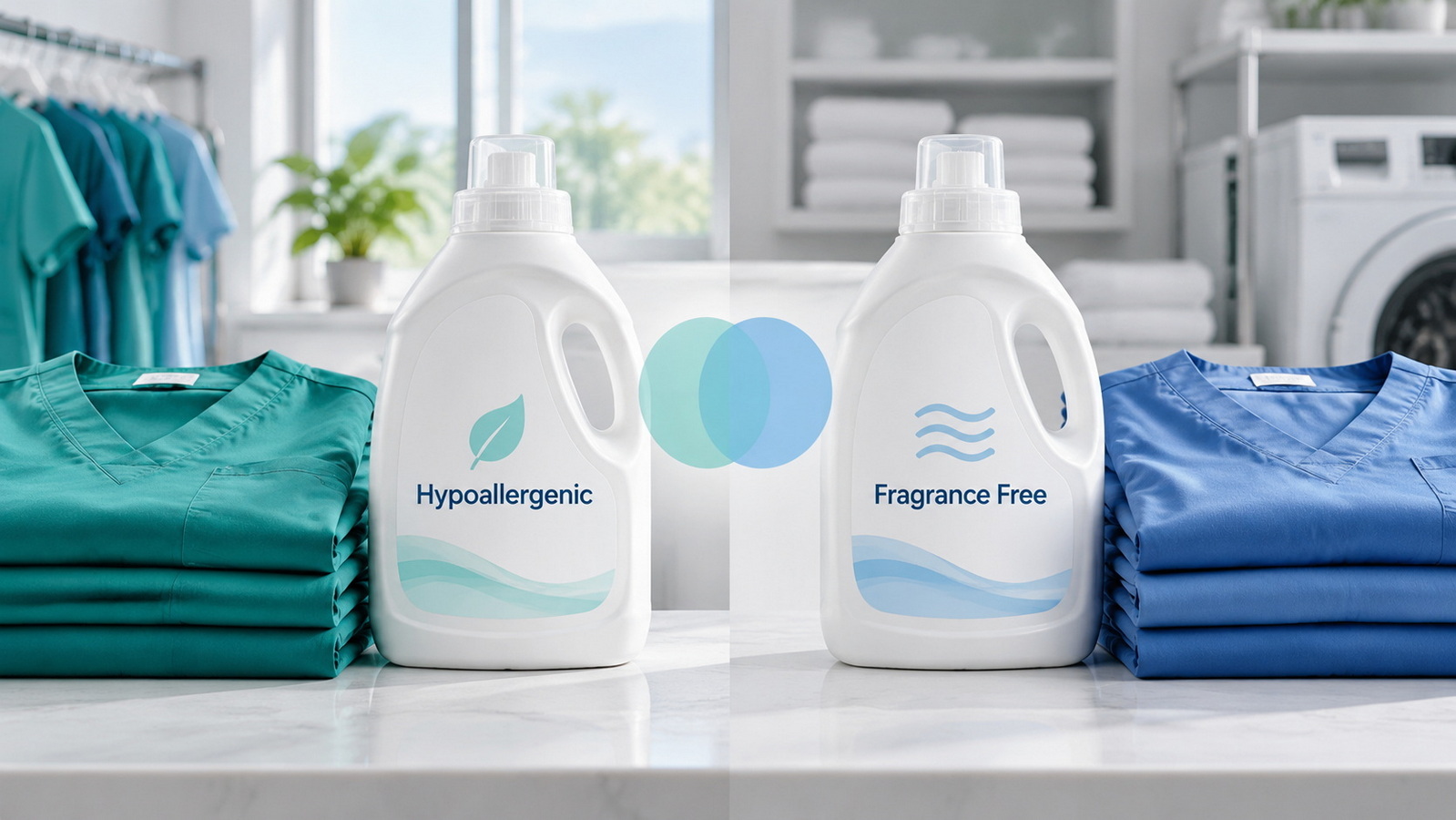
Choosing between hypoallergenic laundry detergent vs fragrance-free laundry detergent for healthcare uniforms starts with one distinction: these labels describe different qualities, not competing product categories. "Hypoallergenic" signals an intention to reduce allergic reactions. "Fragrance-free" addresses fragrance ingredients specifically. A detergent can be both.
For nurses, care workers, and uniform buyers, my starting recommendation is fragrance-free, preferably dye-free, followed by a careful review of cleaning performance, ingredient information, and claim substantiation. Neither label alone establishes that a product disinfects scrubs or suits every sensitive-skin wearer.
The right choice must satisfy three separate needs: wearer comfort, effective soil removal, and the healthcare facility's laundering requirements.
| Comparison point | Hypoallergenic laundry detergent | Fragrance-free laundry detergent |
|---|---|---|
| Main claim | Formulated with reduced allergy potential in mind | Formulated without fragrance materials |
| Can it contain fragrance? | Yes; verify the formulation | It should not, including masking fragrance |
| Guarantees no skin reaction? | No | No |
| Automatically dye-free? | No | No |
| Establishes cleaning strength? | No | No |
| Establishes disinfection? | No | No |
| Most useful purchasing evidence | Relevant irritation and sensitization assessments | Ingredient review and verified fragrance-free status |
| Best application | A substantiated sensitive-skin formulation | Avoiding fragrance exposure, including in sensitive-skin routines |
The practical conclusion is not to select one label and ignore the other. Look for a fragrance-free formula with credible supporting evidence for any additional hypoallergenic claim.
Hypoallergenic laundry detergent is generally positioned as less likely to cause allergic reactions. However, the word itself does not reveal which ingredients were excluded, who tested the finished product, or how the assessment was conducted.
From a formulation-review perspective, I would treat this claim as the beginning of an investigation—not the final purchasing decision.
Useful questions include:
- Was the finished formulation assessed, or only individual ingredients?
- Did the assessment address irritation, sensitization, or both?
- What dilution and exposure conditions were used?
- How many participants were involved?
- Does the report cover the exact formula being purchased?
Irritation and allergy are different issues. A product may irritate skin without causing an allergic response. Conversely, someone with a specific allergy may react to an ingredient that other users tolerate.
"Dermatologist-tested" also needs context. Ask for the test method and findings rather than assuming the phrase means universally suitable.
A hypoallergenic detergent may still contain perfume. That matters when the wearer already knows fragrance is a trigger or works under a fragrance-reduction policy.
Likewise, botanical or naturally derived fragrance should not automatically receive a sensitive-skin exemption. The relevant question is whether the formulation contains the wearer's triggers, not whether its ingredients sound natural.
Fragrance-free laundry detergent addresses a narrower, more specific formulation characteristic: the absence of fragrance materials.
This makes the claim particularly useful when fragrance avoidance is the purchasing priority. However, fragrance-free does not mean ingredient-free, irritation-free, or automatically suitable for every person.
These terms are not interchangeable.
An unscented product may contain ingredients that mask another odor. A fragrance-free product should not contain fragrance or masking scents. It may still have a mild smell from its functional ingredients.
For buyers seeking external verification, the U.S. Environmental Protection Agency offers an additional fragrance-free designation within its Safer Choice program. The general Safer Choice label alone does not establish fragrance-free status.
A fragrance-free formula can still contain dyes.
The American Academy of Dermatology recommends fragrance-free, dye-free detergent in its eczema-related laundry guidance. Although that guidance is not a healthcare-uniform laundering standard, it provides a useful ingredient-selection starting point for eczema-prone wearers.
Confirm both attributes independently rather than assuming one includes the other.
For fragrance-sensitive workers, a verified fragrance-free, dye-free detergent is generally a more directly relevant starting point than an unspecified hypoallergenic product.
For someone with a diagnosed ingredient allergy, however, neither front-label claim replaces checking the formula against their individual avoidance list.
| Situation | Practical selection priority |
|---|---|
| Known fragrance allergy | Fragrance-free formulation and individual allergen review |
| Eczema-prone wearer | Fragrance-free, dye-free detergent; clinical advice where needed |
| Facility fragrance-reduction policy | Formula documentation matching that policy |
| Heavy routine scrub soiling | Demonstrated cleaning performance under permitted wash conditions |
| Blood-contaminated protective clothing | Employer-controlled procedures, not household label comparisons |
| Private-label uniform-care range | Verified formulation claims plus application-specific testing |
This approach separates skin-comfort decisions from infection-control decisions. Both matter, but they require different evidence.
Neither hypoallergenic nor fragrance-free labeling tells you how effectively a detergent removes stains.
Healthcare uniforms may encounter sweat, body oils, cosmetics, food, and other soils. Performance depends on the complete formulation and the washing process—not whether clean clothing smells perfumed.
Cotton-rich scrubs, polyester blends, and stretch garments may behave differently during washing. A useful comparison should include:
- The actual uniform fabrics being purchased.
- Representative routine stains.
- The intended machine and loading conditions.
- Relevant water hardness.
- Label-directed detergent doses.
- Repeated washing, not just one demonstration.
Evaluate stain removal alongside color retention, fabric feel, and visible deposits. A detergent that performs well on one swatch under ideal conditions may not deliver the same result across a mixed uniform program.
A strong scent does not demonstrate soil removal or microbial safety. Equally, the absence of perfume does not mean a uniform remains dirty.
For procurement, assess cleanliness through defined performance criteria rather than a "fresh laundry" smell.
This is the most important boundary in the comparison.
Hypoallergenic detergent and fragrance-free detergent are not automatically disinfectants. Removing soil, reducing microbial contamination, and meeting a validated healthcare laundering process are related but distinct objectives.
CDC guidance describes healthcare laundry as a system involving handling, washing, drying, transport, and protection from recontamination. A detergent label cannot validate that entire system.
Ordinary uniforms worn like street clothing are not automatically personal protective equipment. However, garments contaminated with blood or other potentially infectious material require different handling.
Under the U.S. bloodborne pathogens standard, employers must arrange laundering of required protective equipment at no cost to employees. OSHA guidance also distinguishes ordinary scrubs from contaminated protective clothing.
Do not take contaminated protective garments home simply because a detergent is marketed for sensitive skin.
Do not prescribe one wash temperature for every healthcare uniform.
Appropriate conditions depend on garment instructions, facility policy, contamination risk, equipment, and the validated process. A consumer product's cold-water cleaning claim does not establish suitability for healthcare decontamination.
The following steps apply only when the employer permits home laundering and the garments do not require controlled contaminated-laundry handling.
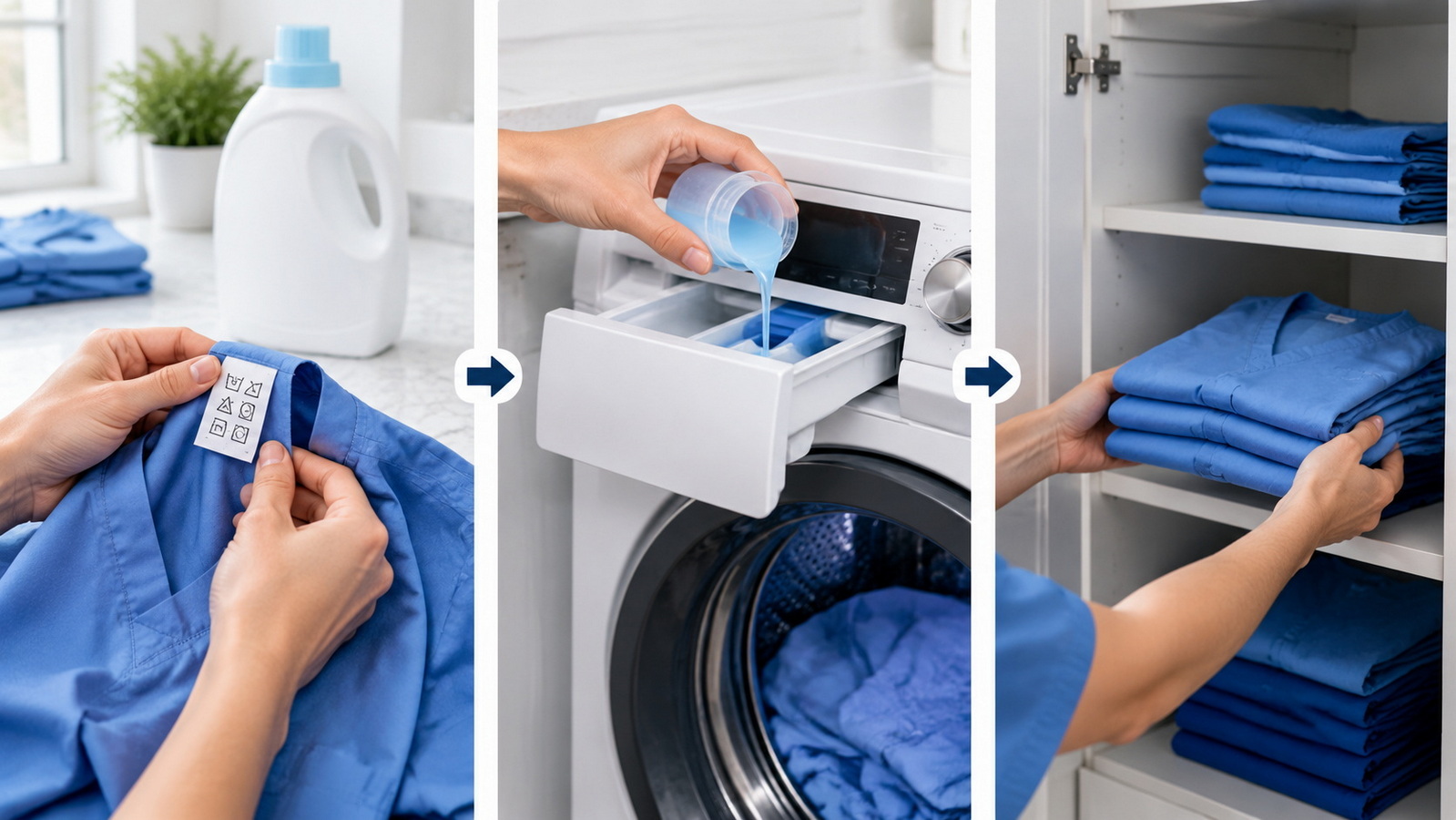
1. Check the rules first. Follow both employer instructions and the garment care label.
2. Choose a documented formula. Confirm fragrance-free and dye-free status where these attributes are required.
3. Measure the dose. Follow directions for load size, soil level, machine type, and water conditions. More detergent is not a substitute for an appropriate cycle.
4. Load the machine correctly. Leave enough room for garments to move and rinse effectively.
5. Avoid unnecessary scented additions. Fragranced softeners, scent boosters, and dryer sheets can undermine a fragrance-free routine.
6. Review rinsing if problems occur. Where permitted, investigate dose, loading, and rinse performance rather than assuming the detergent claim guarantees residue-free clothing.
7. Dry and store as directed. Protect cleaned uniforms from dirty laundry and contaminated surfaces.
If itching or rash persists, stop using the suspected product and seek medical assessment. Detergent is only one possible contributor; fabric, friction, sweat, and other exposures may also matter.
For uniform distributors and healthcare buyers, I recommend a structured pilot before a large purchasing commitment.
This is a proposed evaluation framework, not a published clinical trial or a substitute for infection-control validation.
Before comparing products, define:
- Permitted laundering arrangements.
- Fragrance and dye restrictions.
- Uniform fabric compatibility.
- Required supplier documentation.
- Cleaning-performance acceptance criteria.
- Any separately validated hygiene requirements.
Reject unsuitable candidates before comparing price.
Use comparable garments and soil conditions. Record water conditions, machine settings, load weight, and detergent dose. Use each product according to its directions rather than arbitrarily equalizing volumes.
Score:
- Visible stain removal.
- Odor after complete drying.
- Fabric appearance and feel.
- Visible deposits.
- Rewash frequency.
If collecting wearer feedback, make participation voluntary and provide a clear route for reporting discomfort. Do not deliberately expose workers to known allergens or present informal feedback as allergy testing.
Purchase price alone can conceal operational differences.
A useful calculation is:
Cost per acceptable wash=detergent, utilities, labor, and rewash costs/loads meeting acceptance criteria
This captures the commercial impact of rewashing and dosing—not simply the cost per bottle or sheet.
Laundry detergent sheets are a format, not a safety certification. They can be considered for permitted routine uniform laundering, but buyers should evaluate the finished product under its intended conditions.
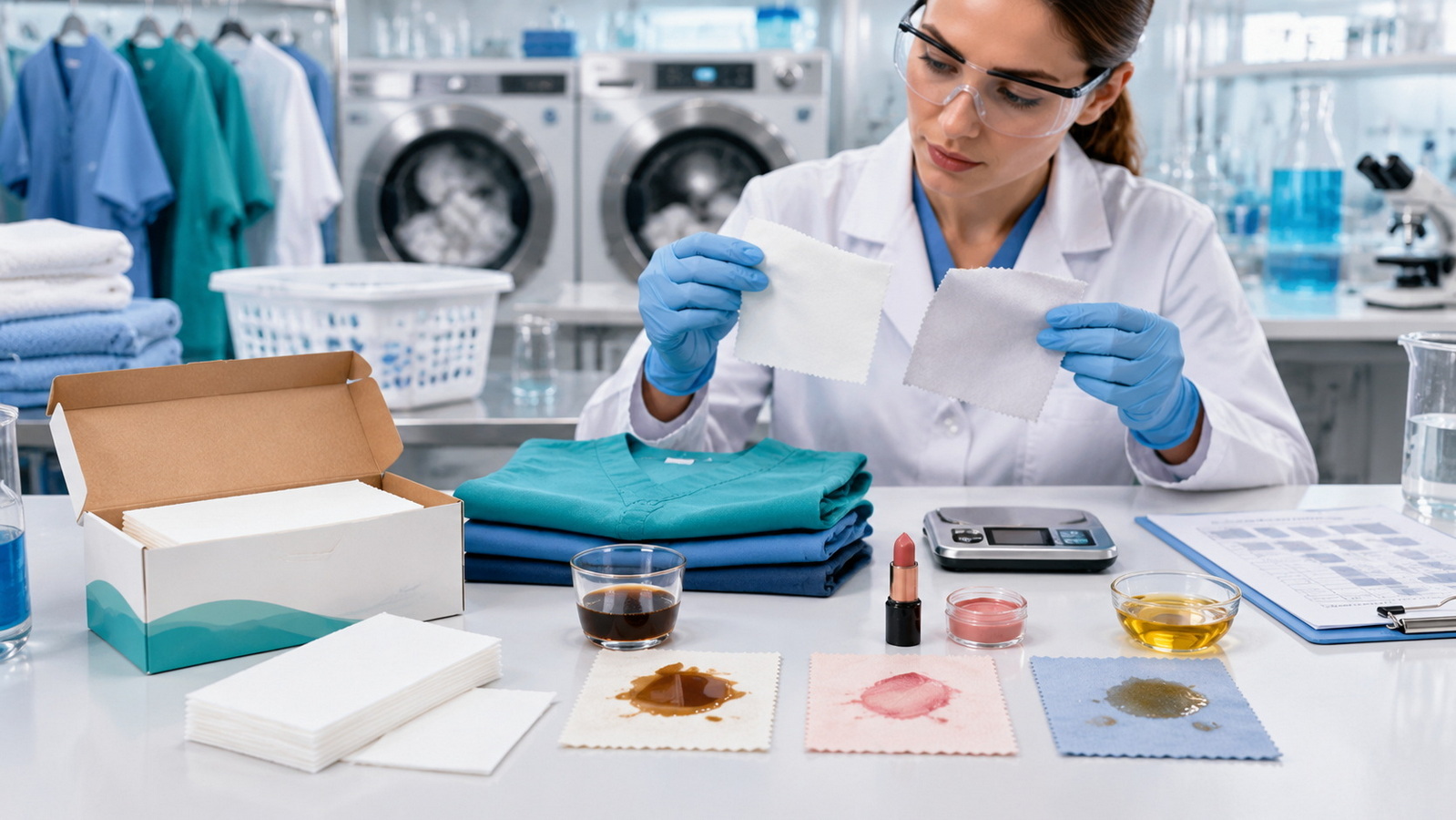
Check:
- Dissolution at the permitted wash temperature.
- Performance at the intended load size.
- Dose suitability across water conditions.
- Cleaning on actual scrub fabrics.
- Ingredient disclosure and claim evidence.
- Storage stability under expected conditions.
Do not assume sheets are automatically hypoallergenic, fragrance-free, residue-free, or suitable for institutional healthcare processes.
From a manufacturing perspective, the strongest product brief connects convenience with measurable performance and clearly defined use limitations.
Foshan Magic Crystal Technology Development Co., Ltd. develops, manufactures, and sells laundry detergent sheets and other clothing-care, household, personal, and pet-cleaning products.
According to company-provided information, the business operates more than three owned factories, has annual production capacity of 30,000–40,000 metric tonnes, and provides OEM/ODM services to over 300 brands. These figures describe company-reported scale, not independently verified healthcare qualifications.
For a healthcare-uniform care project, request a development proposal covering fragrance and dye restrictions, fabric performance, claim substantiation, packaging instructions, and intended-use boundaries.
Contact Foshan Magic Crystal with your target market, uniform fabrics, wash conditions, and packaging requirements to discuss a suitable OEM/ODM formulation and evaluation plan.
No. Confirm fragrance-free status separately. A hypoallergenic claim does not establish which fragrance ingredients, if any, are present.
Yes. Other ingredients or individual sensitivities may remain relevant. Fragrance avoidance reduces one category of exposure; it does not guarantee tolerance.
It can be. Cleaning ability depends on the formulation, dose, soil, and wash conditions—not added perfume.
Not automatically. Neither fragrance-free nor hypoallergenic labeling establishes antimicrobial effectiveness or validates a healthcare laundering process.
No. Follow employer policy. Contaminated protective garments require employer-controlled handling and must not be treated as ordinary home laundry.
Neither format is universally better. Compare cleaning, dissolution, dosing, fabric compatibility, and documented claims under the intended conditions.
1. American Academy of Dermatology. "How can I find eczema friendly products?" Guidance on fragrance-free versus unscented products and fragrance-free, dye-free laundry detergent.
[https://www.aad.org/public/diseases/eczema/childhood/triggers/friendly-products] [aad]
2. U.S. Environmental Protection Agency. "Safer Choice Standard and Criteria." Includes requirements for the additional fragrance-free designation.
[https://www.epa.gov/saferchoice/standard] [epa]
3. U.S. Environmental Protection Agency. "Learn About the Safer Choice Label." Explains product-performance, ingredient, and fragrance-free labeling considerations.
[https://www.epa.gov/saferchoice/learn-about-safer-choice-label] [epa]
4. Centers for Disease Control and Prevention. "G. Laundry and Bedding." Healthcare textile handling, laundering, and uniform-policy guidance.
[https://www.cdc.gov/infection-control/hcp/environmental-control/laundry-bedding.html] [cdc]
5. Occupational Safety and Health Administration. "29 CFR 1910.1030—Bloodborne Pathogens." Employer responsibilities for protective equipment and contaminated laundry.
[https://www.osha.gov/laws-regs/regulations/standardnumber/1910/1910.1030] [osha]
6. Occupational Safety and Health Administration. "Compliance with the OSHA Bloodborne Pathogens Standard," February 27, 2009. Clarifies ordinary uniforms, scrubs, and contaminated protective clothing.
[https://www.osha.gov/laws-regs/standardinterpretations/2009-02-27] [osha]


