
Views: 239 Author: Magic Household Cleaning Publish Time: 2026-10-09 Origin: Site
Content Menu
● What Does Hard Water Mean for Laundry?
● Laundry Detergent Sheet vs Powder Detergent for Hard Water
● How Hard Water Changes Detergent Performance
>> Why Builders Matter More Than Format
● Are Laundry Detergent Sheets Effective in Hard Water?
>> Advantages of Laundry Detergent Sheets
>> Limitations in Very Hard Water
>> Best Practice for Sheet Brands
● Why Powder Detergent Often Performs Well in Hard Water
>> Key Strengths of Powder Detergent
>> Powder Detergent Challenges
● Build for the Water, Not Just the Trend
>> A Practical OEM/ODM Development Checklist
>> The Evidence Standard Brands Should Demand
● How to Choose the Right Detergent for Hard Water
>> Choose Laundry Detergent Sheets When
>> Choose Powder Detergent When
>> Consider a Hybrid Strategy When
● Practical Hard-Water Laundry Routine
>> 1. Are laundry detergent sheets good for hard water?
>> 2. Why does hard water make clothes feel stiff?
>> 3. Is powder detergent better than laundry sheets for very hard water?
>> 4. Can I use two laundry detergent sheets in hard water?
>> 5. What ingredients should I look for in a hard-water laundry detergent?
>> 6. Does hard water damage washing machines?
>> 7. Should I use fabric softener in hard water?
Choosing between a laundry detergent sheet and powder detergent for hard water is not simply about convenience. In mineral-rich water, the formula's ability to manage calcium and magnesium can determine whether laundry comes out clean, bright, soft, and fresh—or dull, stiff, and coated with residue.
For buyers, brand owners, and private-label laundry businesses, the practical answer is nuanced: a well-formulated powder detergent usually offers more dosing flexibility and stronger builder capacity for very hard water, while a properly engineered laundry detergent sheet can be an attractive low-plastic, lightweight option for light-to-moderate daily loads in soft to moderately hard water. The key variable is not the format alone—it is the formulation, especially its surfactants, builders, chelants, enzymes, dissolution behavior, and recommended dose.
Hard water contains elevated levels of dissolved minerals, especially calcium and magnesium. The U.S. Geological Survey defines water hardness primarily by the amount of these dissolved minerals.
These minerals are not usually a direct health concern at typical household levels. However, they can create a major cleaning challenge in the wash drum. Calcium and magnesium compete with detergent ingredients, reduce surfactant efficiency, increase the risk of visible residue, and can contribute to scale inside washing machines over time.
For laundry, hard water often causes:
- Stiff towels and garments
- Dull whites and faded-looking colors
- White, gray, or chalky mineral residue
- Reduced stain-removal performance
- Persistent body-odor or oily-fabric buildup
- Higher detergent consumption
- Limescale accumulation in washers and plumbing
Consumer Reports notes that hard water can reduce cleaning performance, leave clothes stiff or dingy, and contribute to residue problems. Its hard-water testing uses water with approximately 300 ppm hardness, a demanding condition in which many detergent products lose cleaning effectiveness.
Water hardness is often reported as milligrams per liter—or ppm—as calcium carbonate equivalent.
| Water condition | Approximate hardness as CaCO₃ | Laundry implication |
|---|---|---|
| Soft water | 0–60 ppm | Most detergent formats can perform well at normal dose |
| Moderately hard water | 61–120 ppm | Formula quality and correct dosing become more important |
| Hard water | 121–180 ppm | Builders and chelants become essential for consistent results |
| Very hard water | More than 180 ppm | Strong mineral control, adjusted dosage, and washer maintenance are often needed |
If a customer does not know their water condition, they can check their local utility's Consumer Confidence Report, use a home test strip, or commission laboratory testing—especially when using well water.
Both formats can be engineered for good performance. However, their physical format creates different strengths and limitations when they are used in hard water.
| Comparison factor | Laundry detergent sheet | Powder detergent |
|---|---|---|
| Hard-water performance | Depends heavily on formula and fixed per-sheet dose | Often strong when formulated with effective builders |
| Dosing flexibility | Usually limited to half-sheet, one-sheet, or two-sheet increments | High; users can adjust dose by scoop or gram |
| Mineral-control capacity | Limited by the active load that fits in a thin sheet | Can accommodate substantial levels of builders and alkalinity sources |
| Dissolution | Must dissolve fully before or during the wash | Can dissolve well, but poor-quality powder may clump in cold water |
| Stain-removal potential | Suitable for everyday soil when formula includes effective surfactants and enzymes | Often strong for heavy soils, whites, and oxygen-bleach systems |
| Storage and shipping | Lightweight, compact, plastic-reduced packaging potential | Bulkier and may require moisture-protective packaging |
| Consumer convenience | Highly convenient and pre-portioned | Requires measuring and dry storage |
| Residue risk | Can occur if the sheet does not dissolve fully or mineral load exceeds formula capacity | Can occur when overdosed, poorly dissolved, or used without suitable hard-water builders |
| Best use case | Travel, small loads, routine washing, convenience-oriented users | Larger loads, heavily soiled laundry, highly mineralized water, adjustable dosing |
The most important takeaway: a detergent sheet is not automatically weak, and powder is not automatically superior. But in hard water, formula design and dosing control matter more than marketing claims about format.
Laundry detergents rely on surfactants to loosen oils, lift soils, and suspend dirt so it can be rinsed away. In hard water, calcium and magnesium can interfere with that process.
A detergent designed for hard water needs more than a basic surfactant package. It also benefits from a carefully balanced system of:
- Builders to modify water conditions and support cleaning
- Chelating or sequestering agents to bind metal ions
- Alkalinity sources to help remove acidic soils and oily residues
- Anti-redeposition agents to keep released dirt from settling back on fabric
- Enzymes for protein, starch, and body-soil removal
- Dissolution-supporting ingredients for cold-water and quick-cycle washing
The U.S. Environmental Protection Agency explains that detergent builders change water qualities so detergents can work more effectively. Builders may also raise alkalinity, soften water, and support surfactant cleaning performance.
In practical formulation work, builders are often the difference between a detergent that performs acceptably in soft water and one that performs reliably in hard water.
Common hard-water-supporting ingredients may include:
- Sodium carbonate, often used to increase alkalinity and support mineral control
- Sodium citrate or citric-acid-derived salts, which can assist with water conditioning
- GLDA, MGDA, or other chelating systems, depending on regional regulatory requirements and target positioning
- Zeolites, commonly used as water-softening builders in some powder formulations
- Polycarboxylates, often used to help disperse soils and control mineral deposition
The specific ingredient system should always be selected based on target-country regulations, desired environmental profile, detergent format, washing temperature, fragrance strategy, and intended retail price point.
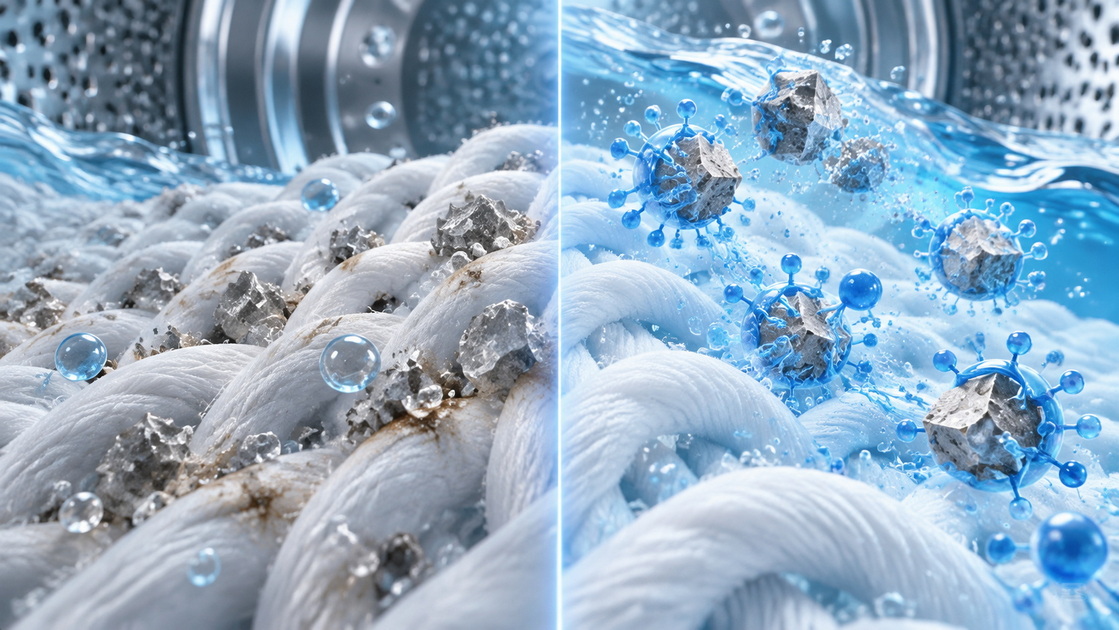
Laundry detergent sheets can work in hard water, but they are generally less forgiving than adjustable-dose detergent formats. A sheet has a pre-set amount of active ingredients. If the water has a high mineral load, the sheet may need to spend a greater share of its cleaning capacity managing calcium and magnesium before it can address stains, odor, body oils, and soil.
This does not mean every detergent sheet will fail. A high-quality hard water laundry detergent sheet can be formulated with suitable chelants, surfactants, enzymes, and dissolution technology. However, its performance should be verified through standardized wash testing rather than assumed from its compact size or eco-friendly positioning.
For many consumers and private-label brands, detergent sheets offer genuine commercial advantages:
- Compact and lightweight for e-commerce, travel, and storage
- Potentially lower packaging material use than traditional bottled liquid products
- Pre-measured dosing that can reduce accidental overuse
- Easy handling without spills, bulky bottles, or measuring caps
- Strong visual differentiation for sustainability-minded retail channels
- Suitable for OEM/ODM customization, including fragrance, color, sheet size, dissolving speed, enzyme system, and packaging design
For a manufacturer serving global brands, the sheet format is particularly valuable when it is positioned honestly: as a convenient, concentrated laundry format for defined water conditions and usage scenarios—not as a universal replacement for every detergent type.
Laundry detergent sheets may struggle when:
- The water hardness is high or very high
- The load is oversized
- The fabric contains heavy body oil, grease, mud, or food stains
- The wash cycle is very short
- The water temperature is extremely low
- The sheet is placed where water circulation is limited
- The formula has insufficient builder or chelant content
- Consumers underdose by using one sheet for a large family load
Independent testing by Consumer Reports found that detergent sheets in its ratings were ineffective in hard water and also under ordinary conditions. That result should not be treated as a verdict on every possible sheet formula; however, it is an important warning to manufacturers and buyers that sheet products require rigorous formula validation, particularly in high-hardness markets.
A responsible laundry sheet brand should provide hard-water-specific instructions, such as:
1. Use one sheet for small or lightly soiled loads in soft water.
2. Use a full or additional sheet only within the tested dosage range.
3. For hard water, recommend an approved water-softening booster when needed.
4. Place the sheet directly in the empty drum before loading garments, if validated for the washing-machine type.
5. Avoid overloading the washer.
6. Use the warmest fabric-safe water setting for heavy soil.
7. Provide transparent ingredient and performance information.
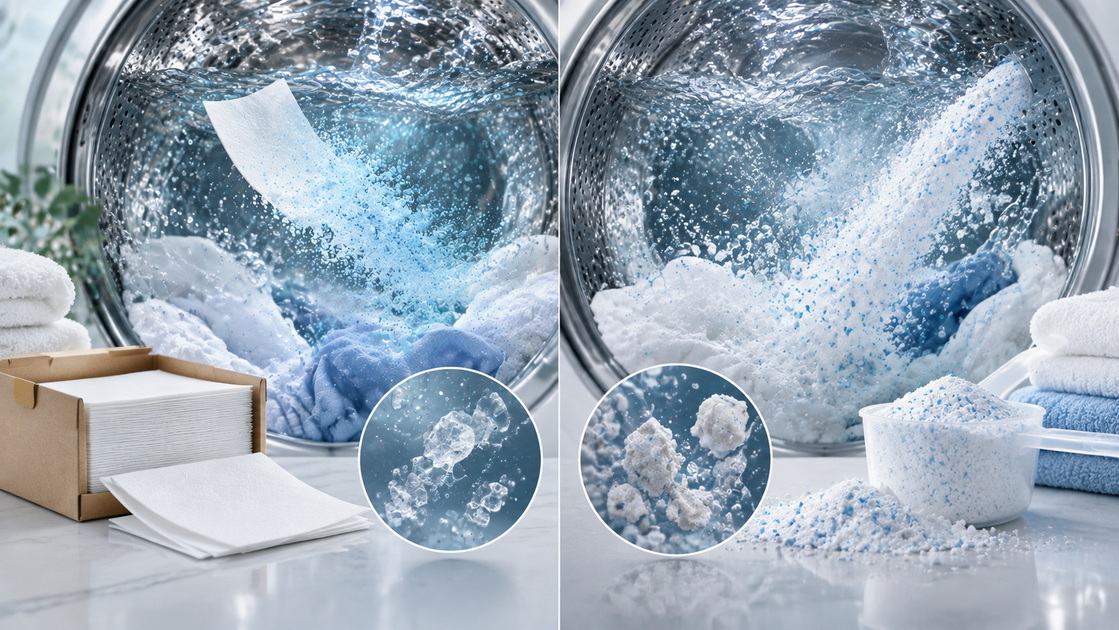
Powder detergent has remained relevant because it can accommodate a high level of solid cleaning ingredients. In hard-water markets, this can be a meaningful advantage.
A well-designed powder detergent may include a relatively robust builder system, oxygen bleach components, alkalinity support, enzymes, anti-redeposition polymers, and surfactants. Because powder can be dosed in variable amounts, consumers can adjust use according to both water hardness and soil level.
1. Flexible dosage
A powder scoop gives consumers more control. A lightly soiled load in moderately hard water may need less detergent than a large load of towels washed in very hard water.
2. Strong builder potential
Powder systems can be well suited for water-softening and alkalinity-supporting components. This is especially useful in regions where calcium and magnesium are common laundry performance barriers.
3. Good potential for whites and heavy soils
Powder can be an effective vehicle for oxygen-based bleaching ingredients, which can support whitening and stain removal when used according to garment-care instructions.
4. Lower water content in transport
Like sheets, powder is generally a dry format. That can reduce the shipment of water compared with conventional liquid detergents, although the full environmental comparison also depends on formula concentration, packaging, transport distance, consumer dosage, and manufacturing process.
Powder is not automatically residue-free. It can create problems when:
- It is overdosed
- It is used in cold water without adequate dissolution performance
- It is poured into the wrong machine compartment
- The formula lacks a suitable mineral-control system
- The washing machine is overloaded
- The product absorbs moisture during storage and clumps
For OEM and ODM product development, the correct question is not "sheet or powder?" It is: What performance result must this formula deliver at a specific hardness range, wash temperature, load size, and price point?
From a product-development perspective, the hard-water question should influence every stage of detergent design.
At Foshan Magic Crystal Technology Development Co., Ltd., product development for global OEM/ODM brands can be approached through a market-specific framework rather than a one-size-fits-all formula. With more than three self-owned factories, annual production capacity of approximately 30,000–40,000 metric tons, and OEM/ODM service experience for over 300 brands, the company can help brand owners evaluate format, formula, packaging, and consumer-use instructions together.
Before launching a laundry detergent sheet or powder detergent, brand owners should define:
- Target market: Which country, region, or retailer will sell the product?
- Typical water hardness: Is the target market soft, moderate, hard, or very hard?
- Washer type: Front-load, top-load, HE, semi-automatic, or hand wash?
- Laundry habits: Cold wash, warm wash, short cycle, family-size load, or travel use?
- Consumer priority: Deep cleaning, fragrance, sensitive skin, plastic reduction, premium appearance, or entry-level cost?
- Target claims: Phosphate-free, fragrance-free, enzyme-based, plant-derived, low-temperature dissolving, or hard-water-supporting?
- Compliance requirements: Ingredient restrictions, labeling rules, safety documentation, biodegradability expectations, and packaging regulations.
- Validation plan: Dissolution testing, stain-removal testing, odor testing, stability testing, packaging compatibility, and consumer-use evaluation.
A credible hard-water claim should be supported by test evidence rather than general copywriting. Depending on the market, brand owners should request or conduct:
- Detergency testing at multiple hardness levels
- Cold-water dissolution testing
- Residue and rinseability assessment
- Fabric-whiteness or anti-graying evaluation
- Stain-removal testing on sebum, protein, starch, pigment, and grease soils
- Fragrance stability testing
- Packaging humidity-resistance testing for powder products
- Sheet integrity and dissolution testing for detergent sheets
- Safety and regulatory document review
Strong marketing starts with verified performance. A sheet product that is outstanding in light daily washing should be presented that way. A powder designed for mineral-heavy water should explain its dosing and builder benefits clearly. Accurate positioning protects consumer trust and reduces negative reviews.
Use this simple decision process when selecting a format.
- Your water is soft to moderately hard
- You wash mainly everyday clothing with light-to-medium soil
- You value compact storage and simplified dosing
- You need a travel-friendly or e-commerce-friendly format
- The brand provides clear hard-water dosing instructions
- The formula has been verified for dissolution and cleaning performance
- Your water is hard or very hard
- You wash large family loads
- You frequently clean towels, bedding, sportswear, uniforms, or workwear
- You need stronger dosing flexibility
- You want a builder-rich formula designed for mineral-heavy water
- You need strong whitening or heavy-soil performance
- You want detergent sheets for convenience but live in a hard-water area
- You need a laundry booster for towels, whites, or heavily soiled items
- You want to market one sheet product for daily use and one powder product for intensive cleaning
- You serve multiple countries with different water conditions
For many private-label brands, a two-product strategy can be more credible than forcing one format into every use case:
- Laundry detergent sheets: Daily convenience, compact storage, travel, and standard loads.
- Hard-water powder detergent: Deep cleaning, heavy soil, large loads, whites, towels, and mineral-rich regions.
Even the best detergent benefits from correct use. Consumers can improve results with the following routine:
1. Test the water hardness. Check a local water report or use a household test strip.
2. Read the detergent's hard-water dosing guide. Do not automatically use the minimum amount shown for soft water.
3. Avoid overloading the drum. Laundry needs room for water circulation and rinsing.
4. Use the warmest fabric-safe temperature for heavily soiled loads. Higher temperatures can improve cleaning and help dissolve some detergent systems.
5. Use an extra rinse when residue is visible. This may be especially useful for towels, bedding, and sensitive-skin households.
6. Maintain the washing machine. Follow appliance guidance for periodic cleaning to control mineral buildup and detergent residue.
7. Do not add more detergent blindly. Excess detergent can worsen residue problems. First check water hardness, product dosage, washer load size, and product compatibility.
For the comparison of laundry detergent sheet vs powder detergent for hard water, powder detergent is usually the more dependable format for highly mineralized water because it can offer stronger builder systems and more flexible dosing. However, laundry detergent sheets remain a valuable modern format when the formula is designed for the intended hardness level and the consumer receives clear use instructions.
The best product is not defined by whether it comes as a sheet or powder. It is defined by whether it delivers reliable cleaning, complete dissolution, low residue, safe handling, and truthful performance claims in the real water conditions of its target market.
For global brands developing a customized laundry care range, Foshan Magic Crystal Technology Development Co., Ltd. can support OEM/ODM laundry detergent sheets, powder detergents, household cleaners, personal-care cleaning products, and pet-care cleaning products with market-oriented formulation and packaging development.

Looking for a hard-water-ready private-label laundry solution? Contact our team to discuss your target market, water-hardness profile, formula requirements, fragrance direction, packaging concept, and OEM/ODM project goals.
Laundry detergent sheets can work in hard water, but performance depends on the sheet's formula, active-ingredient level, builder and chelant system, wash temperature, load size, and dosage. In very hard water, a powder detergent or a sheet combined with an appropriate booster may deliver more consistent results.
Hard-water minerals, especially calcium and magnesium, can contribute to mineral deposits and interfere with rinsing. Combined with body oils, soil, and residual detergent, this buildup can leave fabrics feeling rough, stiff, dull, or less absorbent.
Often, yes. Powder detergent may offer more adjustable dosing and can be formulated with substantial builder systems that help manage mineral-rich water. However, the actual performance depends on the complete formula, not only the format.
Only use an additional sheet if the product's label or manufacturer specifically permits it. More detergent is not always better. Overdosing can increase residue, reduce rinse performance, and leave fabrics feeling less clean.
Look for a balanced formula that may include surfactants, builders, chelating agents, enzymes, alkalinity support, and anti-redeposition ingredients. Common hard-water-supporting ingredients can include citrate-based water conditioners, carbonate-based builders, and compatible chelant systems.
Hard water can contribute to limescale deposits in washers, water heaters, showerheads, and plumbing. When hard water is heated, calcium carbonate deposits can form and may lower appliance efficiency or contribute to maintenance needs over time.
Fabric softener may improve feel temporarily, but it can also coat fibers. If clothes remain stiff or dull, it is better to first address water hardness, detergent dosing, rinsing, and washer maintenance rather than relying only on softener.
1. U.S. Geological Survey. "[Hardness of Water]." Defines water hardness primarily as dissolved calcium and magnesium. [usgs]
2. U.S. Environmental Protection Agency. "[Frequently Asked Questions on Safer Choice]." Explains the role of surfactants and builders in cleaning products, as well as ingredient-review and performance requirements under the Safer Choice program. [epa]
3. U.S. Environmental Protection Agency. "[EPA's Safer Choice and Design for the Environment Standard]." Defines detergent builders and describes their functions, including hardness inactivation, alkalinity support, sequestration, precipitation, ion exchange, and soil anti-redeposition. [downloads.regulations]
4. Consumer Reports. "[Best Laundry Detergents for Hard Water]." Provides test-based discussion of hard-water laundry performance, testing around 300 ppm hardness, detergent performance variation, and sheet-detergent limitations in its evaluations. [consumerreports]
5. Consumer Reports. "[Do Laundry Detergent Sheets Work as Well as Liquid?]." Discusses Consumer Reports' testing observations on laundry detergent sheet cleaning performance. [consumerreports]
6. U.S. Environmental Protection Agency. "[Safer Choice]." Provides background on the EPA program for products designed to perform while using ingredients evaluated for safer human-health and environmental characteristics. [epa]


