
Views: 259 Author: Magic Household Cleaning Publish Time: 2026-09-30 Origin: Site

Content Menu
● What Are Laundry Washing Sheets and Laundry Pods?
● Why Consumer Preferences Are Shifting
● Laundry Detergent Sheets vs Pods
>> Cleaning Performance and Stain Removal
>> Dosing Control and Load Flexibility
>> Cold-Water Dissolution and Washing Machine Compatibility
● Packaging Is Only One Part of the Story
● Safety and Household Considerations
● Consumer Preference by Buyer Persona
● How Brands Can Develop Better Laundry Sheets
>> The Future Is Performance-Led Sustainability
● Are Laundry Sheets Better Than Pods?
● FAQ
>> 1. Are laundry detergent sheets as effective as pods?
>> 2. Do laundry sheets dissolve in cold water?
>> 3. Are laundry detergent pods safer than detergent sheets?
>> 4. Are laundry sheets more sustainable than pods?
>> 5. Can I use laundry detergent sheets in an HE washing machine?
>> 6. Which is more cost-effective: laundry sheets or pods?
Laundry washing sheets vs pods is no longer just a packaging comparison. For consumers, the decision increasingly involves cleaning performance, ease of use, sustainability, safety, storage, skin preferences, and value per load. For brands and private-label buyers, it also involves formulation quality, product claims, packaging design, manufacturing consistency, and the ability to meet different regional consumer expectations.
As a manufacturer specializing in Laundry Detergent Sheets and other household, personal-care, and pet-cleaning products, Foshan Magic Crystal Technology Development Co., Ltd. sees this shift firsthand. With more than three self-owned factories, annual production capacity of approximately 30,000–40,000 tons, and OEM/ODM services for over 300 global brands, the company recognizes that there is no universal "winner" between detergent sheets and pods. The best format depends on the consumer's laundry habits, household profile, washing machine, sustainability priorities, and cleaning expectations.
This guide provides a practical, evidence-based comparison of laundry detergent sheets vs pods, helping brand owners, retailers, and consumers understand where each format performs best—and where product development can create a meaningful competitive advantage.
Laundry washing sheets are thin, pre-measured sheets made with concentrated detergent ingredients. They are usually designed to dissolve in water and release surfactants, builders, enzymes, fragrance, and other cleaning components during a wash cycle. Consumers may also call them detergent strips, laundry strips, or detergent squares.
Laundry pods—also known as pacs or capsules—are water-soluble packets that contain concentrated liquid, gel, or multi-chamber detergent. Some pod formulas combine detergent with stain removers, brighteners, fabric-care agents, or fragrance boosters in separate compartments.
Both formats are designed to simplify dosing. However, they offer different experiences.
| Feature | Laundry Washing Sheets | Laundry Pods |
|---|---|---|
| Physical format | Thin dissolvable detergent sheet | Water-soluble packet containing liquid or gel |
| Dosing flexibility | Often can be torn for small loads | Usually one pod for a standard load |
| Storage footprint | Flat, lightweight, compact | Compact but bulkier than sheets |
| Packaging potential | Often paper-based or reduced-plastic packaging | Usually plastic tubs, bags, or containers |
| Heavy-stain capability | Depends heavily on formula and dosage | Often strong due to concentrated liquid formulas |
| Cold-water dissolution | Formula and sheet construction are critical | Usually reliable when placed correctly in the drum |
| Child-safety concern | Must still be stored securely | Higher concern because pods can look appealing to children |
| Consumer appeal | Minimalist, low-waste, travel-friendly | Familiar, convenient, “premium cleaning” perception |
Consumer demand for laundry products is moving toward convenience, reduced packaging, measurable performance, and ingredient transparency. The sheet category has benefited from consumers looking for lightweight, space-saving alternatives to traditional liquid bottles. Pods remain attractive because they are familiar, easy to use, and widely associated with concentrated cleaning power.
A 2025 European consumer study of 304 respondents found that 72% of participants actively considered sustainability in detergent purchasing decisions. The study also reported a preference for sustainability-related attributes—especially reduced plastic packaging and renewable surfactants—over some conventional product attributes such as washing temperature and efficiency.
This does not mean that consumers have stopped caring about cleaning results. In fact, it means that brands need to deliver both:
- Reliable stain removal
- Convenient pre-measured dosing
- Compact packaging
- Clear safety instructions
- Credible environmental claims
- A formula that works in the consumer's normal wash conditions
For a private-label buyer, this creates an important development opportunity: launch a laundry sheet product that does not rely solely on "plastic-free" messaging, but also demonstrates cleaning effectiveness, cold-water dissolution, fragrance quality, and textile compatibility.
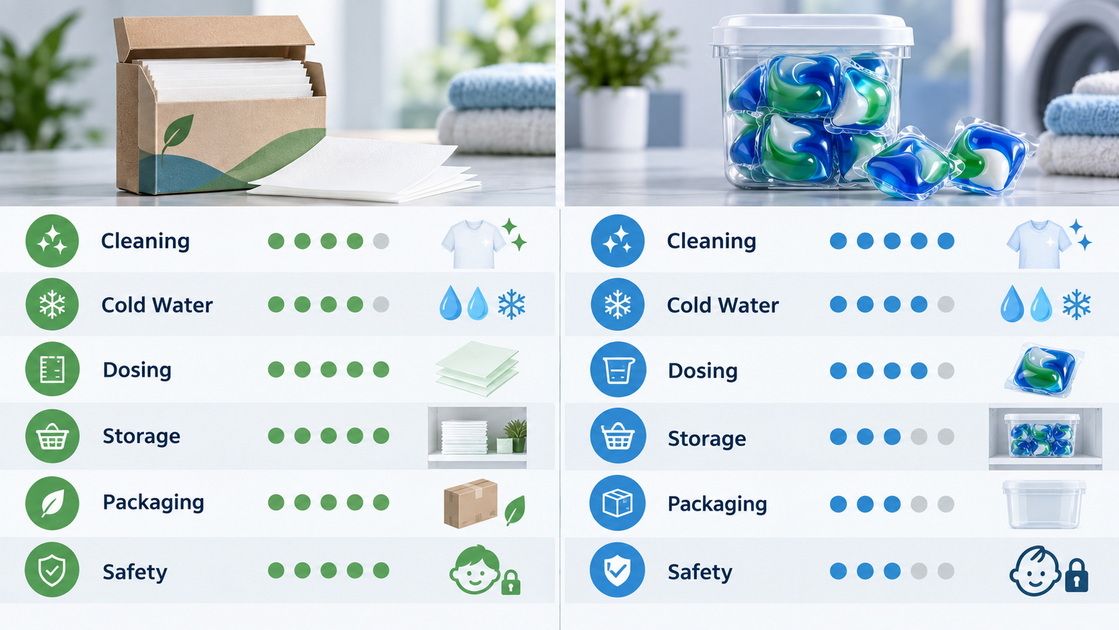
Pods often hold an advantage in consumer perception for difficult laundry loads. Their liquid or gel format can accommodate highly concentrated active ingredients and multi-chamber formulas. This makes pods especially popular among households with children, athletes, pets, or frequent heavily soiled laundry.
Independent product testing has found that laundry detergent sheets can vary substantially in cleaning performance. Consumer Reports describes detergent sheets as concentrated, low-sudsing products designed to dissolve in hot or cold water, but its testing has also indicated that sheets as a category may not clean as strongly as leading liquid and pod products under tough stain-testing conditions.
Wirecutter similarly reported that the laundry sheets it tested performed poorly compared with recommended liquid, powder, and pod detergents, particularly in cold water.
This is an essential product-development lesson: format alone does not determine cleaning quality. A high-performing detergent sheet needs a well-balanced formula, suitable surfactant system, adequate active content, strong film or carrier technology, consistent sheet weight, and reliable dispersion in the wash.
For brands creating an OEM or ODM line, it is better to avoid unsupported claims such as "stronger than all pods." Instead, make claims that can be validated through product testing, such as:
- "Designed for everyday laundry"
- "Dissolves in cold, warm, and hot water"
- "Suitable for HE and standard washing machines"
- "Pre-measured for convenient dosing"
- "Effective on common daily soils when used as directed"
One of the strongest advantages of laundry detergent sheets is dose flexibility. Many sheets can be torn or cut into portions for small loads, handwashing, or lightly soiled garments. This can be particularly useful in apartments, dormitories, RVs, hotels, laundromats, and travel settings.
Pods are extremely convenient, but they are less flexible. A consumer generally uses one pod for a standard load and may need two or more for a larger or heavily soiled load, depending on the label instructions. This makes pods easy for routine laundering, but less adaptable for small loads.
| Consumer Scenario | Better Option | Why |
|---|---|---|
| Small daily load | Laundry sheets | A sheet may be divided for lighter loads, depending on product directions |
| Large family load | Pods or high-dose sheets | Stronger dosage and stain-removal capacity may be needed |
| Travel and camping | Laundry sheets | Lightweight, flat, compact, and spill-resistant |
| College dorm | Laundry sheets or pods | Both are easy to carry; sheets save more storage space |
| Heavy sportswear | Pods | Often preferred for concentrated stain and odor treatment |
| Handwashing | Laundry sheets | A portion can be used more flexibly if the formula is suitable |
| Subscription delivery | Laundry sheets | Lower shipping volume and compact packaging can improve logistics efficiency |
For product managers, this suggests a useful segmentation strategy. Instead of positioning sheets as a total replacement for all pods, position sheet products around specific moments of use:
- Everyday clothes and lightly soiled loads
- Small households
- Urban apartments
- Travelers
- Sustainability-focused consumers
- Subscription and e-commerce buyers
- Users with limited storage space
Cold-water washing is increasingly important because it can reduce energy use and is generally suitable for many everyday laundry loads. The U.S. Department of Energy states that using cooler water reduces washing energy use, and notes that warm or cold water will generally clean well unless the load includes oily stains.
The U.S. Environmental Protection Agency also notes that water heating accounts for about 90% of the energy required to run a clothes washer, while newer detergent formulations can be effective in cold water.
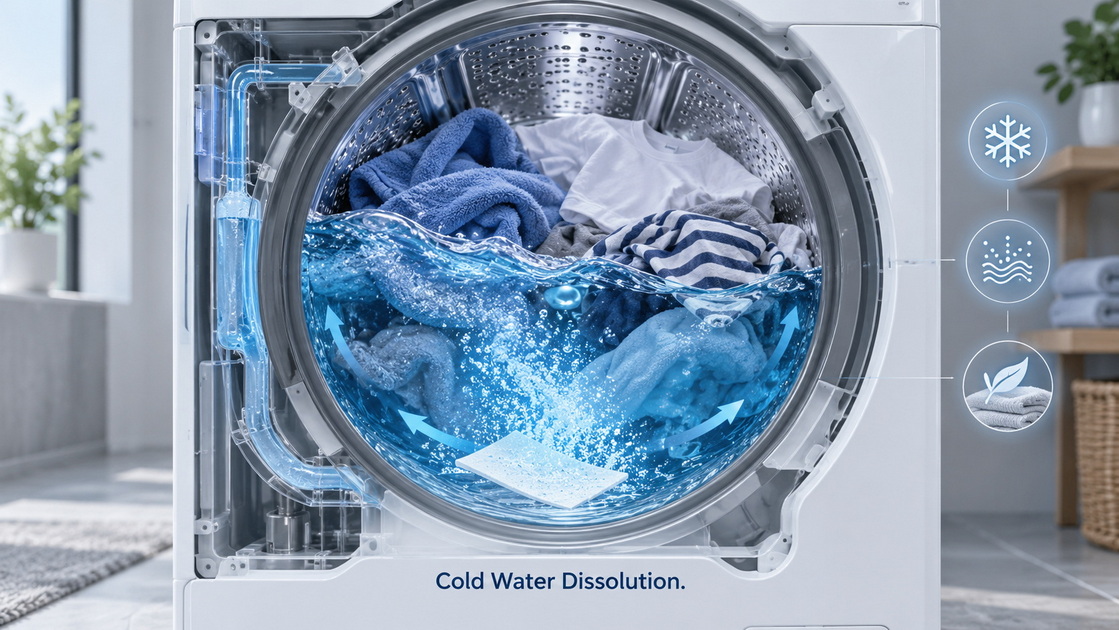
However, cold water creates one of the biggest technical challenges for laundry detergent sheets. A poorly designed sheet may dissolve slowly, leave residue, or fail to distribute active ingredients evenly—especially in short cycles, overloaded washers, or very cold water.
For consumers using sheets, the following practices can improve results:
1. Place the sheet directly in the empty drum before adding garments, unless the product label states otherwise.
2. Avoid placing the sheet in a dispenser drawer unless the product specifically supports this use.
3. Tear the sheet into smaller pieces for very cold water, short cycles, or large loads when recommended by the manufacturer.
4. Do not overload the washing machine, because poor water circulation can reduce dissolution.
5. Select a product formulated and tested for cold-water use.
For pods, the American Cleaning Institute recommends placing the packet at the bottom or back of the washing machine drum before adding clothes. It advises against placing packets in the dispenser drawer.
This section is particularly important for brands selling in North America, Europe, and other markets where cold washing and high-efficiency machines are common. A premium laundry sheet should be tested across:
- Cold, warm, and hot water
- Front-load and top-load washing machines
- HE and standard machines
- Short cycles and normal cycles
- Soft water and hard water
- Light, regular, and heavily soiled loads
Laundry detergent sheets are commonly associated with reduced packaging because they can be sold in small cardboard envelopes or recyclable paper-based cartons. Their compact size can also reduce product volume during storage and transport.
The American Cleaning Institute has noted that concentrated detergent products, including sheets, may help reduce water consumption, transportation-related emissions, and packaging material when combined with compact, lightweight packaging.
However, a responsible sustainability message must go beyond a simple "plastic-free" claim. A product's environmental profile depends on several factors:
- Formula concentration
- Ingredient sourcing
- Packaging material and recyclability
- Manufacturing energy use
- Transport distance and shipping weight
- Washing temperature
- Product dosage
- Product performance per load
- Whether consumers need to rewash clothing due to poor cleaning
This is why brands should avoid implying that every sheet is automatically more sustainable than every pod. The more credible message is that a compact, concentrated, well-performing laundry sheet can reduce packaging and transportation burdens when it is formulated, dosed, and used effectively.
For brands targeting environmentally conscious consumers, consider supporting claims with measurable proof:
- Packaging weight reduction versus a defined baseline
- Number of loads per carton
- Recyclability instructions by market
- Ingredient disclosure
- Third-party certifications where applicable
- Cold-water performance data
- Concentration or active-content information
The EPA's Safer Choice program helps consumers identify products containing ingredients that are safer for human health and the environment, while also considering product performance. Manufacturers should only use EPA-related claims after completing the applicable formal review and approval process.
Both laundry sheets and pods are concentrated cleaning products and should be stored safely. However, pods require especially clear child-safety communication because their colorful, glossy appearance may be attractive to young children.
The American Cleaning Institute advises keeping liquid laundry packets out of the reach and sight of children, storing them in their original container, using dry hands, keeping the container tightly closed, and never allowing children to handle them.
Laundry sheets should also be stored securely, especially in households with children or pets. A flatter paper carton does not eliminate safety responsibility. Brands should include clear label instructions for:
- Secure storage
- Keeping products away from children and pets
- Avoiding ingestion and eye contact
- Handwashing after handling, when applicable
- Following garment-care and washing-machine instructions
- Contacting local poison-control services in case of exposure
From a UX and packaging-design perspective, these instructions should be easy to find—not buried in tiny text. Use icons, plain language, high-contrast warning panels, and market-specific compliance labeling.
The following framework can help brands decide whether sheets, pods, or a dual-format portfolio is the strongest commercial strategy.
| Consumer Persona | Likely Preference | Product Opportunity |
|---|---|---|
| Eco-conscious urban shopper | Laundry sheets | Compact cardboard packaging, low-plastic positioning, cold-water instructions |
| Busy family with children | Pods | Strong cleaning, easy dosing, secure child-resistant packaging |
| Apartment resident | Laundry sheets | Space-saving storage and reduced carrying weight |
| Frequent traveler | Laundry sheets | Portable, lightweight, no spill risk |
| Value-focused shopper | Depends on price per load | Clear cost-per-load comparison and reliable daily cleaning |
| Sensitive-skin shopper | Depends on formula | Fragrance-free, transparent ingredient communication, dermatological testing where substantiated |
| Sportswear household | Pods or advanced enzyme sheets | Odor control, stain-removal testing, performance positioning |
| Online subscription customer | Laundry sheets | Mail-friendly packaging and repeat-delivery convenience |
The strongest product portfolio may include both options. Laundry sheets can attract sustainability- and convenience-focused consumers, while pods can serve households that prioritize intensive cleaning and familiar format expectations.
For OEM/ODM buyers, the competitive opportunity is not merely producing a thin detergent strip. It is producing a sheet that answers the weaknesses consumers and reviewers often identify: uneven dissolution, insufficient stain removal, residue concerns, weak fragrance retention, and unclear dosing guidance.
A high-quality laundry detergent sheet development program should include:
1. Performance benchmarking
Compare the formula with leading pod, liquid, and powder products on standardized stains such as body oil, grass, coffee, chocolate, dirt, and food oils.
2. Cold-water dissolution testing
Test under low-temperature conditions, short cycles, and high-efficiency machines. Consumers increasingly wash in cold water, so dissolution cannot be an afterthought.
3. Sheet-strength optimization
The product must remain stable during packing, shipping, and consumer handling, yet dissolve efficiently during use.
4. Clear dosage architecture
Use perforation, half-sheet guidance, and precise load recommendations to make consumer decisions easy.
5. Packaging engineering
Protect sheets from moisture while reducing unnecessary packaging material. The best carton design balances shelf appeal, moisture resistance, safety, and logistics efficiency.
6. Claim substantiation
Validate claims before printing them on packaging or product pages. "Cold-water effective," "tough on stains," "low-sudsing," "HE compatible," and "plastic-free packaging" should all be supportable.
The category is moving away from simple format marketing. Consumers may initially try laundry sheets because the product looks modern, compact, and environmentally responsible. But repeat purchase will depend on whether the product cleans clothes reliably.
For this reason, the future of laundry detergent sheets belongs to suppliers and brands that combine:
- Low-packaging, compact design
- Verified cold-water solubility
- Competitive everyday cleaning performance
- Clear, responsible safety communication
- Transparent ingredient and claim information
- Flexible OEM/ODM customization
A detergent sheet should not ask consumers to sacrifice performance for convenience. It should make everyday laundry easier while delivering results consumers can trust.
Laundry washing sheets are often better for consumers who value compact storage, lightweight transport, reduced packaging, travel convenience, and flexible dosing for light or standard laundry loads. Pods are often better for consumers who prioritize familiarity, quick use, and concentrated cleaning for tough stains or heavily soiled family laundry.
The best choice depends on the consumer's laundry reality.
For brands, the strategic answer is more nuanced: laundry sheets represent a strong growth category, but only when the formula is engineered for real-world performance. A superior sheet product must dissolve quickly, clean effectively, work across wash temperatures, and communicate its benefits honestly.
Foshan Magic Crystal Technology Development Co., Ltd. supports global brands with OEM/ODM development for laundry detergent sheets, laundry-care products, household cleaning products, personal-care products, and pet-cleaning solutions. With more than three self-owned factories and annual capacity of 30,000–40,000 tons, we help customers develop market-ready products that balance formula performance, packaging innovation, sustainability priorities, compliance needs, and brand differentiation.

Looking to create a competitive laundry detergent sheet or pod line for your market? Contact our team to discuss formula customization, packaging options, fragrance development, sample testing, private-label solutions, and scalable OEM/ODM production.
Laundry detergent sheets can be effective for everyday laundry, but performance varies by formula, dosage, water temperature, and wash cycle. Independent testing has found that some sheets perform less strongly than leading pods and other traditional detergents on difficult stains, particularly in cold water. A well-developed sheet formula, however, can provide dependable cleaning for normal household laundry.
Many laundry sheets are designed for cold-water washing, but dissolution performance can vary. Cold water, short cycles, machine overloading, and sheet construction can affect how quickly a sheet dissolves. Consumers should follow the package directions and place sheets directly in the drum when instructed.
Both products must be stored away from children and pets. Pods require special caution because liquid packets can cause injury if ingested or exposed to the eyes. The American Cleaning Institute recommends storing laundry packets in their original closed container, out of sight and reach of children, and handling them only with dry hands.
Laundry sheets can reduce packaging material and shipping volume because they are lightweight and compact. However, sustainability depends on the full product lifecycle, including formula performance, ingredient selection, packaging, transport, dosage, and whether consumers need to rewash garments. A high-performing concentrated sheet with reduced packaging can offer meaningful environmental advantages.
Many laundry detergent sheets are compatible with high-efficiency washing machines because they are low-sudsing and concentrated. However, consumers should always check the product label for HE compatibility and follow the manufacturer's placement and dosing instructions.
The most useful comparison is the cost per effective load, not simply the retail price. A product that costs less but requires extra sheets, repeat washing, or additional stain treatment may not deliver the best value. Brands should clearly state the number of loads per pack and provide realistic dosing instructions.
1. American Cleaning Institute. "[Liquid Laundry Packet Safety Tips]." Guidance on safe storage, handling, and use of liquid laundry packets. [cleaninginstitute]
2. American Cleaning Institute. "[Laundry]." Laundry-care and safe-storage information. [cleaninginstitute]
3. Consumer Reports. "[Do Laundry Detergent Sheets Work as Well as Liquid?]." Overview of detergent-sheet composition and independent performance testing. [consumerreports]
4. Consumer Reports. "[Best and Worst Laundry Detergents of 2026]." Description of stain-testing methodology and cleaning-performance evaluation. [consumerreports]
5. CNN Underscored. "[Best Laundry Detergent Sheets, Tested and Reviewed]." Testing observations on dissolving behavior, cleaning, and the compact-product sustainability perspective. [cnn]
6. European Commission-style academic evidence via Sustainability (MDPI). "[Assessing European Consumers' Willingness to Pay for Sustainable Laundry Detergents]." Consumer survey findings on sustainability-related detergent preferences. [mdpi]
7. U.S. Department of Energy. "[Laundry]." Guidance on reducing laundry energy use through cooler water settings. [energy]
8. U.S. Environmental Protection Agency. "[WaterSense at Work: Laundry Equipment]." Information on water heating energy and cold-water washing. [epa]
9. U.S. Environmental Protection Agency. "[Safer Choice]." Overview of EPA's voluntary program for products with safer chemical ingredients and performance considerations. [epa]
10. U.S. Environmental Protection Agency. "[Safer Chemical Ingredients List]." Requirements and limitations related to Safer Choice ingredient and product claims. [epa]
11. The New York Times Wirecutter. "[Laundry Detergent Sheets Are Poor Cleaners. And Their Environmental Benefits Are Debatable.]." Independent testing perspective on detergent-sheet cleaning, particularly in cold water. [nytimes]


