
Views: 258 Author: Magic Household Cleaning Publish Time: 2026-09-27 Origin: Site

Content Menu
● What Is Paper Laundry Detergent?
● What Is Plastic Bottle Detergent?
● Paper Laundry Detergent vs Plastic Bottle Detergent at a Glance
● Packaging Waste and Environmental Considerations
>> Evaluate the Whole Product System
>> Factors That Influence Detergent Sheet Cleaning Results
>> How to Improve Sheet Performance in Cold Water
● Convenience, Dosage, and Consumer Experience
>> Advantages of Pre-Measured Sheets
● A Practical Product Development Checklist for Brands
>> Seven Questions to Ask Before Developing Laundry Sheets
● Regulatory and Ingredient Transparency
● Which Format Should You Choose?
● Build a Better Laundry Detergent Product
>> 1. Are paper laundry detergent sheets better than plastic bottle detergent?
>> 2. Do laundry detergent sheets work in cold water?
>> 3. Are detergent sheets suitable for front-load washing machines?
>> 4. Do plastic detergent bottles get recycled?
>> 5. Can laundry detergent sheets remove tough stains?
>> 6. What should private-label buyers test before selecting a detergent-sheet manufacturer?
Paper laundry detergent sheets and plastic bottle detergent solve the same cleaning task in very different ways. Sheets offer a compact, pre-measured, low-packaging format, while liquid detergent in plastic bottles remains a strong choice for flexible dosing and high-performance stain removal.
For retailers, importers, private-label brands, and households, the right choice depends on more than packaging. It depends on cleaning performance, cold-water dissolution, formulation quality, shipping efficiency, customer habits, safety, regulatory readiness, and brand positioning.
As a manufacturer serving global OEM/ODM projects across laundry care, household cleaning, personal care, and pet care, laundry care sees a clear market shift: buyers want lower-waste formats, but they still expect reliable wash results. A successful product strategy must deliver both.
Paper laundry detergent, also called laundry detergent sheets, laundry strips, or detergent sheets, is a thin, lightweight sheet of concentrated detergent. Users typically tear off one or more sheets and place them directly into the washing-machine drum before adding clothes.
The sheet dissolves during the wash and releases cleaning ingredients such as surfactants, builders, enzymes, fragrances, brighteners, or fabric-care additives, depending on the formula.
Most laundry detergent sheets are sold in:
- Paperboard boxes
- Recyclable cartons
- Lightweight flexible packaging
- Compact refill-oriented packs
- Travel-size formats
The term "paper laundry detergent" can be misleading. The outer package may be paper-based, but the detergent sheet itself is a formulated cleaning product. Its base materials, binders, film-forming ingredients, surfactants, and dissolution behavior should all be assessed carefully.
Plastic bottle detergent usually refers to liquid laundry detergent packaged in HDPE or PET bottles. It may be standard liquid detergent, ultra-concentrated detergent, fabric conditioner, stain remover, or detergent with multifunctional benefits.
Liquid detergent has been a mainstream category for decades because it is familiar, easy to pour, and adaptable to different wash conditions. Consumers can often increase or decrease the dosage based on load size, soil level, water hardness, or stain severity.
However, the format also creates practical concerns:
- Bulky bottles use more warehouse space
- Liquid products are heavier to ship
- Consumers may over-pour
- Empty bottles require local recycling systems
- Leakage can occur during storage or transport
- Large packs can be inconvenient for travel and small living spaces
| Comparison Factor | Paper Laundry Detergent Sheets | Plastic Bottle Liquid Detergent |
|---|---|---|
| Packaging format | Usually paperboard carton or lightweight flexible pack | Usually HDPE, PET, or multilayer plastic bottle |
| Product weight | Very light because it contains little or no added water | Heavier because liquid detergent often contains water |
| Shipping efficiency | Strong potential for lower-volume, lower-weight logistics | Higher freight weight and more warehouse volume |
| Dosage | Pre-measured or partially pre-measured | Flexible, but easier to over-dose |
| Convenience | Easy to store, carry, and use | Familiar format but bulky and heavier |
| Tough-stain performance | Depends heavily on formula; quality varies significantly | Often stronger in established premium formulas |
| Cold-water performance | May vary; incomplete dissolution can occur with weak formulas | Usually performs more consistently when properly formulated |
| Spill risk | Very low | Moderate, especially after opening |
| Household accessibility | Convenient for travel, dorms, and small homes | Familiar for families and high-volume laundry users |
| Private-label opportunity | Strong for differentiated, low-waste positioning | Strong for mass-market and performance-led positioning |
The most visible advantage of paper laundry detergent is reduced rigid-plastic packaging. A compact sheet format can eliminate the need for a large plastic bottle, measuring cap, shrink film, and other secondary packaging components.
This matters because plastic packaging has a significant end-of-life challenge. U.S. Environmental Protection Agency data show that plastic containers and packaging generate substantial waste, while only a limited share is recycled. In 2018, the recycling rate for PET bottles and jars was 29.1%, while the recycling rate for HDPE natural bottles was 29.3%. A large proportion of plastic packaging was landfilled or managed through energy recovery.
That does not mean every paper laundry sheet is automatically the lowest-impact choice. A responsible comparison should consider the full product system.
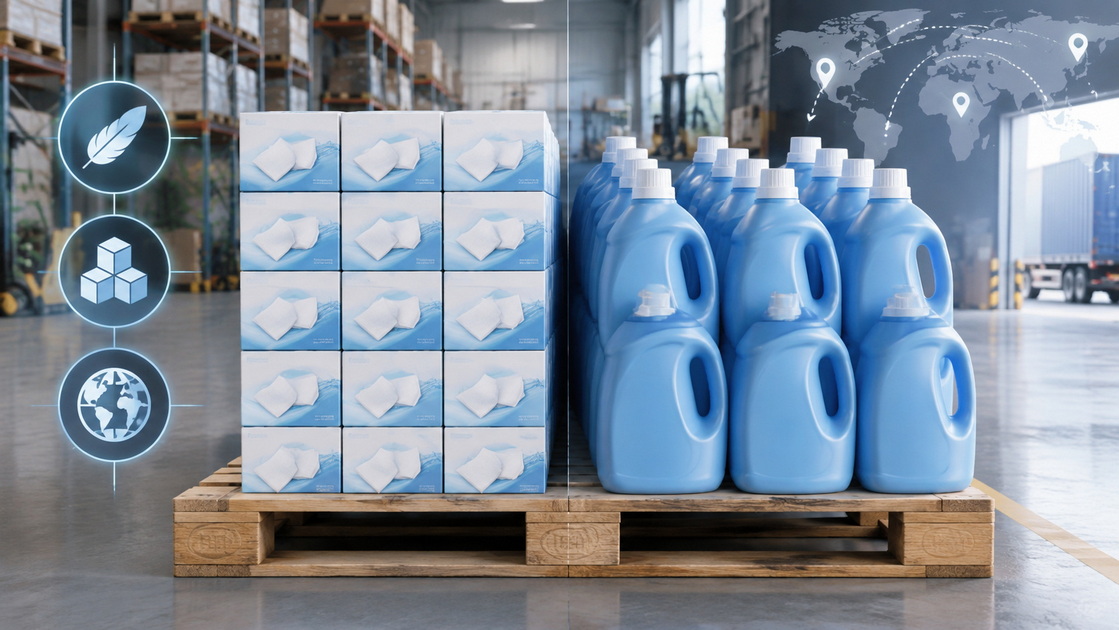
A better sustainability assessment considers:
- Packaging material and recyclability
- Product concentration
- Shipping weight
- Outer-carton efficiency
- Formula biodegradability
- Water use in manufacturing
- Wash temperature
- Consumer over-dosing
- Rewash risk caused by poor cleaning performance
- Local recycling and waste-management infrastructure
A sheet that fails to dissolve or remove stains may require a second wash. That extra wash can increase water and electricity use, reducing part of the environmental advantage gained from lightweight packaging.
The most credible environmental claim is not "plastic-free equals perfect." It is: a well-designed, concentrated product can reduce unnecessary packaging and transport weight while still providing dependable cleaning performance.
For buyers, cleaning effectiveness is still the decisive factor. Consumers may be attracted to a plastic-free detergent sheet, but they will not repurchase if it leaves odors, body oils, food stains, makeup, or visible residue on garments.
Independent tests have found that performance within the laundry-sheet category can vary greatly. Some sheet products perform poorly against difficult stains, especially during cold-water washing. Consumer Reports' testing examined sheet detergents using challenging stains such as blood, body oil, chocolate, coffee, dirt, grass, and salad dressing. The organization has repeatedly emphasized that sheets should be evaluated carefully rather than assumed to match premium liquid detergent performance.
This is why OEM/ODM development should focus on measurable formulation capability, not only attractive packaging.
A high-performing laundry detergent sheet may require:
- Appropriate surfactant selection for soil removal
- Enzymes for protein, starch, and food stains
- Builders for hard-water performance
- Anti-redeposition agents to help prevent dirt from settling back on fabric
- Controlled foaming for front-load and high-efficiency machines
- Fast dissolution technology
- Fragrance stability
- Formula compatibility with sheet substrates and binders
- Quality control for sheet weight and active-ingredient uniformity
Liquid detergent can have an advantage because it offers more formulation flexibility. It can suspend certain ingredients, incorporate more complex active systems, and be dosed more freely for heavily soiled laundry.
However, premium laundry sheets can narrow the performance gap when they are built with the right active ingredients and tested rigorously.
Cold-water washing is increasingly common because it can reduce energy used for heating water and can be gentler on many fabrics. But it is also one of the toughest conditions for laundry detergent sheets.
A poorly engineered sheet may not dissolve fully in low-temperature water. That can leave residue on clothing, in the drum, or around the door seal. It may also reduce cleaning results because the active ingredients are not released evenly into the wash water.
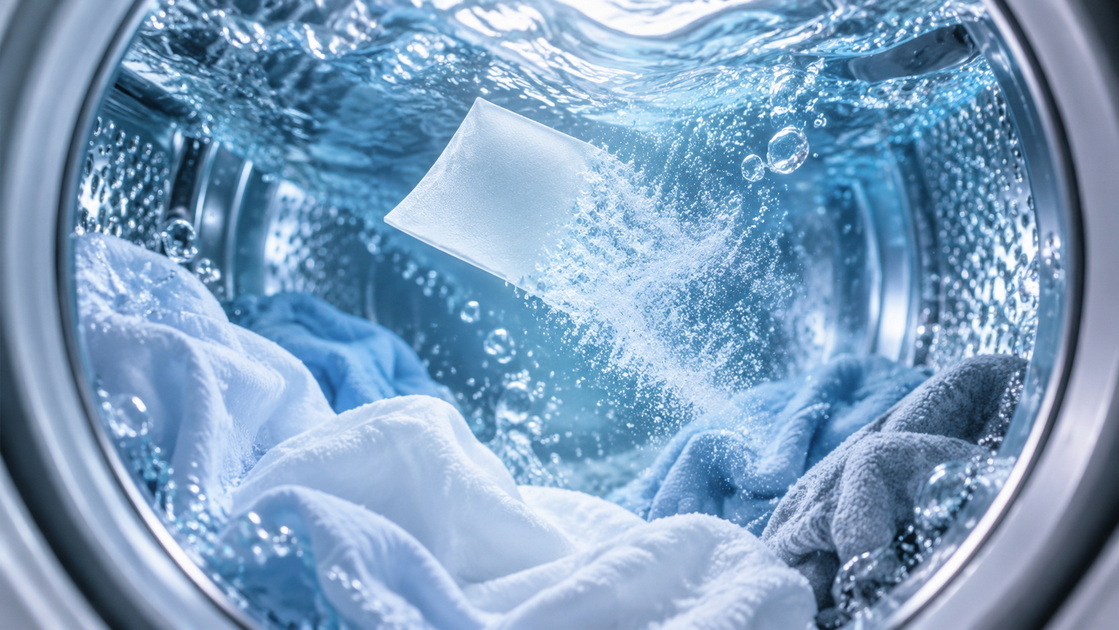
Manufacturers and brand owners should test detergent sheets under real-use conditions, including:
1. Different water temperatures, including cold cycles.
2. Different water hardness levels, especially for export markets.
3. Front-load and top-load washing machines.
4. Short and long wash cycles.
5. Small, medium, and oversized loads.
6. Common stain types, not only clean-fabric dissolution tests.
7. High humidity and high-temperature storage conditions.
For consumers, simple usage guidance can also help:
- Place the sheet in the empty drum first.
- Add clothing after the sheet.
- Avoid overfilling the machine.
- Use the recommended number of sheets.
- Tear the sheet for smaller loads when dosage instructions allow.
- Consider warm water for very heavy stains if fabric-care labels permit it.
This is an important opportunity for private-label brands. A brand that clearly explains correct use can reduce complaints, improve repurchase rates, and build trust.
Laundry detergent sheets are designed to simplify the wash routine. They are lightweight, clean to handle, and easy to store. For users who dislike measuring sticky liquid detergent, this is a meaningful benefit.
- No heavy bottles to carry
- No dripping caps or sticky shelves
- Less risk of over-pouring
- Easy storage in apartments, RVs, dormitories, and travel bags
- Simple use for elderly consumers or people with limited hand strength
- Compact format for e-commerce shipping
- Useful for subscription and refill models
Liquid detergent still provides valuable flexibility. Households that wash heavily soiled uniforms, baby clothes, sportswear, workwear, or large family loads may prefer the ability to adjust dosage precisely.
The best choice often depends on the target customer.
| Customer Type | Better Starting Format | Why |
|---|---|---|
| Eco-conscious urban consumer | Laundry detergent sheets | Compact pack, low-plastic image, easy storage |
| Travel, camping, RV, dormitory user | Laundry detergent sheets | Lightweight and low spill risk |
| Family with frequent heavy stains | Liquid detergent or a premium enzyme sheet | Flexible dosing and stain-treatment potential |
| E-commerce subscription brand | Laundry detergent sheets | Efficient shipping and simple replenishment |
| Mass retail value buyer | Liquid detergent | Familiarity, large pack sizes, broad price expectations |
| Premium lifestyle brand | Either format | Depends on formula claims, packaging design, and target market |

A successful laundry sheet project should begin with customer needs rather than packaging alone. Before launching, private-label buyers should define the product's market, price point, cleaning benchmark, packaging expectations, and compliance needs.
1. Who is the target user?
Define whether the product is designed for families, travelers, eco-focused consumers, sensitive-skin users, or commercial buyers.
2. What cleaning benchmark must the product meet?
Compare it against the leading liquid detergent or competitor sheet in the intended market.
3. Will the product be used in cold water?
If yes, prioritize cold-water dissolution and low-temperature cleaning tests.
4. What packaging claim can be supported?
Avoid vague claims. Confirm carton material, coating, recyclability, and local disposal instructions.
5. What fragrance profile fits the market?
Fragrance preferences differ sharply by region. Fresh linen, floral, citrus, baby-care, and fragrance-free options may require separate strategies.
6. What certifications or regulatory documents are required?
Prepare ingredient information, safety documentation, labeling, biodegradability evidence, and market-specific compliance files.
7. How will the product be tested before launch?
Include stability testing, transportation testing, humidity testing, dissolution testing, washing performance testing, and packaging-drop testing.
For global buyers, a manufacturer with in-house development capacity and large-scale manufacturing experience can make this process more efficient. Foshan Magic Crystal Technology Development Co., Ltd. operates more than three self-owned factories, with annual production capacity of approximately 30,000–40,000 tons, and supports OEM/ODM development for more than 300 global brands.
Laundry detergent is not only a consumer product. It is also a regulated chemical formulation. A strong brand should provide clear information about product use, dosage, fragrance allergens where required, warnings, and ingredient-related documentation.
In the European market, detergent rules have long included biodegradability requirements for surfactants. The regulatory framework is evolving further, including increasing attention to detergent ingredients, polymeric materials, consumer information, and product transparency.
For brand owners, this means the product-development conversation should include more than appearance and fragrance. It should include:
- Ingredient selection
- Surfactant biodegradability
- Fragrance allergen labeling
- Safety data sheets
- Claims substantiation
- Packaging labeling
- Country-specific language requirements
- Test reports from qualified laboratories
- Documentation for retailer and customs requirements
Transparent documentation is a competitive advantage. It helps buyers assess quality, manage risk, and communicate honestly with consumers.
Paper laundry detergent sheets are often the better option when your brand wants to emphasize compact storage, low-weight shipping, convenient dosing, modern packaging, and reduced use of rigid plastic bottles.
Plastic bottle detergent may be the better choice when your product strategy depends on flexible dosing, high-volume household use, premium stain treatment, or familiar mass-market behavior.
The strongest portfolio strategy may include both.
For example:
- Launch detergent sheets for travel, e-commerce, lifestyle, and low-packaging shoppers
- Offer concentrated liquid detergent for families, heavy-duty cleaning, and value-focused retail
- Develop a premium enzyme sheet for consumers who want both convenience and stronger stain removal
- Use clear product positioning so shoppers understand which formula fits their laundry habits
The future of laundry care is not simply paper versus plastic. It is about developing products that are effective, convenient, responsibly packaged, and honest about their performance.
If you are building a private-label laundry detergent line, start with the use case. Define your target consumer, cleaning benchmark, packaging requirement, and launch market. Then work with an experienced OEM/ODM manufacturer that can support formulation development, sheet production, packaging customization, compliance documentation, and scalable delivery.
Foshan Magic Crystal Technology Development Co., Ltd. can help global brands develop laundry detergent sheets, concentrated laundry products, and broader home-care solutions designed around real market needs.
They can be better for convenience, storage, shipping efficiency, and reducing rigid-plastic packaging. However, cleaning performance depends on the formula. A well-made detergent sheet can work well for daily laundry, while liquid detergent may be more suitable for heavy stains or users who need flexible dosing.
Many sheets are designed for cold-water use, but actual performance varies. Poorly formulated sheets may dissolve slowly or leave residue in cold cycles. Brands should conduct real cold-water testing before launch, and consumers should follow loading and dosage directions carefully.
Yes. Most laundry detergent sheets are low-sudsing and can be designed for front-load and high-efficiency machines. The sheet should normally be placed in the drum before clothing, not in the detergent drawer unless the product instructions specifically say otherwise.
Some plastic detergent bottles can be recycled, particularly bottles made from widely accepted materials such as HDPE or PET. However, actual recycling depends on local collection systems, bottle design, contamination, labels, caps, and consumer behavior.
They can remove everyday soil when formulated well, but difficult stains may require stronger enzyme systems, pretreatment, warmer water where appropriate, or an additional stain remover. Cleaning results should be validated through comparative wash testing rather than assumed from the format.
Buyers should review formula performance, cold-water dissolution, active-ingredient consistency, fragrance stability, packaging durability, humidity resistance, safety documentation, compliance files, production capacity, quality-control procedures, and samples tested against competitor products.
1. U.S. Environmental Protection Agency. [Containers and Packaging: Product-Specific Data]
2. Consumer Reports. [Do Laundry Detergent Sheets Work as Well as Liquid?]
3. Consumer Reports. [Best and Worst Laundry Detergents]
4. American Cleaning Institute. [Get the Facts About PVA and Detergent Pods]
5. European Commission. [New Rules for Safer and More Sustainable Detergents]
6. EUR-Lex. [Safer Detergents for European Consumers]
7. UL Solutions. [EU Publishes New Detergent Regulation]
8. Wirecutter. [Laundry Detergent Sheets Are Poor Cleaners. And Their Sustainability Claims Are Still Unproven.]


