
Views: 259 Author: Magic Household Cleaning Publish Time: 2026-10-06 Origin: Site

Content Menu
● What Are Plastic-Free Laundry Sheets?
● What Makes a Liquid Detergent Eco-Friendly?
● Plastic-Free Laundry Sheets vs Eco-Friendly Liquid Detergents at a Glance
● Packaging Is Important, but It Is Not the Whole Story
>> The Packaging Questions Every Brand Should Ask
● Cleaning Performance: The Most Important Test
>> Where Laundry Sheets Can Perform Well
>> Where Eco-Friendly Liquids May Have an Advantage
● Formula Design Determines Whether a Product Earns Repeat Purchase
>> A Practical Development Brief for Laundry Brands
>> Better Consumer Instructions Improve Product Outcomes
● Build a Portfolio, Not a Single-Format Argument
>> Example Product Architecture
● How to Choose Between Laundry Sheets and Liquid Detergent
● Build a Laundry Product That Performs
>> 1. Are plastic-free laundry sheets truly plastic-free?
>> 2. Do laundry detergent sheets work in cold water?
>> 3. Are laundry detergent sheets better than eco-friendly liquid detergents?
>> 4. Can laundry detergent sheets remove tough stains?
>> 5. What should private-label buyers test before launching detergent sheets?
>> 6. Is concentrated liquid detergent more sustainable than regular liquid detergent?
>> 7. Are laundry detergent sheets safe around children and pets?
Plastic-free laundry sheets and eco-friendly liquid detergents both promise a lower-impact laundry routine, but they solve different problems. Laundry sheets can reduce bulk, eliminate rigid plastic bottles, and improve shipping efficiency, while a well-formulated eco-friendly liquid detergent may offer stronger cleaning flexibility for tough stains, heavy soil, and varied wash conditions.
For retailers, private-label brands, distributors, and procurement teams, the best format is not automatically the one with the most sustainable-looking package. The right choice depends on formula performance, packaging design, dosage accuracy, transportation model, consumer habits, ingredient transparency, and local end-of-life systems.
At Foshan Magic Crystal Technology Development Co., Ltd., we develop and manufacture laundry detergent sheets and a broad portfolio of fabric-care, home-care, personal-care, and pet-cleaning products. With more than three self-owned factories, annual capacity of approximately 30,000–40,000 tonnes, and OEM/ODM experience serving over 300 brands worldwide, we see an important market reality: the most competitive laundry products balance measurable cleaning performance with practical sustainability claims.
Plastic-free laundry sheets are pre-measured, concentrated detergent sheets designed to dissolve in the wash. They are usually lightweight, dry, compact, and packed in paperboard cartons or other low-material formats rather than rigid plastic bottles.
The detergent ingredients are held in a thin soluble matrix. The sheet is placed in the washing drum before clothing is added. Water activates the formula during the wash cycle.
For many consumers, the attraction is immediate:
- No bulky bottle
- No liquid spills
- No measuring cap
- Less storage space
- Lightweight e-commerce shipping
- Simple dose control for routine loads
However, "plastic-free" needs careful interpretation. A paper carton may eliminate a conventional HDPE or PET bottle, but the sheet itself can contain functional polymers or water-soluble binders. Brand owners should avoid broad claims unless they can verify the full bill of materials, including inner wraps, adhesive labels, moisture barriers, shipping materials, and product matrix components.
Eco-friendly liquid detergents are liquid laundry products designed around lower-impact choices. These may include concentrated formulas, biodegradable ingredient approaches, reduced water content, recyclable or recycled-content bottles, refill systems, phosphate-free formulas, fragrance-free options, or transparent ingredient disclosure.
A liquid detergent is not automatically less sustainable simply because it comes in a bottle. Its environmental profile depends on the entire product system, including:
- Formula concentration
- Dose per wash
- Bottle weight
- Recycled-content percentage
- Recyclability in the target market
- Product-to-packaging ratio
- Transportation distance
- Consumer overuse
- Cleaning performance at low temperatures
A highly concentrated liquid in a lightweight bottle may outperform a poorly designed product in a large, heavy package. Conversely, a liquid detergent containing excessive water and a large virgin-plastic bottle can create unnecessary transport and packaging burdens.
| Comparison Factor | Plastic-Free Laundry Sheets | Eco-Friendly Liquid Detergents |
|---|---|---|
| Primary format | Dry, pre-measured sheet | Liquid concentrate or standard liquid |
| Typical package | Paper carton or compact flexible pack | Bottle, refill pouch, or reusable container |
| Storage efficiency | Excellent | Moderate |
| Shipping weight | Usually low | Usually higher due to water content |
| Dose control | Simple and consistent | Can vary; consumers may over-pour |
| Stain-treatment flexibility | Often limited without formula upgrades | Usually strong, especially with targeted liquid formulas |
| Heavy-soil performance | Product-dependent | Often stronger across established formulas |
| Spill risk | Very low | Moderate |
| Cold-water performance | Product-dependent; must be validated | Often reliable when formulated for cold washing |
| Moisture sensitivity | Requires strong barrier packaging | Less sensitive while sealed |
| Consumer learning curve | Low, but placement instructions matter | Familiar format for most households |
| Refill potential | Possible, but less common | Strong potential with refill stations and reusable bottles |
| Private-label differentiation | Strong visual and sustainability positioning | Strong formula, fragrance, refill, and recycled-packaging options |
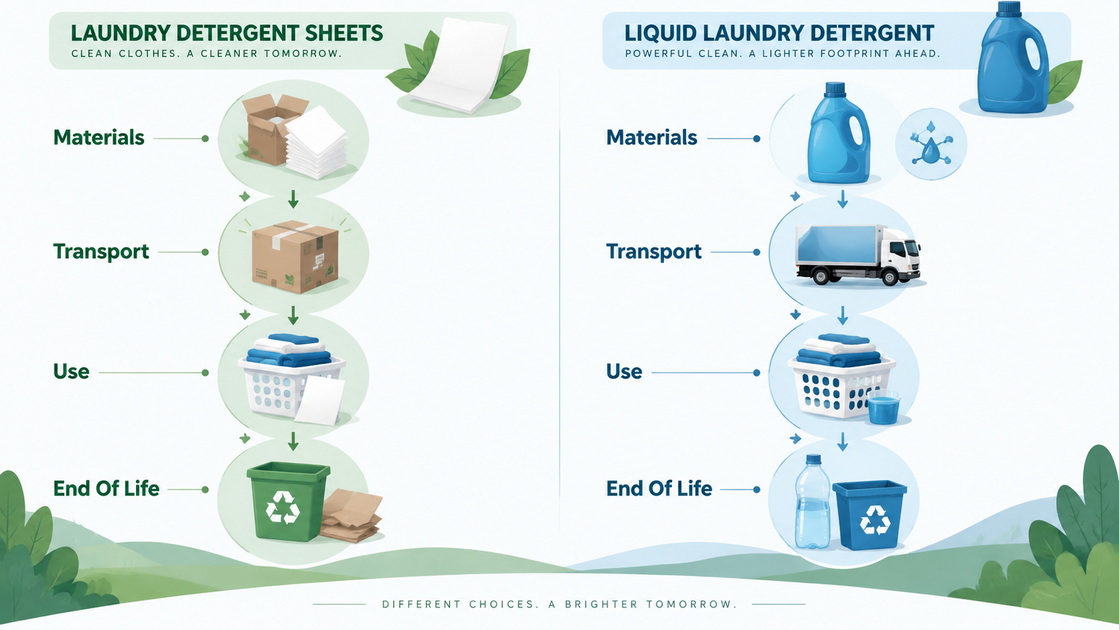
A plastic-free laundry sheet format can reduce the need for rigid plastic bottles. It also lowers volumetric weight because the product does not carry the same amount of water as traditional liquid detergent.
This matters in international supply chains. Lighter, more compact packs can improve carton utilization, warehouse efficiency, and transport economics. For e-commerce brands, that can mean lower fulfillment complexity and fewer damaged packages caused by leakage.
Yet packaging should be evaluated with discipline.
A comparative life-cycle assessment of liquid laundry detergent packaging found that material production was a major contributor to several impact categories. The results also showed that the environmental profile varies substantially by package type, weight, and product system rather than by a simple "bottle versus no bottle" rule.
Before using a "plastic-free" or "eco-friendly" claim, ask suppliers and internal teams:
1. What materials are used in the primary package?
2. Does the sheet require an inner moisture barrier?
3. Is the carton made with recycled or responsibly sourced fiber?
4. Can the packaging be recycled in the target market?
5. What is the packaging weight per wash load?
6. What is the product weight per wash load?
7. How many wash loads fit in one shipping carton?
8. Are there unnecessary inserts, shrink films, or single-use accessories?
9. Is the claim backed by specifications, test records, and packaging declarations?
A smaller package is not automatically a better package. The best choice is one that protects product quality, supports accurate claims, and fits real collection and recycling infrastructure.
Convenience and packaging do not replace cleaning performance. If a product fails to remove stains, odors, body oils, and everyday soils, consumers may use more product, wash in hotter water, repeat the wash cycle, or switch brands.
That is why performance must sit at the center of laundry detergent development.
Independent testing has shown mixed results for laundry sheets. Consumer Reports tested six sheet brands and found that the category, as a group, performed from mediocre to poor in its stain-removal assessments, with liquids and pods generally outperforming the tested sheet products on tough stains. Wirecutter also reported weaker sheet performance, particularly in cold-water washing and odor removal, across several tested brands.
These findings should not be interpreted as proof that every laundry sheet is ineffective. They show that format alone does not guarantee performance. Sheet quality depends on formulation design, surfactant system, enzyme selection, builders, dissolution behavior, dose level, fabric type, water hardness, soil type, and consumer instructions.
A professionally developed laundry sheet may be suitable for:
- Lightly soiled daily clothing
- Routine household loads
- Travel and portable washing
- Dormitory and apartment laundry rooms
- Consumers who value measured dosing
- High-efficiency washing machines
- Brands focused on compact packaging and direct-to-consumer delivery
An eco-friendly liquid detergent can be a stronger choice for:
- Heavy soil and greasy stains
- Workwear and uniforms
- Children's clothing
- Sportswear and odor-prone textiles
- Households needing adjustable dosing
- Pretreating collars, cuffs, food stains, and makeup marks
- Hard-water regions that require more formulation flexibility
The practical answer is not "sheets or liquids." It is "which tested formula best matches the user's laundry habits?"

From a manufacturing perspective, a detergent sheet is not merely "liquid detergent made thin." Its production requires a compatible system of active ingredients, structural materials, coating or binding methods, drying control, cutting accuracy, moisture protection, and dissolution validation.
A good laundry sheet must balance several competing requirements:
- Fast dissolution in cold and warm water
- Low residue risk on dark fabrics
- Stable fragrance performance
- Enough active cleaning power in a small dose
- Good sheet strength during packing and consumer handling
- Humidity resistance throughout shipping and storage
- Compatible performance in front-load and top-load machines
- Reliable results at the recommended dosage
Liquid detergent formulation is different. Liquids can allow more dosing flexibility, easier stain pretreatment, and a broader range of viscosity, fragrance, enzyme, and active-ingredient configurations. However, they require preservation control, bottle compatibility, leakage testing, and strong guidance to prevent overuse.
For private-label product development, the most credible path is to establish a performance brief before discussing packaging design.
Ask these questions during OEM/ODM product planning:
1. What are the target markets and local regulations?
2. Will the product be positioned for everyday washing or tough-stain performance?
3. Does the brand need fragrance-free, sensitive-skin, baby-care, pet-friendly, or plant-derived positioning?
4. Will consumers primarily wash in cold, warm, or mixed temperatures?
5. Is the formula designed for HE machines, standard machines, or both?
6. What is the intended dose for small, standard, and heavily soiled loads?
7. Which packaging materials are acceptable for the brand's claim framework?
8. What stability testing is required for humid climates and ocean freight?
9. What quality documents and batch controls will support the launch?
10. How will the brand substantiate environmental and ingredient claims?
The sustainability impact of a laundry product does not end when it leaves the factory. Consumer behavior can change the outcome significantly.
For example, washing clothing in cold water can reduce energy used for water heating. Wirecutter cites the American Cleaning Institute's estimate that approximately 90% of a washing machine's energy use is associated with heating water.
That means a laundry product that performs well in cold water can support a more efficient use phase. By contrast, a product that requires warm or hot water, repeated washing, or extra doses to remove common stains may reduce some of the packaging benefits it claims.
Whether selling sheets or liquids, brands should provide simple, visible directions:
- Use the correct dosage for load size and soil level
- Do not overload the washing machine
- Pretreat heavy stains when needed
- Place laundry sheets in the drum before clothing
- Keep detergent dry and sealed
- Store products out of reach of children and pets
- Follow the care label on garments
- Use cold water when the formula and laundry care requirements allow
The American Cleaning Institute advises consumers to store laundry products carefully and keep them out of the reach of children and pets.
For brand owners, the strongest commercial strategy may be a two-format laundry care portfolio rather than a winner-takes-all decision.
A brand can position laundry sheets for portability, plastic reduction, compact storage, simple dosing, and routine-use convenience. It can also offer concentrated liquid detergent for stain care, flexible dosing, refill programs, and performance-sensitive households.
This portfolio approach helps brands serve different buying occasions without forcing every consumer into one format.
| Consumer Need | Recommended Product Format | Commercial Opportunity |
|---|---|---|
| Travel, small apartments, direct-to-consumer orders | Laundry detergent sheets | Compact, lightweight, easy-to-store format |
| Everyday family washing | Concentrated liquid detergent | Familiar use and adjustable dose |
| Sportswear and odor control | Enzyme-focused liquid detergent | Higher-performance specialty positioning |
| Sensitive-skin households | Fragrance-free sheets or liquid | Clear, focused ingredient and fragrance positioning |
| Plastic-reduction campaign | Paper-packed laundry sheets | Strong shelf differentiation and compact packaging story |
| Refill-focused retail concept | Concentrated liquid detergent | Reusable bottle and refill-system potential |
For global OEM/ODM buyers, this creates room for differentiated fragrance profiles, detergent strengths, packaging formats, private-label artwork, regional compliance planning, and tiered product pricing.
Choose plastic-free laundry sheets when your priority is compact packaging, fixed dosing, low spill risk, light shipping weight, and a strong plastic-reduction message.
Choose eco-friendly liquid detergent when your priority is stain treatment, dosage flexibility, robust performance positioning, refill compatibility, or serving households with diverse washing needs.
Choose both formats when building a complete laundry-care brand designed for multiple consumer segments.
The key procurement principle is simple: validate the formula before making sustainability claims. Request product specifications, stability data, dissolution checks, wash-performance testing, ingredient documentation, packaging material details, and clear use instructions.

The future of laundry care is not defined by a single package format. It is defined by credible claims, verified performance, safer product design, efficient logistics, and a clear understanding of real consumer behavior.
For brand owners, importers, retailers, and e-commerce sellers, a custom laundry detergent sheet program can create a compact and differentiated product line. A concentrated liquid detergent program can add performance flexibility and refill potential. Together, they can form a stronger, more resilient laundry-care portfolio.
Foshan Magic Crystal Technology Development Co., Ltd. supports global OEM/ODM development for laundry detergent sheets, fabric-care products, home cleaning products, personal-care products, and pet-cleaning solutions. Contact our product-development team to discuss your target market, formula requirements, packaging concept, positioning goals, and production needs.
They can eliminate traditional rigid plastic bottles, but the full answer depends on the product matrix, moisture barrier, inner wrap, carton coatings, adhesives, and other packaging components. Brands should verify every component before using broad plastic-free claims.
Many laundry sheets are designed for cold-water use, but actual performance varies by formula. Brands should test dissolution and stain removal under cold-water conditions, especially for high-efficiency machines and short wash cycles.
Neither format is universally better. Sheets can offer convenience, compactness, and lower shipping weight. Eco-friendly liquids may provide stronger cleaning flexibility, pretreatment capability, and adjustable dosing for difficult laundry conditions.
They can help with ordinary soil, but challenging stains such as grease, coffee, protein stains, and embedded odors may require a higher-performance formula, pretreatment, a larger dose, or a specialized liquid stain remover.
Buyers should evaluate cold-water dissolution, residue, stain removal, odor removal, moisture stability, carton durability, sheet breakage, fragrance retention, machine compatibility, shipping stability, and labeling compliance for each target market.
It can be. A concentrated formula may reduce water shipped per wash and allow smaller packaging. However, sustainability depends on dosage, packaging weight, recycled content, recyclability, cleaning effectiveness, transport distance, and consumer use habits.
Laundry products should always be stored securely, dry, sealed, and out of reach of children and pets. Follow the product label and local safety requirements for the specific formulation.
1. U.S. Environmental Protection Agency. [Frequently Asked Questions on Safer Choice]. The EPA explains that products carrying its Safer Choice label undergo ingredient review, require ingredient disclosure, and must meet criteria related to packaging and volatile organic compounds. [epa]
2. D. F. S. de Oliveira et al. [Comparative Life Cycle Assessment of Multiple Liquid Laundry Detergent Packaging Formats]. *Sustainability*, 2020. This study compares conventional HDPE bottles, PET containers with pods, and flexible-pouch detergent packaging across life-cycle impact categories. [mdpi]
3. Consumer Reports. [Do Laundry Detergent Sheets Work as Well as Liquid?]. Consumer Reports describes its testing of six laundry sheet brands and reports weaker stain-removal results for the sheets tested than for leading liquid and pod products. [consumerreports]
4. The New York Times Wirecutter. [Laundry Detergent Sheets Are Poor Cleaners. And Their Sustainability Benefits Are Debatable]. Wirecutter discusses its testing of laundry detergent sheets, cleaning performance in cold water, odor-removal concerns, and practical ways to reduce laundry impacts. [nytimes]
5. American Cleaning Institute. [Laundry]. The American Cleaning Institute provides consumer guidance on laundry product storage and safety. [cleaninginstitute]
6. Good Housekeeping Institute. [Best Laundry Detergent Sheets]. This guide describes testing criteria such as dissolution, use instructions, and machine compatibility for detergent sheets. [goodhousekeeping]
7. Ellen MacArthur Foundation. [How to Prevent Plastic Pollution and Eliminate Waste]. The foundation outlines the circular-economy challenge posed by single-use plastic packaging and the importance of elimination, reuse, recycling, and composting strategies. [ellenmacarthurfoundation]


