
Views: 288 Author: Magic Household Cleaning Publish Time: 2026-11-24 Origin: Site
Content Menu
● How Toilet Bowl Cleaner Strips Support Controlled Dosing
>> Fixed Dose Does Not Mean Fixed Concentration
● Toilet Bowl Cleaner Strips vs. Other Hospitality Dosing Options
● Define Hospitality Bathroom Requirements Before Selecting a Formula
>> Separate Routine Cleaning from Descaling
>> Separate Bowl Interiors from Bathroom Touchpoints
● Cleaning Is Not the Same as Disinfection
>> Treatment Time Must Match the Product
● A Procurement Specification for Controlled-Dose Toilet Cleaning
● A Practical Hotel Pilot Before Full Deployment
>> 1. Establish the Existing Baseline
>> 2. Select Representative Conditions
>> 3. Standardize the Procedure
>> 4. Define Pass Criteria Before Testing
● Calculate Cost per Accepted Clean
● Housekeeping Procedures That Preserve Dose Control
● Packaging and Environmental Claims Need Separate Evidence
● OEM/ODM Development for Hospitality Cleaning Brands
>> Can one strip clean every hotel toilet?
>> Are toilet bowl cleaner strips disinfectants?
>> Can strips replace a hotel's descaling product?
>> Should housekeepers cut strips to reduce costs?
>> Can strips be placed in the toilet tank?
>> What documents should hospitality buyers request?
Toilet bowl cleaner strips for hospitality bathrooms with controlled dosing requirements should be evaluated as a complete cleaning system—not simply as a compact alternative to liquid chemicals. The right product must deliver a defined dose, dissolve under specified conditions, support consistent housekeeping procedures, and meet the property's cleaning objectives.
From a manufacturing and procurement perspective, my first question is not, "How small is the strip?" It is, "Can different housekeepers achieve the required result without guessing?"
This guide examines the relationship between toilet bowl cleaner strips and controlled dosing, compares strips with conventional dispensing options, and explains how hospitality buyers can build a practical purchasing specification.
Toilet bowl cleaner strips are preformed portions of cleaning formulation designed for use according to product-specific instructions. Depending on their composition, they may support routine soil removal, deodorizing, or other validated functions.
Controlled dosing is the process of delivering a specified amount of product under defined application conditions.
These concepts are related, but they are not interchangeable. A strip provides a countable unit. A controlled cleaning process also requires instructions covering water conditions, dissolution, surface coverage, brushing, and treatment time.
A premeasured strip can reduce one source of variation: free-pour measurement. It cannot automatically compensate for unsuitable chemistry, incomplete dissolution, or rushed application.
When a strip dissolves in bowl water, the resulting concentration depends partly on the water volume present.
For illustration, the same quantity of fully dissolved formulation in two liters of water produces twice the nominal product concentration obtained in four liters. Actual performance also depends on formulation, soil, mixing, and surface contact.
This is why "one strip per toilet" should be a validated instruction, not an assumption based on convenient packaging.
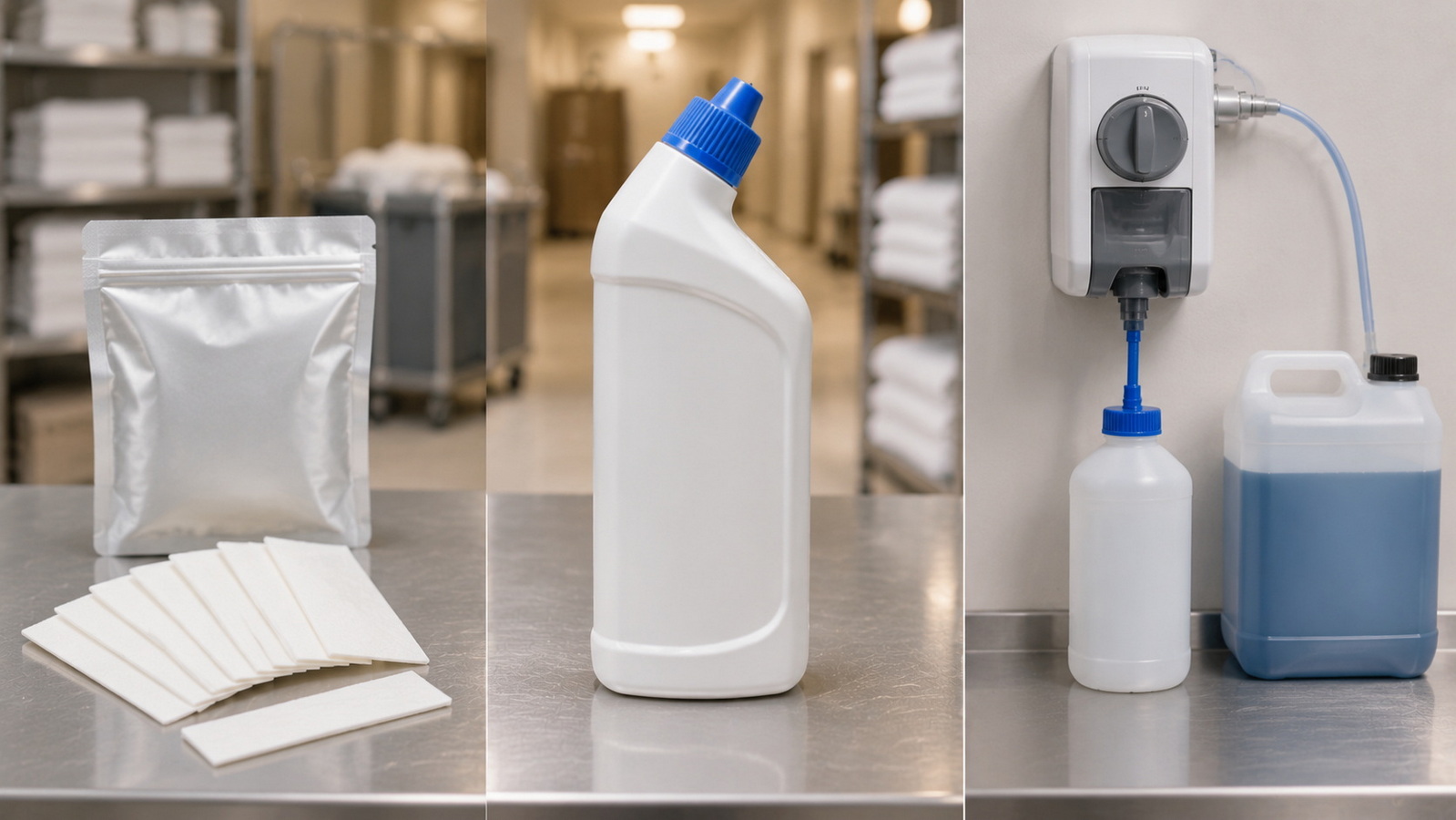
No format is universally superior. Buyers should compare complete workflows rather than package appearance.
| Evaluation factor | Premeasured strips | Ready-to-use liquid | Dilution-controlled concentrate |
|---|---|---|---|
| Dose management | Counted units; requires consistent strip specifications | Requires measured application unless a dosing feature is provided | Depends on dispenser setup and maintenance |
| Application | Must follow validated dissolution and distribution instructions | Can be applied directly where the label permits | Prepared solution requires correct application |
| Equipment | May avoid measuring equipment | Usually requires no dilution equipment | Requires compatible dispensing equipment |
| Storage considerations | Moisture protection and pack integrity | Bottle leakage and closure integrity | Concentrate security and equipment space |
| Main verification need | Dose uniformity, dissolution, cleaning performance | Application quantity, coverage, cleaning performance | Dilution accuracy, equipment reliability, cleaning performance |
A hotel with reliable dilution equipment may gain little from changing formats. A property struggling with inconsistent manual pouring may have a stronger reason to trial unit-dose products.
The appropriate decision depends on existing infrastructure, staff behavior, and verified results.
Guestroom bathrooms, public restrooms, and event facilities may require different cleaning schedules and operating procedures.
Before requesting samples, document:
- Toilet models and bowl-water conditions.
- Incoming water hardness and temperature.
- Typical soil and mineral deposits.
- Required turnaround time.
- Existing cleaning and disinfection procedures.
- Housekeeping-cart storage conditions.
- Applicable purchasing and regulatory requirements.
A formulation that removes everyday soil is not automatically effective against established mineral deposits.
Ask suppliers to define the soils their product addresses and provide relevant test methods. Properties with persistent scale may need a separate, compatible maintenance program.
Do not make an unvalidated strip work harder by adding extra units, extending treatment arbitrarily, or combining it with another cleaner.
A product intended for the bowl interior should not automatically be used on seats, flush controls, taps, or surrounding finishes.
These surfaces can have different compatibility and hygiene requirements. A controlled bathroom program therefore needs separate instructions for the bowl and for external touchpoints.
Cleaning removes soil and impurities. Disinfection uses an appropriately authorized product to kill specified microorganisms under defined conditions.
A pleasant fragrance, visible foam, or clean-looking bowl does not establish disinfectant performance.
For hospitality buyers, this distinction affects product selection, staff training, and marketing language. If the property requires disinfection, confirm that the exact product has the necessary authorization in its destination market and that its approved directions cover the intended use.
In the United States, disinfectant selection should include verification of the product's EPA registration and applicable label directions.
Dissolution time, cleaning dwell time, and disinfectant contact time describe different things.
A strip can disappear before the required treatment period has elapsed. Likewise, dissolved product in the bowl does not prove that surfaces above the waterline received adequate coverage.
Where disinfection is required, follow the authorized instructions for application and contact time. Do not transfer directions from a liquid disinfectant to an untested strip formulation.
My preferred purchasing approach is to replace broad promises with measurable acceptance criteria.
"Fast dissolving," "professional strength," and "consistent results" are incomplete specifications unless the supplier explains how they are measured.
| Specification area | Information to request |
|---|---|
| Dose definition | Nominal unit mass, tolerances, and intended dose |
| Formulation consistency | Relevant active-content or composition controls |
| Dissolution | Test conditions, timing, agitation, and residue criteria |
| Cleaning performance | Defined soils, surfaces, methods, and acceptance limits |
| Compatibility | Evidence covering intended bowl materials and applications |
| Stability | Shelf-life support and storage conditions |
| Packaging | Moisture protection, closure performance, and batch identification |
| Documentation | Instructions, safety data, specifications, and relevant authorizations |
Strip weight alone does not establish chemical consistency. Depending on the formulation, appropriate release checks may include moisture, composition-related measurements, appearance, and performance.
Buyers should agree which controls are essential before approving commercial production.

A structured trial provides more useful evidence than a single demonstration in an already-clean bathroom.
The following is a proposed evaluation framework, not a reported customer case study.
Record current chemical use, active labor time, repeat cleaning, inspection failures, and packaging consumption.
Separate routine cleaning from occasional descaling. Otherwise, one unusually difficult bathroom can distort the comparison.
Include different toilet models, water conditions, and soil levels where relevant. Involve more than one trained housekeeper.
Document the number of cleaning events and the reasons for selecting them. A small pilot can identify operational problems, but it should not be presented as proof of universal performance.
Keep inspection criteria consistent between products. Record dosing, treatment time, brushing, and any required rework.
Where practical, use the same lighting and photography positions. Do not use visual cleanliness alone to infer microbial reduction.
Agree acceptable outcomes for:
- Cleaning quality and repeat-cleaning frequency.
- Dissolution and visible residue.
- Staff handling and instruction clarity.
- Pack performance during normal use.
- Total cost per completed clean.
Predefined criteria help prevent fragrance preference or supplier enthusiasm from replacing objective assessment.
Purchase price per strip is only one part of the operating cost.
A more useful measure is:
Cost per accepted clean = total relevant operating cost ÷ cleaning events that pass inspection.
Relevant costs can include product, labor, dispensing equipment, packaging disposal, and rework. Use consistent boundaries when comparing formats.
For illustration, suppose a strip costs $0.12 per application and a liquid costs $0.08. The strip begins with a $0.04 product-cost disadvantage.
At an assumed labor cost of $18 per hour, eight seconds of labor equals $0.04. A verified eight-second saving could therefore offset that difference before other costs are considered.
These are hypothetical figures, not savings achieved by a specific product. Hotels should substitute measured application quantities and observed labor times.
A sound formula can still fail when the operating procedure is unclear.
Develop a product-specific instruction card covering:
1. Confirm the product, task, and required protective equipment.
2. Check that no incompatible chemical remains in use.
3. Prepare the toilet according to the label.
4. Apply the specified number of strips using the approved method.
5. Follow the required dissolution, brushing, coverage, and treatment instructions.
6. Flush, inspect, and document exceptions as directed.
Never mix cleaning products. Bleach combined with acidic cleaners can release chlorine gas, while bleach mixed with ammonia-containing products can generate hazardous gases.
Safety data sheets should remain accessible. Training must address ventilation, handling, storage, and emergency procedures.
Instructions should tell staff what to do when a strip is damaged, fails to dissolve, or does not remove the soil.
The response should not be "add more until it works." Establish an escalation route and an approved alternative procedure.
Dry-format convenience does not establish environmental superiority.
Evaluate product and packaging together, including:
- Packaging material and weight per validated cleaning dose.
- Protection against moisture during storage and use.
- Transport weight and case configuration.
- Damaged or unusable product rates.
- Evidence supporting specific environmental claims.
Dissolution is not the same as biodegradation. Similarly, a paper-looking outer pack does not establish that the complete packaging system is recyclable in every market.
Request evidence relevant to the exact formulation, packaging construction, disposal route, and claim being made. Avoid broad statements such as "zero impact" or "completely harmless."
Foshan Magic Crystal Technology Development Co., Ltd. develops, manufactures, and sells laundry-care, household, personal-care, and pet-cleaning products, including dishwashing sheets and floor-cleaning sheets.
According to company-provided information, the business operates more than three company-owned factories, reports annual production capacity of 30,000–40,000 metric tonnes, and serves more than 300 brands through OEM/ODM arrangements.
These figures describe the broader business. They should not be interpreted as verified toilet-cleaner-strip capacity or evidence of a particular product's performance.
For a hospitality toilet-cleaning project, the development brief should define the target market, intended claims, dose, water conditions, performance criteria, packaging, and required documentation.
Contact Foshan Magic Crystal with your bathroom-cleaning protocol, destination market, expected order volume, and packaging requirements. Request a feasibility review, pilot samples, and a documentation checklist before committing to a commercial specification.
Not automatically. The appropriate dose depends on the validated formulation and use conditions. Follow the product's instructions rather than assuming all toilets require the same amount.
Only when the specific product has the required authorization and supported claims for that use. A cleaning strip should not be promoted as a disinfectant solely because it removes visible soil.
Only if testing supports that application. Routine soil removal and established mineral-scale removal are different requirements and may need separate products.
Only when the manufacturer explicitly validates partial dosing and provides instructions. Cutting by eye can introduce variation and undermine the intended unit-dose system.
Use them in a tank only when that application is expressly supported by the manufacturer's instructions and relevant equipment guidance. Bowl-use directions do not establish tank compatibility.
Request product instructions, a current safety data sheet where applicable, specifications, relevant performance reports, stability support, batch-traceability information, and documentation supporting regulated or environmental claims.
1. Centers for Disease Control and Prevention. "When and How to Clean and Disinfect a Facility." March 18, 2025. Supports the distinctions between cleaning and disinfection, surface suitability, dilution, and contact time. [cdc]
2. CDC/NIOSH. "Hazard Communication for Disinfectants Used Against Viruses." Archived guidance, February 8, 2023. Supports correct concentration, application, contact time, and warnings about incompatible chemicals. [archive.cdc]
3. OSHA/NIOSH. "Protecting Workers Who Use Cleaning Chemicals." Supports accessible safety information, worker training, ventilation, protective equipment, and safe dilution practices. [stacks.cdc]
4. U.S. Environmental Protection Agency. "Lysol Brand Disinfectant Toilet Bowl Cleaner: Accepted Product Label." May 19, 2021. Illustrates product-specific application quantities and different cleaning, sanitizing, and disinfection directions; it is not evidence of strip performance. [www3.epa]
5. U.S. Environmental Protection Agency. "Final Guidance on Environmentally Preferable Purchasing." Supports the need for reliable evidence behind environmental purchasing claims. [epa]


