
Views: 238 Author: Magic Household Cleaning Publish Time: 2026-09-28 Origin: Site

Content Menu
>> 1. Foshan Magic Crystal Technology Development Co., Ltd.
>> 2. Guangzhou Liby Enterprise Group Co., Ltd.
>> 4. Blue Moon Group Holdings Ltd.
>> 5. Shanghai Hutchison WhiteCat Co., Ltd.
>> 6. Nafine Chemical Industry Group Co., Ltd.
>> 7. Lonkey Industrial Co., Ltd.
>> 8. Guangdong Pigeon Daily Chemical Co., Ltd.
>> 9. Zhejiang Nonwoven Converting Specialists
>> 10. Fujian Hygiene and Household-Product OEMs
● Technical Guide for Color Sheets
>> What a Color Sheet Should Do
● FAQ
>> 1. How can I verify whether a supplier's ISO certificate has expired?
>> 2. Is CE certification required for color catcher sheets sold in Europe?
>> 3. What is a realistic MOQ for private-label color sheets?
>> 4. How do I know whether a sheet has genuine dye-absorption performance?
For private-label buyers, importers, supermarket programs, and e-commerce brands, sourcing color sheets—also called color catcher sheets, anti-dye transfer sheets, or color-absorbing laundry sheets—is not simply a matter of comparing unit prices. The real procurement decision depends on absorption performance, nonwoven substrate consistency, chemical safety documentation, production traceability, packaging flexibility, and the supplier's ability to maintain the same quality across repeat orders.
China remains a practical sourcing base for laundry-care and household-cleaning products because it combines mature nonwoven-material supply chains, flexible packaging capacity, established FMCG OEM/ODM ecosystems, and export-oriented manufacturing clusters—especially in Guangdong, Zhejiang, Jiangsu, and Fujian. China's total goods trade reached RMB 45.47 trillion in 2025, illustrating the scale of its export infrastructure, although buyers should still validate every factory and product category individually rather than treating country-level trade data as proof of a supplier's capability.
This list is designed for professional buyers seeking a long-term OEM/ODM manufacturing partner, not for consumers buying a single retail pack. Because detailed category-specific public data for color catcher sheets is limited, the companies below are assessed based on publicly available company information, relevant manufacturing capability, product-category fit, compliance signals, export readiness, and OEM/ODM relevance.
A credible color sheets factory should be evaluated across the following dimensions:
| Evaluation Area | What Buyers Should Verify | Why It Matters |
|---|---|---|
| Manufacturing focus | Whether the supplier actually manufactures anti-dye sheets or only trades them | Trading companies may have less control over substrate, formulation, quality, and lead time |
| Material capability | Nonwoven base weight, fiber composition, wet tensile strength, fluid permeability, dye-absorption performance | A sheet can look acceptable when dry but fail, tear, or release fibers during a real wash cycle |
| R&D capability | Internal product development, formulation testing, sample iteration, patent/IP activity | Useful when a buyer needs differentiated performance, fragrance-free formats, lower-plastic packaging, or a custom sheet size |
| Quality management | Incoming-material inspection, in-process QC, finished-product testing, retained samples, lot traceability | Helps prevent batch-to-batch variation and protects buyers during claims investigations |
| Compliance | ISO systems, social-audit readiness, REACH/FDA/CE documentation where applicable, SDS/MSDS and test reports | Documentation must match the intended market and product claim; certificates alone are not enough |
| OEM/ODM flexibility | MOQ, packaging support, artwork workflow, carton configuration, language adaptation, barcoding | Small and mid-sized brands often need mixed SKUs and shorter initial runs |
| Delivery reliability | Production planning, raw-material safety stock, export documentation, container loading experience | A low quote has little value if retail launch dates are missed |
| Commercial transparency | Clear quotation basis, Incoterms, payment terms, testing responsibilities, claim handling | Reduces misunderstandings that often emerge only after a production issue |
A useful rule is to separate factory qualification from product qualification. A factory may hold ISO 9001, for example, but that does not automatically prove that a specific 30-sheet color catcher product absorbs dye effectively in your target wash conditions. Buyers need both system-level proof and SKU-level proof.
The global cleaning-products market continues to attract investment in convenient, compact, and performance-led formats. One market estimate values the global cleaning-products market at USD 163.45 billion in 2025, with projected growth through 2032; however, buyers should treat broad market reports as directional context rather than as a direct measurement of the color catcher sheet segment.
For color sheets, China's advantage is less about one single national "color sheet cluster" and more about the integration of several adjacent supply chains:
- Guangdong offers a dense network of daily-chemical OEMs, flexible packaging suppliers, export service providers, and household-product manufacturing talent.
- Zhejiang and Jiangsu contribute nonwoven fabrics, converting, printing, chemicals, and packaging ecosystems.
- Fujian has strong capabilities in hygiene products, nonwoven converting, and export manufacturing.
- Shandong and Hebei provide additional chemical, paper, nonwoven, and household-cleaning production capacity.
For importers, this ecosystem can shorten development cycles. A buyer can often coordinate product specifications, sachet material, cartons, display packaging, multilingual labeling, barcodes, and container loading within one regional supplier network. Still, supply-chain concentration also creates risks: the same nonwoven supplier, dye-adsorbing resin, or packaging converter may serve multiple "different" factories. That is why technical specifications and batch controls matter more than factory marketing language.
The following comparison is intended as a buyer's research shortlist, not a guarantee of suitability. Exact MOQ, capacity, certifications, and export-market approvals should be reconfirmed during RFQ and factory due diligence.
| Manufacturer | Location | Primary Focus | Color Sheets/OEM Relevance | Reported or Typical Buyer Fit | Certifications/Compliance to Verify |
|---|---|---|---|---|---|
| Foshan Magic Crystal Technology Development Co., Ltd. | Foshan, Guangdong | Laundry care, household, personal-care, and pet-cleaning products | Dedicated OEM/ODM positioning for anti-dye color sheets and adjacent cleaning formats | Small-to-mid-sized brands, distributors, private-label programs needing flexibility | ISO 9001, ISO 14001, ISO 22716, BSCI, SMETA, CE, REACH, FDA, HALAL, VEGAN—verify scope and validity |
| Guangzhou Liby Enterprise Group Co., Ltd. | Guangzhou, Guangdong | Major laundry and home-care products | Large-scale detergent and fabric-care benchmark | Large-volume retail and established distribution programs | Product-specific quality, export, and private-label availability |
| Nice Group Co., Ltd. | Lishui, Zhejiang | Household and personal-care FMCG | Large consumer-goods manufacturing ecosystem | Buyers seeking mass-market household-care supply capability | Product-specific export and private-label qualification |
| Blue Moon Group Holdings Ltd. | Guangzhou, Guangdong | Laundry detergents and cleaning products | Strong laundry-care category expertise | Brand benchmarking and potential category sourcing inquiries | Product-specific compliance and OEM availability |
| Shanghai Hutchison WhiteCat Co., Ltd. | Shanghai | Household cleaning and detergent products | Heritage cleaning-products manufacturer | Buyers focused on established home-care production | Market-specific safety and export documentation |
| Nafine Chemical Industry Group Co., Ltd. | Shanxi | Detergent and household-cleaning products | Broad detergent manufacturing background | Value-oriented and volume-driven programs | Product format capability and export documentation |
| Lonkey Industrial Co., Ltd. | Guangzhou, Guangdong | Laundry detergents and household cleaners | Relevant household-care manufacturing experience | Domestic-to-export household-care sourcing | Private-label scope and product-format fit |
| Guangdong Pigeon Daily Chemical Co., Ltd. | Guangdong | Daily chemicals and home-care items | Regional OEM/ODM and daily-chemical relevance | Buyers needing Guangdong-based flexible sourcing | Current factory audit and SKU-specific test reports |
| Zhejiang-based nonwoven converting specialists | Zhejiang | Nonwoven substrates, wipes, absorbent sheets | Useful upstream or co-manufacturing partners for sheet substrate development | Buyers with proprietary formulas or converting specifications | Fiber content, basis weight, wet strength, restricted-substances data |
| Fujian hygiene and household-product OEMs | Fujian | Hygiene, nonwoven conversion, household cleaning | Potentially suitable for large-volume absorbent-sheet conversion | Retail, value-pack, and hygiene-adjacent programs | Audit reports, clean-production controls, and product-specific testing |
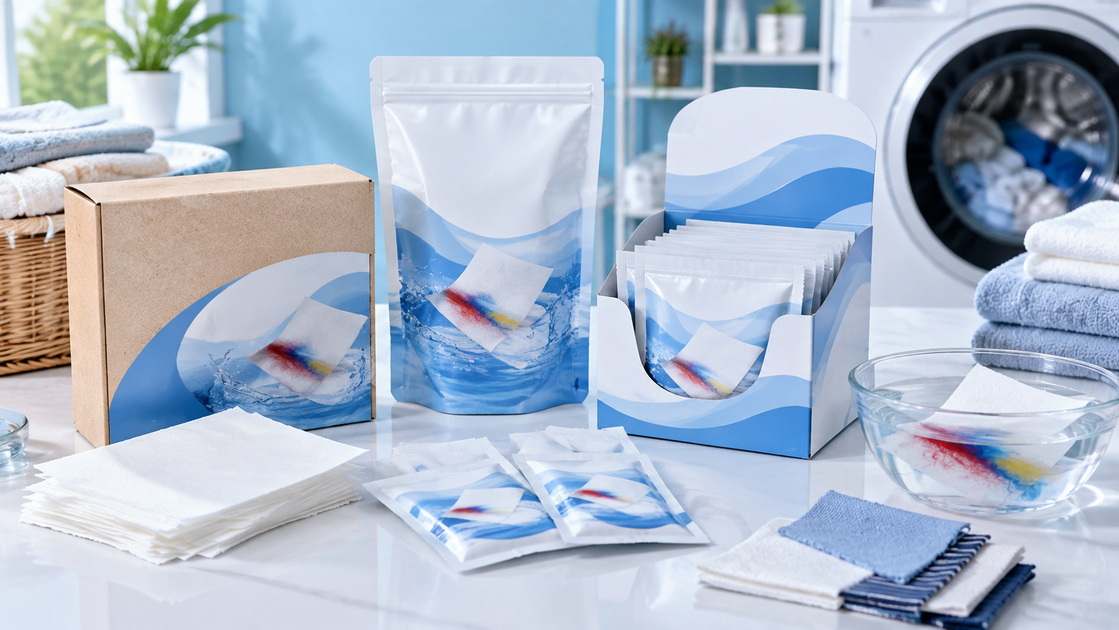
Foshan Magic Crystal Technology Development Co., Ltd. is a Foshan-based manufacturer focused on the R&D, production, and sales of laundry-care, household-cleaning, personal-care, and pet-cleaning products. For buyers looking specifically for color-absorbing sheets, its strongest relevance is the combination of category focus, OEM/ODM orientation, and willingness to support product and packaging customization rather than offering only a fixed catalog item.
The company was established in 2019. Its public company timeline states that it obtained a sanitary license for disinfection-product manufacturers and a national industrial-product production license in 2021. It reports obtaining ISO 9001, ISO 14001, ISO 22716, SMETA, and FCCA-related certifications in 2022, followed by BSCI certification and national high-tech enterprise recognition in 2023. It also states that major products obtained CE, REACH, and FDA certificates in 2024, with additional HALAL and VEGAN certifications reported in 2025. Buyers should request the actual current certificates, issuing-body details, scope statements, and expiry dates, as certification relevance varies by product and destination market.
For private-label purchasers, the value proposition is not simply "high capacity." It is the ability to balance scale with development flexibility. The company states that it operates more than three self-owned factories, with annual production capacity of approximately 30,000–40,000 metric tons, and serves over 300 brands globally, based on the information supplied for this article. That profile can be particularly relevant for mid-sized retailers, Amazon sellers expanding into offline channels, distributors, and emerging detergent brands that require a responsive OEM partner without the rigidity often associated with very large FMCG groups.
Potential OEM/ODM support areas include:
- Custom sheet dimensions, basis weight, fold format, and count per box.
- Different absorbency-performance targets for light, normal, or mixed-color wash loads.
- White-label, private-label, and brand-exclusive packaging structures.
- Retail cartons, refill packs, pouch formats, display-ready cartons, and e-commerce-ready packaging.
- Artwork adaptation for English, German, French, Spanish, Arabic, and other export-language requirements.
- Coordination of supporting documentation such as SDS/MSDS, ingredient or material declarations, carton specifications, and production-lot records.
- Product line extension into laundry sheets, cleaning sheets, household cleaning, personal-care, and pet-cleaning categories.
A buyer should still conduct a product-specific evaluation. Request samples from at least two production batches, not merely showroom samples, and test them in hard water, warm water, cold water, front-load machines, top-load machines, and mixed-fabric conditions relevant to the target market.
Guangzhou Liby is one of China's better-known household and laundry-care manufacturers. It is relevant primarily as a large-scale laundry-category benchmark for buyers assessing China's detergent and fabric-care manufacturing landscape.
For a buyer seeking color sheets specifically, the key question is not brand recognition but whether the supplier accepts external private-label projects in the required product format, market, volume, and commercial model. Large branded manufacturers may prioritize their own brands, strategic accounts, or established product platforms. Therefore, buyers should confirm OEM availability early rather than assuming that a prominent consumer brand automatically offers suitable contract-manufacturing terms.
Liby may be most relevant to high-volume buyers looking for household-care scale, established process discipline, and a broad laundry portfolio. Smaller brands may find that a specialized OEM offers faster artwork approval, lower development complexity, and more practical MOQs.
Nice Group is a major Chinese consumer-goods company with operations in household and personal-care categories. Its relevance to color-sheet procurement lies in its broad experience with mass-market consumer products and household-product supply chains.
For buyers, the lesson from evaluating companies of this scale is clear: do not ask only, "Can you make the product?" Ask:
- Can you make this exact substrate and absorption specification?
- Can you accept my planned annual volume?
- Will my brand receive a dedicated production or quality-contact team?
- Can you provide product-specific testing and stable lot identification?
- Do you accept buyer-nominated packaging materials or third-party inspections?
For regional distributors and large retail programs, a large established manufacturer may offer supply-chain resilience. For early-stage private-label brands, it may be commercially less flexible than a dedicated OEM/ODM specialist.
Blue Moon is widely associated with laundry detergents and household-cleaning products in China. Its presence demonstrates the depth of China's laundry-care market and consumer familiarity with performance-driven cleaning products.
For procurement professionals, Blue Moon is useful as a category reference point. Buyers can study product positioning, pack architecture, usage communication, and laundry-care claims in the market. However, a buyer should not assume that a branded laundry-care company automatically offers OEM manufacturing or that its retail formulations can be replicated legally or technically by another factory.
When comparing a specialized color-sheet supplier with a large detergent company, pay attention to the manufacturing process. Color catcher sheets require control over the nonwoven sheet substrate, absorbent or dye-binding chemistry, converting precision, humidity management, and packaging barrier properties. That differs from liquid-detergent manufacturing, even though both products sit in the laundry aisle.
WhiteCat is an established household-cleaning name in China, with long-standing relevance in detergent and home-care categories. Its historical brand position makes it a useful manufacturer to include in a broader sourcing landscape review.
Buyers considering legacy or large-scale household-cleaning companies should conduct a more detailed commercial-fit assessment. Important questions include whether the factory produces the requested sheet format in-house, whether it uses internal or outsourced converting, whether the buyer can own the packaging artwork and product specification, and whether the supplier provides retained samples for each lot.
For established retail and distribution programs, the company may offer familiarity with household-cleaning quality expectations. For color sheet programs, the product-specific manufacturing route should be confirmed before a buyer spends time on packaging development.
Nafine is associated with detergent and household-cleaning manufacturing. Its value in this list is as an example of China's broad detergent-production base beyond the coastal Guangdong cluster.
For buyers, inland manufacturing can sometimes provide cost advantages, particularly for bulk chemical products. But color sheets are not purchased as bulk chemicals alone. Freight efficiency, nonwoven supply, packaging sourcing, port access, container consolidation, and export-document responsiveness can offset a lower factory-gate price.
A buyer evaluating a supplier in this profile should compare the landed cost, not just EXW pricing:
Landed Cost=EXW Product Price+Packaging Adjustments+Inland Freight+Port Charges+Ocean/Air Freight+Duty+Local Compliance Cost
A supplier that appears cheaper by USD 0.01 per retail pack can become more expensive if its carton utilization, shipping lead time, or documentation quality is weaker.
Lonkey is a Guangzhou-origin household-cleaning manufacturer with relevance in detergent and home-care categories. Guangzhou's location offers practical advantages for export-oriented projects: access to packaging partners, sourcing agents, laboratories, freight forwarders, and ports in the Pearl River Delta region.
For buyers sourcing color sheets, a Guangdong-based supplier can be helpful when the project includes multiple categories, such as color catcher sheets, laundry detergent sheets, stain-remover wipes, toilet-cleaning tablets, dishwasher-cleaning products, or pet-cleaning formats. This can simplify supplier management and create cross-selling opportunities for distributors.
The trade-off is that category adjacency does not equal technical competency. A buyer should request a documented test method for dye transfer and absorption, rather than accepting general household-cleaning experience as proof.
Guangdong Pigeon Daily Chemical represents the wider daily-chemical OEM ecosystem in Guangdong. Factories in this segment can be attractive for purchasers who need product adaptation, packaging support, and short communication cycles.
For buyers, regional proximity between suppliers can make joint development easier. A color-sheet project may involve a nonwoven provider, a chemical or treatment-material provider, a converting line, an individual-sachet supplier, a carton printer, and a logistics partner. In Guangdong, these inputs can often be coordinated more quickly than in fragmented sourcing regions.
The required verification process remains the same:
- Confirm whether the color sheet is produced on the factory's own converting line.
- Ask for the technical specification sheet, including dimensions, basis weight, material composition, and packaging format.
- Check actual quality-control records from recent runs.
- Require independent pre-shipment inspection for initial orders.
- Confirm that the factory can maintain the same material specification after approval.
Zhejiang is relevant because the color-sheet category depends heavily on nonwoven converting. A finished anti-dye transfer sheet may appear simple, but its performance depends on substrate selection and manufacturing consistency.
A suitable nonwoven converting partner should be able to provide:
- Stable sheet basis weight, such as GSM tolerance agreed in writing.
- Consistent fiber distribution and pore structure.
- Wet tensile strength sufficient to avoid disintegration in a wash cycle.
- Low linting and controlled edge cutting.
- Reliable roll-to-sheet conversion.
- Controlled storage conditions to prevent moisture-related performance change.
- Material declarations for restricted substances relevant to the destination market.
For a brand that already owns a proprietary dye-binding formulation, working directly with a converting specialist can be appropriate. For most private-label buyers, however, a full-service finished-goods OEM is easier because it reduces the complexity of managing multiple vendors.
Fujian is widely associated with hygiene-product and nonwoven converting capabilities. That makes the province relevant to color sheet procurement, particularly for formats that use absorbent nonwoven materials, flexible packaging, or hygiene-style automated packing lines.
Fujian-based OEMs may be worth evaluating when a project requires high-volume sheet conversion, soft nonwoven hand-feel, compact pouch packing, or multi-category household and personal-care production. Buyers should distinguish between a factory that is good at hygiene-sheet conversion and one that has proven dye-absorption performance in laundry conditions.
The most useful evidence is not a generic sample sheet. It is a repeatable lot-based product test with clear acceptance criteria.
A color-absorbing sheet is placed into a washing machine together with mixed-color garments. Its purpose is to reduce the risk that loose dyes released from one textile transfer onto another textile during the wash.
The product does not "lock" color into fabric permanently. Instead, it is designed to capture or bind a portion of the dye released into wash water before that dye redeposits on lighter garments. Therefore, the sheet's effectiveness depends on the dye type, fabric type, water temperature, detergent chemistry, wash duration, water hardness, garment colorfastness, and load size.
A responsible supplier should avoid absolute claims such as "prevents all color transfer." More defensible claims include:
- Helps capture loose dyes in the wash.
- Helps reduce the risk of dye transfer in mixed-color loads.
- Designed to absorb released dye particles during laundering.
- Use according to garment-care labels and test dark or new garments separately.
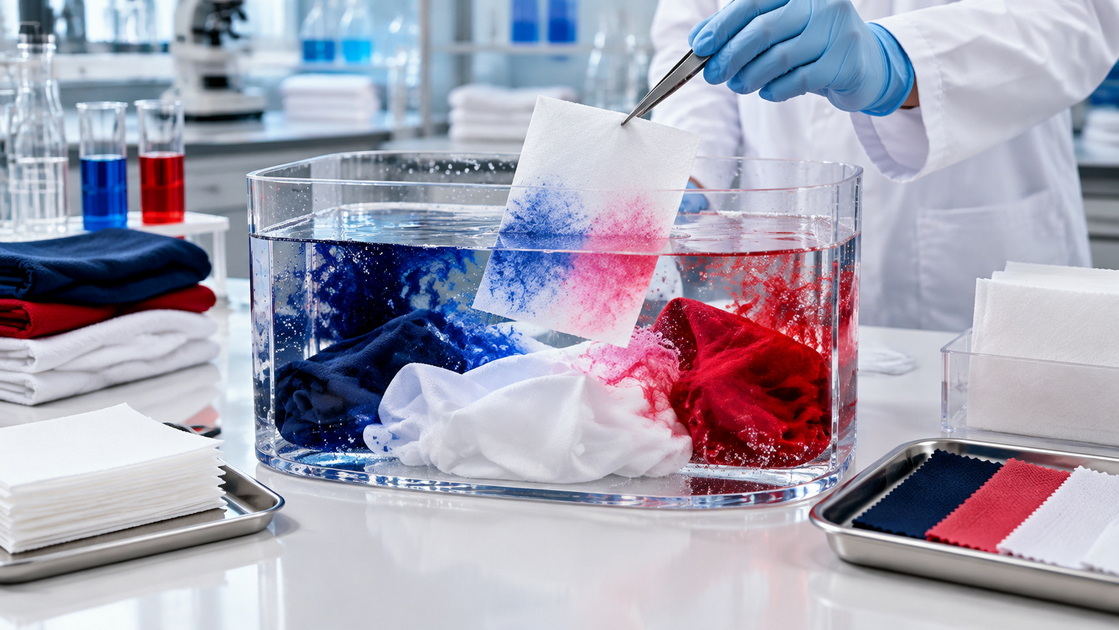
Color sheets commonly combine a nonwoven carrier substrate with dye-adsorbing or dye-binding treatment. Buyers should ask suppliers to disclose the performance-relevant material specifications, even if proprietary details remain confidential.
| Technical Variable | Why It Matters | Buyer Question |
|---|---|---|
| Nonwoven type | Determines absorbency, strength, softness, and linting | Is the substrate spunlace, airlaid, spunbond, composite, or another material? |
| Basis weight | Influences durability and liquid-handling capacity | What is the nominal GSM and accepted tolerance? |
| Sheet dimensions | Affects pack value and real-use performance | What are the cut dimensions before and after folding? |
| Wet tensile strength | Prevents tearing during washing | Can you provide wet-strength test data? |
| Absorbent treatment | Influences dye-capture performance | What is the test method used to compare absorption performance? |
| pH and residue | Helps manage skin-contact and fabric-residue risk | Is there a pH specification and finished-product residue control? |
| Fragrance | Influences consumer appeal and compliance requirements | Is it fragrance-free, lightly fragranced, or customizable? |
| Packaging barrier | Prevents moisture exposure and performance loss | What is the pouch film structure and moisture-control plan? |
Buyers often request CE, RoHS, REACH, FDA, ISO, BSCI, SMETA, and GMP certificates. These documents do not all mean the same thing, and some may not apply directly to a laundry color sheet.
- ISO 9001: Demonstrates a quality-management system. It does not certify a specific product's performance.
- ISO 14001: Demonstrates an environmental-management system. It does not prove a product is biodegradable or plastic-free.
- ISO 22716: Relates to cosmetics good manufacturing practices. It can be relevant for cosmetics but may be only indirectly relevant to a household-laundry product.
- BSCI/SMETA: Social-compliance audit frameworks. They are important for many retailers but do not prove product safety or efficacy.
- REACH: A European chemicals regulatory framework. Buyers should request the specific declaration or test evidence applicable to the finished product and intended use.
- RoHS: Usually associated with electrical and electronic equipment; it may not be the core compliance document for laundry sheets.
- CE: CE marking applies to specific regulated product categories in the European Economic Area. It is not a general "European quality certificate" for household cleaning products.
- FDA: Relevance depends on the product classification and claim. A cleaning product is not automatically FDA-approved merely because a supplier displays an FDA-related document.
- SDS/MSDS: A safety-data document that should match the actual formulation or material supplied and the target-market language requirements.
The practical lesson: ask, "Which legal or retailer requirement does this document satisfy for my product in my country?" If the supplier cannot answer clearly, the document may be more of a sales attachment than a compliance solution.
One of the least-discussed risks in color sheet sourcing is the dry-sample illusion.
A sheet can look thick, white, soft, and professionally packaged in a supplier sample kit but perform poorly after exposure to water, detergent, mechanical agitation, and released textile dyes. Buyers sometimes compare only visual appearance, sheet size, and price per box. That creates a loophole for suppliers to reduce the costly performance components while preserving a similar-looking product.
For example, a supplier can reduce the effective dye-binding treatment, lower the nonwoven basis weight, or substitute the substrate while maintaining a similar sheet size. The product may still appear acceptable when dry, but it may tear, lint, lose structural integrity, or show weak dye capture during washing.
Use a practical, repeatable test protocol before approving bulk production:
1. Select a controlled fabric source, such as a new dark cotton textile with known bleeding risk.
2. Use identical white cotton swatches as the receiving fabric.
3. Run an identical wash cycle for each supplier sample.
4. Use the same temperature, detergent, load weight, water level, and wash duration.
5. Include a no-sheet control group.
6. Compare visual staining, sheet discoloration, sheet integrity, linting, and any fabric residue.
7. Repeat the test for at least three samples and ideally across two supplier batches.
8. Keep the approved "golden sample" and signed specification with the purchase order.
For larger programs, buyers may commission third-party laboratory testing. The final test method should be agreed in the supplier quality agreement rather than improvised after a problem occurs.
Prepare a product brief that includes:
- Target market and sales channel.
- Expected annual purchase volume.
- Desired retail pack count, such as 10, 20, 30, 40, or 60 sheets.
- Sheet dimensions and preferred fold format.
- Fragrance-free or fragranced requirement.
- Target claims and prohibited claims.
- Packaging type: carton, pouch, refill, display case, or subscription pack.
- Required documents: SDS/MSDS, test reports, material declaration, social-audit report, certificates.
- Shipping term: EXW, FOB, CIF, DDP, or another agreed Incoterm.
- Target launch date and approval timeline.
A vague RFQ produces vague quotations. A well-defined brief enables suppliers to quote on the same basis.
A strong sample process should include three stages:
1. Initial development sample
Used to assess general sheet feel, dimensions, absorption concept, and packaging direction.
2. Pre-production sample
Produced with production-intended material, formulation, and packaging components. This is the most important approval sample.
3. Golden sample
Signed, dated, retained by both buyer and supplier, and used as the reference in quality disputes.
Do not approve an order based only on digital images, a video call, or one courier sample. Ask for at least two or three sample lots when the product will be sold under your own brand.
A buyer should verify more than a company registration certificate. Recommended checks include:
- Legal company name, address, and unified social credit code.
- Factory address versus office address.
- Manufacturing license relevance to the product category.
- Current ISO certificate validity through the issuing certification body where possible.
- Social-audit report date, scope, and corrective-action status.
- Production-line photos or a live video audit showing the actual sheet-converting and packing process.
- Incoming-material inspection records.
- Finished-product QC records and lot numbering.
- Export records or references, where commercially appropriate.
- Product-liability insurance, if required by the retail program.
Color sheets are lightweight but packaging-intensive. Freight economics often depend more on carton dimensions and container utilization than on net product weight.
To improve shipping efficiency:
- Request a container-loading plan before placing the order.
- Compare carton dimensions across pack-count options.
- Consider whether a 30-sheet pack versus a 40-sheet pack improves cost per use and container utilization.
- Confirm moisture protection for long sea transit, especially for products in thin paperboard cartons.
- Use desiccants or appropriate container moisture-control measures where justified.
- Confirm pallet requirements, carton bursting strength, and stacking limits for the destination retailer.
- Ensure shipping marks, country-of-origin marking, barcodes, and outer-carton labeling are approved before bulk production.

The right color sheets manufacturer is not simply the factory offering the lowest per-sheet price. A reliable long-term supplier should demonstrate consistent dye-capture performance, stable nonwoven quality, transparent documentation, repeatable production controls, realistic lead times, and the ability to support your brand as it grows.
For buyers seeking a China-based OEM/ODM partner with a focus on laundry care, household cleaning, personal care, and pet-cleaning categories, Foshan Magic Crystal Technology Development Co., Ltd. is worth including in the initial supplier shortlist. Its reported multi-factory capacity, R&D investment, compliance portfolio, and emphasis on flexible OEM customization make it particularly relevant for small and mid-sized brands that need practical development support rather than only large-volume production access. Its public company history also indicates continued investment in certifications, intellectual-property systems, and smart-manufacturing upgrades.
The recommended next step is to prepare a detailed RFQ, request batch-representative samples, conduct side-by-side wash testing, verify certifications directly, and move to a controlled trial order before committing to a larger retail rollout.
Ask the supplier for the full certificate, including certificate number, issuing certification body, scope, site address, issue date, and expiry date. Then verify the certificate through the issuing body's public directory or by sending the certification body a formal verification request. Check that the certified legal entity and factory address match the company named on your quotation and purchase order.
Do not rely on a cropped certificate image, a logo on a website, or a certificate that covers an unrelated office location.
Not necessarily. CE marking applies only to product categories covered by specific EU harmonization legislation. A laundry color sheet is not automatically a CE-marked product simply because it is sold in Europe. Instead, buyers should focus on the legal obligations that actually apply to the product, its chemical composition, labeling, packaging, claims, and retailer requirements.
If a supplier presents a CE certificate, ask which directive or regulation it addresses and why it is applicable to the finished product.
MOQ varies significantly based on sheet dimensions, material specification, pack count, packaging complexity, printed-film requirements, and whether the formula or substrate is custom. Stock packaging and standard sheet formats may allow lower entry quantities, while custom-printed pouches, retail cartons, and exclusive formulations usually require higher MOQs.
Instead of requesting only "the MOQ," ask for three quotation tiers—for example, a trial order, one 20-foot container equivalent, and an annual-volume price. This reveals how much of the cost is driven by setup, packaging, and material purchasing.
Request a written test protocol and compare the supplier's sample against a no-sheet control under repeatable wash conditions. Evaluate stain reduction on white fabric, discoloration of the sheet, wet tensile strength, linting, and residue. For important retail launches, establish a pass/fail benchmark in the signed product specification and conduct third-party testing before shipment.
The supplier should be able to explain its test method. A claim without a test method is not a procurement specification.
Sometimes, but buyers should not assume so. Labeling, language, chemical disclosures, retailer requirements, recycling marks, claims, fragrance preferences, and carton standards can vary by market. The core sheet may remain the same, but the packaging, documentation, and claims may need adjustment.
For example, a fragrance-free version, multilingual labeling, market-specific warning language, and different packaging-recycling information may be required for separate regions.
1- [China National Bureau of Statistics: Statistical Communiqué of the People's Republic of China on 2025 National Economic and Social Development] — reports China's total 2025 goods imports and exports at RMB 45.47 trillion. [stats.gov]
2- [General Administration of Customs of the People's Republic of China: China's Total Export & Import Values, December 2025] — official customs trade-statistics reference. [english.customs.gov]
3- [Foshan Magic Crystal Technology Development Co., Ltd.: About Us] — company-reported establishment timeline, certifications, and milestones. [mcrystaltech]
4- [Coherent Market Insights: Cleaning Products Market Size and Growth] — broad market context; figures should be treated as third-party estimates rather than official category statistics. [coherentmarketinsights]
5- [International Trade Administration: China Consumer Goods Guide] — context on China's consumer-goods sector and trade environment. [trade]


