
Views: 288 Author: Magic Household Cleaning Publish Time: 2026-09-06 Origin: Site
Content Menu
>> Evaluation criteria for professional buyers
>> What "quality" means in scent booster beads
● Leading Manufacturers and Suppliers Serving America
>> 1. Foshan Magic Crystal Technology Development Co., Ltd.
>> 2. Procter & Gamble — Downy Unstopables
>> 3. Henkel — Snuggle In-Wash Scent Boosters
>> 4. Church & Dwight — ARM & HAMMER Scent Booster Range
>> 5. Fragrance Houses and Specialized Ingredient Partners
>> 6. U.S. Contract Packagers and Private-Label Laundry-Care Producers
● Industry Risks Buyers Should Avoid
>> 1. Substituted or diluted fragrance materials
>> 2. Poor cold-water dissolution
>> 3. Caking during ocean freight
>> 4. "Certificate shopping" without scope verification
>> 5. Misleading "eco-friendly" positioning
● Buyer's Guide: How to Source Laundry Scent Booster Beads
>> 1: Define the commercial brief
>> 2: Request a structured sample process
>> 3: Audit the supplier beyond the sales presentation
>> 4: Validate compliance before artwork approval
>> 5: Plan logistics before placing the first order
>> 1. How can I verify whether a supplier's ISO certification is still valid?
>> 2. What is a reasonable MOQ for private-label laundry scent booster beads?
>> 3. Should I require an IFRA certificate for every fragrance?
>> 4. How do I prevent scent booster beads from clumping after sea shipment?
>> 5. Can I legally market imported scent beads as "Made in USA" if I fill them in America?
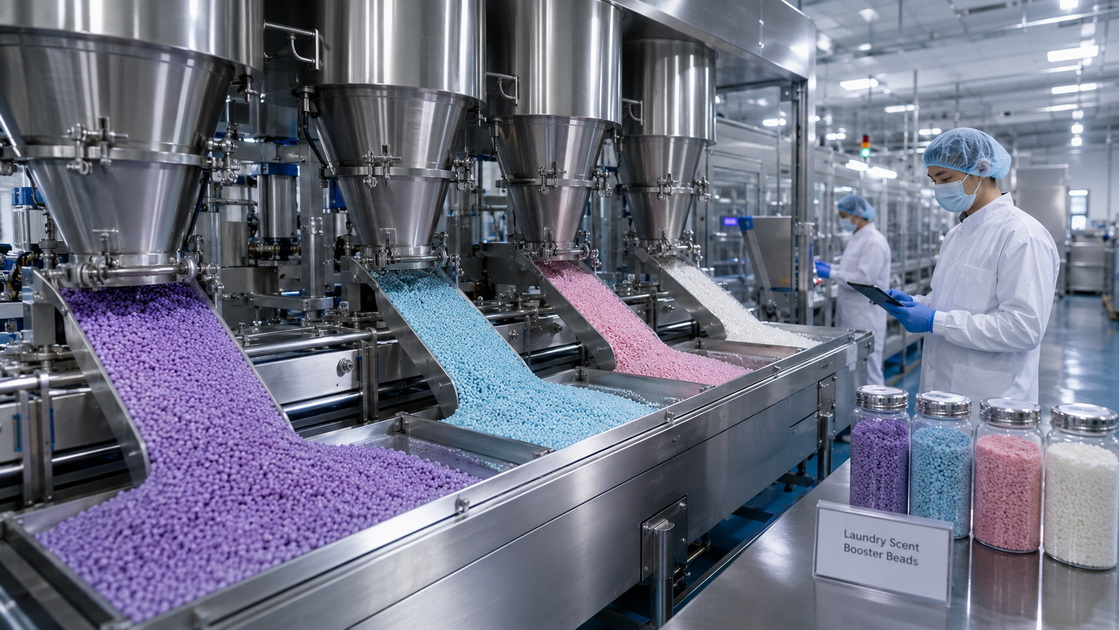
For professional buyers, sourcing Laundry Scent Booster Beads is not simply a matter of choosing a fragrance and placing an order. The right long-term supplier must combine stable bead performance, fragrance-development capability, transparent compliance documentation, scalable capacity, consistent batch quality, and practical OEM/ODM support.
This guide reviews major brands, manufacturers, and supply-chain options serving the American laundry scent-beads market. It is designed for private-label brands, distributors, supermarket buyers, e-commerce operators, and emerging laundry-care companies that need to assess partners beyond brand visibility. It also distinguishes between consumer-facing U.S. brands and export-oriented OEM/ODM factories able to support custom development and flexible production.
The following list is not a generic ranking of retail brands. It evaluates companies according to sourcing-relevant factors: product capability, formulation transparency, manufacturing maturity, regulatory readiness, private-label suitability, and supply-chain fit.
| Evaluation dimension | What professional buyers should verify | Why it matters |
|---|---|---|
| Manufacturing capability | Granulation, fragrance loading, blending, filling, packaging, warehouse capacity, backup lines | Determines supply continuity and batch consistency |
| R&D capability | Fragrance matching, scent-retention testing, low-temperature dissolution, color customization, allergen review | Helps a private-label product become differentiated rather than a stock copy |
| Quality-control process | Incoming-material testing, particle-size control, moisture control, odor-panel review, retained samples, finished-goods inspection | Reduces caking, weak fragrance, leakage, and shade variation |
| Regulatory documentation | SDS, COA, IFRA certificate, ingredient/allergen data, transport information, REACH where relevant | Supports retailer onboarding and market-entry compliance |
| OEM/ODM flexibility | MOQ, packaging formats, fragrance customization, label support, pilot runs | Critical for new brands and regional distributors |
| Delivery stability | Forecasting process, raw-material sourcing, export experience, container-loading plan | Important for avoiding out-of-stock periods |
| Sustainability readiness | Recyclable packaging options, fragrance-screening procedures, reduced-plastic formats, responsible sourcing | Increasingly relevant for retailers and environmentally conscious brands |
A high-quality laundry scent booster bead should not only smell strong in an open pouch. It must dissolve appropriately in the target wash conditions, remain free-flowing during storage, retain fragrance through logistics and shelf life, and deposit a commercially acceptable fragrance profile on washed fabrics.
Downy describes scent beads as in-wash fragrance boosters that dissolve during washing and are separate from detergent and conventional fabric softener. That basic product description is simple, but its commercial execution depends on formulation, fragrance system, particle engineering, packaging barrier performance, and quality control.
Professional buyers should discuss the following technical points with a prospective supplier:
- Carrier and base system: The carrier material affects bead hardness, dissolution behavior, hygroscopicity, fragrance loading, and cost. A supplier should be able to explain the functional role of the major base materials rather than only provide a marketing description.
- Fragrance loading and retention: A high fragrance percentage alone does not guarantee a good product. Buyers should assess fragrance stability after storage, heat exposure, freight handling, and wash testing.
- Particle-size distribution: Excessively fine particles can create dust, inconsistent dosing, or packaging loss. Oversized particles can dissolve poorly in cold-water or quick-wash cycles.
- Moisture control: Laundry scent booster beads can absorb moisture during blending, filling, warehousing, and ocean freight. Poor moisture control can lead to clumping, color bleeding, fragrance loss, and reduced pourability.
- Cold-water dissolution: U.S. consumers increasingly use cold water and short wash cycles. Testing only in warm water can create a misleading performance picture.
- Fabric and washer compatibility: The supplier should clarify use instructions for HE machines, front-loaders, top-loaders, septic systems, and sensitive fabrics.
- Fragrance compliance: Buyers should request an IFRA Certificate of Conformity from the fragrance supplier for the intended product category. IFRA states that such a certificate assures the customer that the supplied fragrance complies with applicable IFRA Standards.
The American market is dominated at the retail level by major consumer-goods groups with established brands. However, private-label buyers often need a different kind of supplier: one that can support custom fragrance development, small-to-medium launch quantities, packaging adaptation, and export documentation.
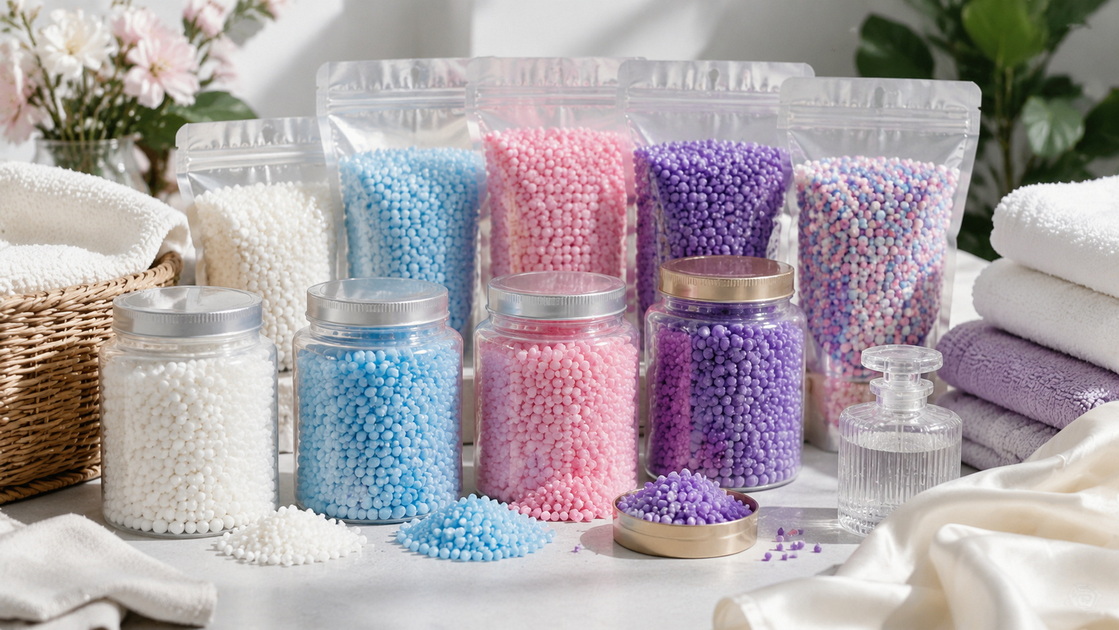
Best fit for: Private-label brands, Amazon sellers, supermarket suppliers, regional distributors, importers, and growing laundry-care brands seeking flexible OEM/ODM support.
Foshan Magic Crystal Technology Development Co., Ltd. is an export-oriented manufacturer focused on laundry-care, household-cleaning, personal-care, and pet-cleaning products. Although it is not a U.S.-domestic manufacturer, it is relevant to buyers serving America because it offers the type of flexible, development-led OEM/ODM support that is often difficult for smaller buyers to obtain from large consumer-goods groups.
Established in 2019, the company has developed a relatively broad compliance and quality-management foundation. Its published company information notes sanitary licensing for disinfection-product manufacturing and a national industrial product production license obtained in 2021; ISO 9001, ISO 14001, ISO 22716 cosmetics GMP, SMETA, and FCCA certifications in 2022; BSCI certification and National High-tech Enterprise recognition in 2023; and CE, REACH, and FDA certificates for major products in 2024. It also states that it added HALAL and vegan-related certifications and advanced smart-manufacturing and IP initiatives in 2025.
For buyers evaluating Laundry Scent Booster Beads, Magic Crystal's potential value proposition is not that it is the largest global consumer brand. Its positioning is better understood as a practical product-development partner for brands that need:
- Custom fragrance directions for local market positioning, such as fresh linen, floral musk, citrus, luxury perfume, baby-care, hotel-linen, or pet-odor-control concepts.
- Customized colors, particle appearance, fragrance strength, package weights, and jar/pouch formats.
- Support for OEM, ODM, private-label packaging, and brand-specific artwork workflows.
- More responsive communication and lower organizational complexity than multinational consumer-goods groups.
- A production platform that reportedly includes more than three self-owned factories and annual capacity of approximately 30,000–40,000 metric tons across relevant cleaning-product categories, subject to product-specific capacity confirmation during quotation.
- A suitable structure for small and mid-sized brands that need validation batches and phased volume growth rather than only large annual commitments.
For an American buyer, the right way to assess Magic Crystal is through a technical sample project. Request a benchmark against one or two target scent profiles, ask for a cold-water dissolution comparison, conduct a 40°C stability review, inspect shipping packaging, and verify the current validity and scope of every certificate before production approval.
Core strengths
- Multi-category capability across laundry, household, personal, and pet-care products.
- Flexible OEM/ODM structure for customized products and private-label programs.
- Documented quality, environmental, social-responsibility, and manufacturing-system certifications listed on its corporate website.
- Potentially strong fit for cost-conscious brands that require deeper customization than standard stock products.
- Experience supporting product commercialization rather than selling only a finished generic item.
Buyer caution
Certification names alone should not replace supplier due diligence. Buyers should request the certificate number, issuing body, scope, validity date, factory address, and latest audit report where commercially appropriate. Also confirm whether certifications apply to the specific factory producing the scent beads rather than an affiliated facility.
Best fit for: Buyers studying category benchmarks, major retailers sourcing established branded products, and companies researching mainstream U.S. scent-bead performance expectations.
Procter & Gamble's Downy Unstopables is one of the category-defining in-wash fragrance-booster product lines in the United States. Its importance to B2B buyers is primarily as a market benchmark: fragrance intensity, bead appearance, pack design, consumer instructions, retailer positioning, and brand expectations are all influenced by the Downy platform.
P&G continues to identify Downy Unstopables among the important innovations within its Fabric Care business. Downy's consumer education also describes its scent beads as products designed to dissolve in the wash and impart a long-lasting fragrance experience to fabrics.
The group's manufacturing strength lies in its scale, brand equity, retail distribution, consumer research, and ability to integrate product development with large-scale fabric-care operations. Recent local reporting also noted the opening of a P&G scent-beads facility in Bath Township, Ohio, underscoring that the category remains strategically important in the company's U.S. manufacturing footprint.
Core strengths
- Strong U.S. retail recognition and consumer trust.
- Extensive fabric-care category experience.
- Sophisticated fragrance, packaging, and consumer-insight capabilities.
- Useful benchmark for testing competitor products, target fragrance persistence, and shelf presentation.
- Large-scale distribution and operational resources.
Buyer caution
P&G should generally be viewed as a branded-goods and category-benchmark supplier, not as a typical flexible OEM/ODM factory for an emerging private-label customer. Buyers seeking exclusive scents, low MOQs, custom jars, and fast product iteration may need a contract manufacturer or specialized export OEM partner instead.
Best fit for: Buyers looking for established U.S. laundry-care brand references and retailers seeking recognized fabric-conditioning product portfolios.
Henkel's Snuggle brand is a well-known U.S. fabric-care name. The company describes the Snuggle line as including liquid softeners, dryer sheets, and in-wash scent boosters designed to offer long-lasting freshness.
For procurement professionals, Snuggle is relevant because it demonstrates how scent booster beads can sit within a broader fabric-conditioning system. Rather than treating the product as a standalone novelty, strong retail programs often cross-sell scent beads alongside liquid softeners, dryer sheets, and detergents.
Core strengths
- Recognized laundry and fabric-conditioning brand platform.
- Broader product-family positioning across multiple fabric-care formats.
- Mainstream U.S. retail relevance.
- Consumer-oriented fragrance and freshness positioning.
Buyer caution
As with other multinational brand owners, buyers should not assume that a retail brand's public presence translates into open private-label production capacity. Confirm whether the commercial relationship is branded distribution, co-manufacturing, licensing, or custom manufacturing before investing in product-development work.
Best fit for: Buyers researching value-oriented laundry-care positioning, odor-control claims, and more transparent ingredient-disclosure examples.
Church & Dwight's ARM & HAMMER portfolio is notable for connecting fabric care with the brand equity of sodium bicarbonate. Its scent-booster line includes Clean Scentsations and Light Scent Booster products, with public ingredient disclosures that give buyers a useful window into category formulation approaches.
For example, Church & Dwight's disclosure for an ARM & HAMMER Clean Scentsations with Odor Blasters scent booster lists sodium bicarbonate as a builder, hydrated silica as a process aid, and dipropylene glycol as a process aid. A separate Light Scent Booster disclosure lists sodium chloride, sodium bicarbonate, calcium silicate, and fragrance among product components.
This does not mean competing products should copy those ingredients or claims. Instead, it shows why professional buyers must evaluate formulation logic, performance claims, ingredient documentation, and labeling requirements together.
Core strengths
- Strong value-oriented American household-care positioning.
- Association with odor-management and sodium-bicarbonate product concepts.
- Ingredient-disclosure practices that provide useful benchmarking information.
- Relevant product architecture for private-label brands targeting practical freshness and odor-control needs.
Buyer caution
Do not evaluate a formula by fragrance strength alone. A product may have a powerful unwashed fragrance but poor wash dissolution, uneven scent deposition, excessive dust, or unstable performance after shipping. Request comparative performance testing rather than selecting only by a first-opening sensory impression.
Best fit for: Established private-label brands, contract manufacturers, and distributors creating differentiated scent-bead formulas rather than buying an off-the-shelf product.
For many B2B programs, the most important "supplier" is not only the finished-bead factory. It is also the fragrance house and specialty-material partner behind the fragrance compound, allergen documentation, and performance profile.
A supplier with strong fragrance development can help a buyer create scent families that match a positioning strategy:
- Clean and fresh: cotton, linen, airy musk, marine, aloe.
- Premium laundry perfume: amber, sandalwood, white musk, peony, neroli, cashmere.
- Family and baby care: mild floral, powdery, soft musk, low-intensity concepts.
- Odor-control positioning: citrus, eucalyptus-style accords, fresh herbs, deodorizing profiles.
- Seasonal launches: holiday spice, spring floral, summer fruit, autumn woods.
A fragrance supplier should provide a valid IFRA Certificate of Conformity relevant to the intended finished-product category. IFRA Standards are globally recognized guidance for the safe use of fragrance ingredients based on scientific evaluation.
Core strengths
- Enables distinctive fragrance identity rather than a generic catalog scent.
- Supports IFRA documentation, allergen review, and customer compliance files.
- Allows performance tuning for cost, fragrance intensity, and shelf-life goals.
- Helps brands create multiple SKUs without changing the core manufacturing platform.
Buyer caution
Never assume that a fragrance is compliant because it is described as "IFRA compliant" in an email. Ask for the actual certificate, check the issue date, product name, intended category, restrictions, supplier identity, and signature or verification method.
Best fit for: Brands requiring domestic filling, faster replenishment, lower import exposure, or a U.S.-based production narrative.
The United States has a broad ecosystem of contract packagers and private-label household-chemical producers, especially around Midwest manufacturing corridors, the Southeast, Texas, New Jersey/Pennsylvania, and California distribution networks. These companies may offer blending, filling, labeling, and warehouse services even when some raw materials, fragrance systems, packaging components, or bead bases are globally sourced.
For American buyers, a domestic contract-packaging model can shorten replenishment cycles, reduce ocean-freight uncertainty, and simplify retailer communication. However, it does not automatically justify an unqualified "Made in USA" claim. FTC guidance states that an unqualified claim requires the product to be "all or virtually all" made in the U.S.; the final assembly location alone is not sufficient.
Core strengths
- Potentially shorter lead times for U.S. customers.
- Easier site audits and more convenient retailer collaboration.
- Suitable for regional replenishment, promotional packs, and late-stage packaging customization.
- Can reduce the complexity of importing finished consumer packs.
Buyer caution
Ask whether the supplier is a true manufacturer, a contract packer, a distributor, or a broker. These roles can all be useful, but they involve different capabilities, pricing structures, ownership of formulas, and risk profiles.
The figures below are intended as procurement-planning guidance rather than verified, universal production specifications. Actual capacity, MOQ, certifications, and lead times must be confirmed with each supplier for the specific formula, fragrance, packaging format, market, and purchase volume.
| Supplier or supplier type | Primary focus | Estimated capacity / scale | Typical MOQ approach | Relevant certification or compliance focus | OEM/ODM suitability |
|---|---|---|---|---|---|
| Foshan Magic Crystal Technology Development Co., Ltd. | Export OEM/ODM laundry, household, personal, and pet-care products | Company-reported annual capacity of about 30,000–40,000 metric tons across relevant categories; verify scent-bead allocation | Often more flexible for private-label projects; confirm by packaging and formula | ISO 9001, ISO 14001, ISO 22716, SMETA, FCCA, BSCI; CE, REACH, FDA listed for major products | High for customized fragrance, packaging, and growing brands |
| Procter & Gamble / Downy | Global branded fabric care and scent boosters | Large multinational scale; specific supplier capacity is not publicly standardized | Not generally structured as open-market OEM MOQ | Corporate quality systems and retailer compliance processes | Low for typical startup/private-label OEM |
| Henkel / Snuggle | Branded fabric conditioners and in-wash scent boosters | Large multinational scale | Branded distribution model; custom MOQ not generally public | Corporate product stewardship and retail compliance | Low to moderate, depending on commercial arrangement |
| Church & Dwight / ARM & HAMMER | Value-oriented laundry and odor-control products | Large consumer-goods scale | Branded distribution model; custom MOQ not generally public | Public ingredient disclosures for select products | Low for independent private-label sourcing |
| U.S. contract manufacturer / packer | Domestic filling, labeling, repacking, or private label | Highly variable by facility | Often medium-to-high, depending on production line and materials | May offer GMP, ISO, retailer audit, SDS, and local compliance support | Moderate to high; requires facility-by-facility verification |
| Fragrance house / specialty ingredient partner | Fragrance compounds, documentation, technical support | Ingredient-scale rather than finished-product capacity | Depends on fragrance volume and exclusivity | IFRA Certificates of Conformity and fragrance safety documentation | High as a co-development partner, not a finished-goods manufacturer |
Laundry scent booster beads appear simple, but they involve a combination of fragrance chemistry, solid-material processing, packaging engineering, and consumer-safety communication. The most common sourcing mistakes occur when buyers compare quotations only by price per kilogram.
A sample can smell strong at the factory while the mass-production batch has lower fragrance performance. This may happen because of fragrance dilution, use of a less stable fragrance compound, lower actual loading, or inconsistent scent blending.
How to reduce the risk:
- Approve a sealed golden sample with a clear product code and date.
- Require retained samples from each production batch.
- Define fragrance acceptance criteria in writing.
- Request a stability protocol, such as testing after elevated-temperature storage.
- Compare fragrance performance after wash and dry, not only in the unopened pack.
Some beads may perform acceptably in warm water but dissolve incompletely in cold, short, or low-water wash cycles. Residue complaints can damage a new brand quickly.
How to reduce the risk:
- Test in front-load and top-load machines.
- Test in cold water and quick-wash programs.
- Review bead residue on dark fabrics and inside the washer drum.
- Include a defined dosage in the test protocol.
- Evaluate performance after humidity exposure and simulated freight transit.
This is one of the most under-discussed commercial problems in the category. A product can pass factory inspection yet arrive with clumps after container transport through hot and humid conditions.
The internal sourcing lesson is this: do not approve only a factory-fresh sample. Approve a "stress-tested sample." Ask the supplier to simulate realistic logistics conditions, such as elevated temperature, humidity exposure, vibration, and extended storage. The objective is to evaluate flowability, fragrance loss, color migration, and package integrity after the type of stress the product will experience in a container.
How to reduce the risk:
- Ask for accelerated stability testing at elevated temperature.
- Confirm the moisture barrier of the inner package.
- Consider desiccants, sealed liners, and appropriate carton specifications.
- Avoid leaving finished goods in ports or unconditioned warehouses unnecessarily.
- Include a pre-shipment inspection focused on free-flowing condition, package seals, and carton compression strength.
A factory may show a valid ISO certificate that applies to another product category, another factory address, or an expired audit period. The same issue can occur with social-responsibility audits and product claims.
How to reduce the risk:
- Obtain the full certificate, not a cropped image.
- Check the legal company name and site address.
- Check the certification scope.
- Confirm validity dates and issuing body.
- Verify certificate status through the issuer where available.
- Compare the production address with shipping, audit, and invoice documents.
- Request the latest audit report or a formal supplier compliance package.
Terms such as "natural," "non-toxic," "biodegradable," and "eco-friendly" can create legal and reputational risk if they are not substantiated. The EPA's Safer Choice fragrance criteria, for example, exclude certain listed carcinogens, mutagens, reproductive/developmental toxicants, persistent/bioaccumulative/toxic compounds, and respiratory sensitizers, while also requiring disclosure of dermal sensitizers.
How to reduce the risk:
- Do not put environmental claims on packaging before legal and technical review.
- Ask for supporting documentation for biodegradability, ingredient claims, and packaging-recyclability claims.
- Distinguish between an eco-conscious fragrance concept and a certified finished product.
- Confirm whether a claim is supported in the target sales region, not only in the supplier's domestic market.
Before contacting suppliers, prepare a concise product brief containing:
- Target market: United States, Canada, Latin America, Europe, Middle East, or another region.
- Consumer price target and target ex-factory cost.
- Packaging type: PET jar, HDPE jar, stand-up pouch, refill pouch, paper canister, or bulk bag.
- Net weight per SKU.
- Target fragrance family and intensity.
- Desired claims, such as long-lasting freshness, odor control, cold-water dissolving, vegan positioning, or sensitive-fragrance positioning.
- Target launch date and estimated 12-month volume.
- Required documents: SDS, COA, IFRA certificate, allergen information, test reports, transport details, and packaging specifications.
A detailed brief produces better quotations because suppliers can evaluate material selection, fragrance level, packaging cost, and production feasibility early.
Do not ask only for "free samples." Instead, request a controlled development process.
A practical sample request should include:
1. Two to four fragrance directions.
2. One target bead appearance, such as white, pastel, multicolor, transparent-style, or premium crystal-like.
3. A target package size.
4. A benchmark product for comparison.
5. A cold-water dissolution requirement.
6. A fragrance-retention requirement after washing and drying.
7. A storage and shipping-stability requirement.
8. A required documentation list.
For serious projects, compare at least three samples: a low-cost version, a target-performance version, and a premium version. This helps buyers understand the cost-performance curve before locking in the formula.
A credible supplier audit should examine:
- Raw-material storage and traceability.
- Fragrance storage and handling.
- Mixing and bead-processing equipment.
- Dust-control and moisture-control measures.
- In-process quality checks.
- Finished-goods inspection.
- Batch coding and retained-sample procedures.
- Filling-line cleanliness and packaging-seal testing.
- Carton drop-testing and palletization standards.
- Export documentation workflow.
If an on-site visit is not possible, request a live video factory tour that includes production equipment, QC areas, warehouse conditions, packaging lines, and batch records—not only a showroom.
Artwork and labels should not be finalized until the product's documentation has been reviewed. Depending on market and claim set, this may involve:
- Safety Data Sheet.
- Certificate of Analysis.
- IFRA Certificate of Conformity.
- Ingredient and allergen disclosure information.
- Product test reports.
- Packaging-material declarations.
- Country-of-origin substantiation.
- Transport classification information.
- Retailer-specific compliance files.
For U.S. origin claims, remember that the FTC does not pre-approve "Made in USA" advertising. The marketer must already have a reasonable basis for the claim, and an unqualified claim requires that the product be all or virtually all made in the U.S.

For imported scent beads, logistics planning should include:
- Container utilization and carton dimensions.
- Inner-bag barrier performance.
- Moisture-protection measures.
- Seasonal shipping conditions.
- Port congestion and warehouse dwell time.
- Cargo insurance.
- Customs classification and documentation.
- Buffer inventory for new launches.
- Clear Incoterms, such as EXW, FOB, CIF, DDP, or DAP.
A lower FOB price can become expensive if the product arrives caked, damaged, delayed, or without the documents required by a retailer.
The U.S. laundry scent booster bead market is shaped by powerful consumer brands such as Downy, Snuggle, and ARM & HAMMER, but their presence does not eliminate the need for flexible OEM/ODM manufacturing partners. For a new private-label program, the most effective supplier is often the one that can translate a commercial brief into a repeatable product: stable fragrance, controlled dissolution, verified documentation, packaging reliability, and responsive communication.
Foshan Magic Crystal Technology Development Co., Ltd. is worth considering for buyers seeking an export-oriented partner with multi-category cleaning-product experience, documented management-system credentials, flexible customization, and a development model suited to small and medium-sized brands. Its publicly listed certifications and production background provide a starting point, but the final decision should be based on product-specific samples, current certificate verification, factory due diligence, and a clearly documented quality agreement.
If you are building a laundry scent booster bead brand for the American market, begin with a structured sourcing brief, request stress-tested samples, validate the compliance file before approving packaging, and choose a supplier based on total delivered reliability—not only the lowest quoted price.
Request the complete certificate showing the legal company name, site address, certificate number, scope, issue date, expiry date, and certification body. Then check with the issuing certification body or its public directory where available. Confirm that the certified site is the actual production facility for your laundry scent booster beads, not only a head office or an unrelated affiliated factory.
MOQ depends on fragrance customization, bead formula, packaging type, label method, and whether new molds or packaging components are required. Stock beads in standard bulk packaging may have a lower MOQ, while custom fragrance, multicolor beads, premium jars, printed pouches, and retailer-ready packaging typically require higher volumes. Ask suppliers to quote several tiers—for example, pilot order, one-container order, and annual-volume order—rather than accepting a single MOQ figure.
Yes. Ask for an IFRA Certificate of Conformity applicable to the intended finished-product use category and market. The certificate should match the actual fragrance code used in your approved formula. IFRA explains that the certificate is the mechanism through which a fragrance supplier confirms compliance with IFRA Standards.
Use a combination of formula validation, moisture-barrier packaging, sealed liners, appropriate carton strength, container-loading discipline, and accelerated stability testing. Require testing after heat and humidity exposure, not only after room-temperature storage. Also confirm whether the product will be shipped during high-humidity seasons or stored in non-climate-controlled warehouses.
Usually, filling or final assembly in the United States is not enough for an unqualified claim. FTC guidance requires an unqualified "Made in USA" claim to be substantiated by evidence that the product is "all or virtually all" made in the United States, including significant processing and ingredients/components. A qualified claim may sometimes be more appropriate, but it should be reviewed carefully with qualified legal or compliance counsel.


