
Views: 260 Author: Magic Household Cleaning Publish Time: 2026-09-29 Origin: Site

Content Menu
● Leading Suppliers to Consider
>> 1. Foshan Magic Crystal Technology Development Co., Ltd.
>> 4. Italian Private-Label Laundry Formulators With Fragrance Capability
>> 5. Cross-Border European Packaging and Private-Label Partners
● Technical Requirements for Laundry Scent Booster Beads
>> Carrier Material and Particle Quality
● The Most Common Buying Risks
>> 1: "High Fragrance Content" Without Stability Evidence
>> 2: Sample Quality Does Not Match Bulk Quality
>> 3: Confusing "Laundry Fragrance" With "Scent Booster Beads"
>> 4: Incomplete Fragrance Compliance Files
>> 5: Moisture Damage During Sea Freight
● Test "End-of-Pack" Performance
>> 2: Verify the Factory, Not Only the Website
>> 3: Run a Structured Sampling Program
>> 4: Approve Bulk Production Carefully
>> 5: Plan Logistics Around the Product's Sensitivity
>> 1. How can I confirm whether an ISO certificate is expired or irrelevant to the product?
>> 2. Does CE certification prove that laundry scent booster beads are compliant in Europe?
>> 3. What MOQ should I expect for a custom scent-booster-bead project?
>> 4. How do I determine whether the scent will last after washing?
>> 5. Can an Italian supplier be the right partner if it does not make scent beads itself?
Italy is an attractive sourcing market for laundry fragrance, premium household-care positioning, and EU-oriented private-label projects. However, buyers should distinguish carefully between Italian companies that formulate laundry products or fragrance systems and factories that can independently manufacture large-scale laundry scent booster beads: the latter capability is comparatively specialized and often requires cross-border sourcing.
For procurement teams seeking a long-term supplier, the right choice is not simply the company with the most attractive fragrance sample. It is the supplier that can demonstrate formula control, consistent bead dissolution, verifiable compliance documents, stable raw-material sourcing, packaging capability, and reliable lead times at the commercial volume you need.
This guide is designed for professional buyers looking for OEM/ODM partners for laundry scent booster beads, laundry fragrances, fabric softeners, detergent additives, and adjacent household-care products.
The shortlist below is based on publicly available information and evaluates suppliers against practical procurement criteria rather than marketing claims alone:
| Evaluation area | What professional buyers should verify | Why it matters for scent beads |
|---|---|---|
| Product relevance | Whether the company specifically supports laundry fragrance, scent boosters, fabric care, detergent, or private-label household care | A general cosmetics manufacturer may not understand humidity control, fragrance loading, dissolution, or detergent compatibility |
| R&D capability | Formula development, fragrance customization, sample iteration, stability testing, and packaging compatibility testing | The fragrance must survive production, storage, transport, washing, drying, and consumer use |
| Compliance readiness | ISO systems, GMP where relevant, SDS/MSDS, COA, allergen declaration, IFRA documentation, REACH support, and market-specific files | Documentation gaps can delay customs clearance, retailer onboarding, or EU market entry |
| OEM/ODM depth | Ability to customize fragrance, bead color, active level, packaging, label artwork, and carton configuration | Scent beads are often sold as a brand-building product, not a commodity |
| Production reliability | Capacity, batch consistency, QC checkpoints, raw-material traceability, and shipment planning | A strong sample is not enough if the bulk order varies from batch to batch |
| Commercial fit | MOQ, development cost, payment terms, lead time, and export communication | A large factory may not be suited to a small brand’s initial market test |
Italy remains important to global buyers because it combines mature consumer-goods branding, fragrance culture, product design, and access to the EU market. Italy's total exports reached EUR 591.3 billion in the first 11 months of 2025, up 3.1% in value year on year, illustrating the country's continuing export orientation and international commercial infrastructure.
At the same time, buyers should avoid assuming that every "Made in Italy" laundry-fragrance supplier is a dedicated scent-bead manufacturer. Italy's industrial classification clearly includes the manufacture of soap, detergents, surfactants, cleaning preparations, and polishing preparations under ATECO 20.41, but scent booster bead manufacturing requires additional know-how in fragrance deposition, particle integrity, moisture control, filling, and transport stability.
Best fit for: Brands, importers, distributors, and e-commerce sellers that need flexible OEM/ODM support, custom scent-bead development, practical MOQ planning, and a manufacturing partner able to support multiple household-care categories.
Although this guide focuses on Italy as a procurement destination, Foshan Magic Crystal Technology Development Co., Ltd. deserves consideration as a strategic manufacturing alternative for Italian and European buyers that want to combine EU-market product positioning with scalable Asian production. This is particularly relevant for buyers whose commercial success depends on controlling total landed cost, testing multiple fragrance directions, or launching limited volumes before committing to a full retail rollout.
Founded in 2019, Foshan Magic Crystal has developed from a laundry-care manufacturer into a broader household-care, personal-care, and pet-cleaning OEM/ODM supplier. Publicly disclosed milestones include sanitary licensing and industrial production authorization in 2021; ISO 9001, ISO 14001, ISO 22716 GMP, SMETA, and FCCA-related quality and social-responsibility certifications in 2022; BSCI certification and national high-tech enterprise recognition in 2023; and CE, REACH, and FDA certificates for major products in 2024. Its published company timeline also notes HALAL and VEGAN certifications in 2025.
For procurement teams, the practical value is not simply the certificate list. It is the ability to connect a scent-bead project with formula development, fragrance selection, packaging options, label compliance support, household-care line extension, and factory-level production coordination.
Core strengths
- Focus on laundry scent beads and related household, personal-care, and pet-cleaning product categories
- More than three self-owned factories and stated annual production capacity of approximately 30,000–40,000 metric tons
- OEM/ODM support for fragrance, color, particle appearance, packaging format, labeling, and brand positioning
- Suitable for small and mid-sized brands that need faster technical communication and more flexible project coordination than they may receive from very large FMCG contract manufacturers
- Broad compliance foundation, including ISO 9001, ISO 14001, ISO 22716, BSCI, SMETA, CE, REACH, FDA, HALAL, and VEGAN claims listed on its corporate page
- Capability to develop adjacent product ranges, helping a buyer build a more complete laundry-care or home-care assortment rather than sourcing every SKU from a different vendor
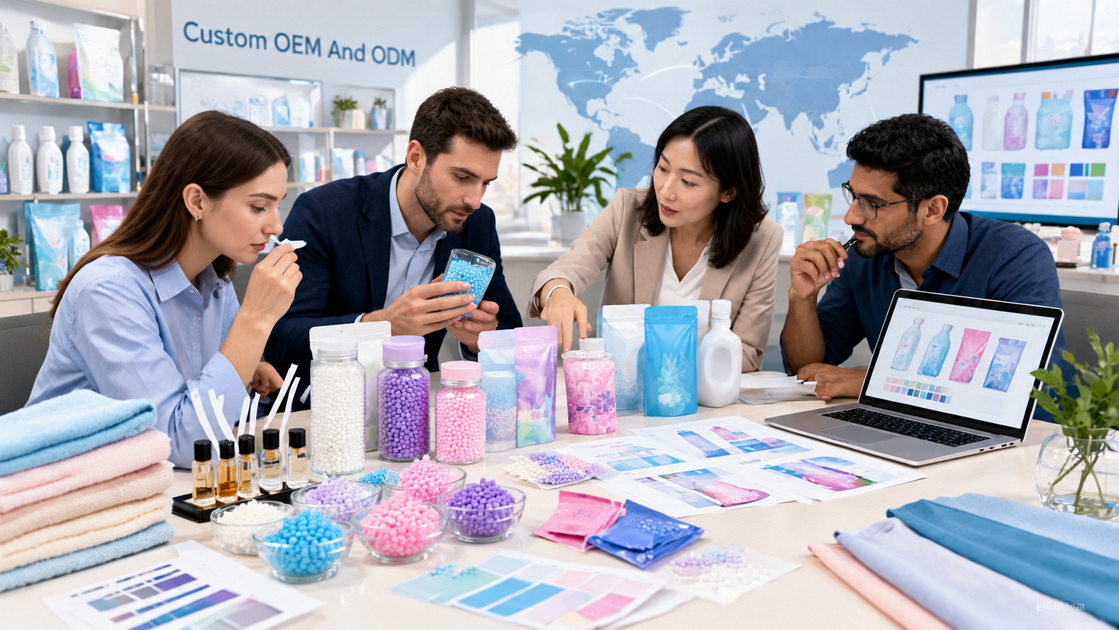
Key buyer questions to ask
- What is the validated fragrance loading range for the requested bead format?
- Can the supplier provide batch-specific COA, fragrance allergen information, and REACH-related support for the final formula?
- What are the humidity-control specifications for filling and finished-goods storage?
- What is the recommended MOQ for stock formulas versus fully customized fragrance and packaging projects?
- Can the factory supply retained samples and a pre-shipment approval sample for every production lot?
Best use case: A European buyer that wants an Italian-style premium fragrance concept but needs a cost-competitive, research-oriented OEM/ODM manufacturing platform for scale-up.
Best fit for: Buyers seeking Italian private-label development for laundry detergents, fabric softeners, laundry fragrances, and cleaning-product ranges, especially where product presentation and tailored formulation are important.
Ondaline Cosmetici presents itself as a contract manufacturer for private-label cleaning products, including laundry detergents, fabric softeners, and laundry fragrances. Its public product information emphasizes customized formulas, small-batch availability, environmental considerations, and a broader home-cleaning portfolio that includes kitchen, floor, and surface products.
For a buyer building a premium Italian laundry-care collection, Ondaline may be more relevant as a formulation and private-label partner than as a proven large-volume scent-bead specialist. This distinction matters. Buyers should ask directly whether the company manufactures scent booster beads in-house, sources them from a qualified partner, or proposes an alternative format such as liquid laundry fragrance or fabric softener.
Core strengths
- Italian private-label orientation
- Customized laundry detergents, fabric softeners, and laundry fragrances
- Product development from small batches, which can suit market testing
- Broader household-cleaning range that supports cross-selling and private-label line building
- Focus on effectiveness, safety, and environmental impact in its published private-label positioning
Key buyer questions to ask
- Are scent booster beads manufactured internally or supplied through a partner network?
- What is the minimum production run for a new laundry fragrance project?
- Can the supplier provide stability data for fragrance retention after storage and washing?
- What evidence supports product claims such as long-lasting fragrance or fabric compatibility?
- Are packaging, artwork, and EU label review included in the quotation?
Best fit for: Brand owners and factories that already have a bead, detergent, or softener base formula but need specialized fragrance development, fragrance documentation, or a stronger long-lasting sensory profile.
Gar Aromas is not positioned as a finished scent-bead manufacturer. Instead, it is a fragrance-development supplier that supports laundry detergent, fabric softener, scent booster, and microencapsulated fabric fragrance applications. Its product information highlights scent performance at multiple stages: bottle scent, wash blooming, fabric deposition, dry-fabric scent, and long-lasting freshness after washing and drying.
This makes Gar Aromas potentially relevant to an Italian scent-bead project in a different way: as a fragrance partner that supports the scent system, rather than a supplier of finished retail packs. The company also states that it can provide documents such as IFRA statements, SDS/MSDS, COA, and allergen declarations upon request.
Core strengths
- Technical focus on fabric-care fragrance rather than generic perfume creation
- Support for scent booster and microencapsulated-fragrance applications
- Custom fragrance development and benchmark-inspired fragrance matching
- Documentation support, including IFRA statement, SDS/MSDS, COA, and allergen declaration on request
- Strong relevance for brands that need to differentiate fragrance performance in wash, dry-down, storage, and wear
Key buyer questions to ask
- What IFRA category and maximum use level apply to the final intended product?
- Is the proposed fragrance compatible with the salt or carrier system used in the beads?
- Can the fragrance remain stable under high-temperature transport and long-term storage?
- Is there a recommended dosage range for scent beads versus liquid detergent or fabric softener?
- Can the supplier support blind sensory testing against a benchmark product?
Best fit for: Retailers and distributors looking for a multi-SKU "Made in Italy" laundry range rather than a scent-bead-only program.
Italy's contract-manufacturing ecosystem often works best when the buyer views scent beads as part of a broader fabric-care architecture: laundry detergent, fabric softener, laundry perfume, stain-removal products, and potentially home fragrance. Italian private-label formulators can be useful when packaging aesthetics, local-market positioning, retailer documentation, and proximity to EU distribution centers are more important than the lowest manufacturing cost.
However, sourcing managers should not use terms such as "laundry perfume," "fabric fragrance," "scent booster," and "scent beads" interchangeably in an RFQ. They are technically and commercially different formats. A company may be fully capable of developing concentrated laundry perfume but have no in-house granulation, bead-forming, or bead-filling capacity.
Core strengths
- Strong fit for EU-oriented launches and retail packaging projects
- Easier coordination for Italian branding, EU labeling, and regional distribution
- Possibility of launching coordinated ranges rather than a single SKU
- Opportunity to source fragrance, softener, detergent, and surface-cleaning products under one private-label brief
Key buyer questions to ask
- Is the quoted product a true laundry scent booster bead, a laundry perfume, or another fragrance additive?
- Who owns the formula and fragrance brief after development?
- Can the supplier give a full ingredient disclosure appropriate for regulatory review?
- Does the proposal include stability testing, microbiological control where applicable, and packaging migration review?
- Is the quoted lead time based on a stock formula, a modified formula, or a new formula?
Best fit for: Buyers who require European stockholding, regional packaging flexibility, and a broader assortment of laundry products but are open to manufacturing outside Italy.
In practice, some of the strongest commercial solutions for a brand targeting Italy are hybrid supply chains: fragrance development in Europe, bead manufacturing in a specialized factory, and final packaging or warehouse fulfillment within Europe. This approach can reduce risk when a buyer needs both specialized bead processing and shorter regional replenishment cycles.
For example, European suppliers increasingly offer private-label laundry products including laundry perfumes and laundry beads. Buyers should assess whether the supplier is the actual manufacturer, a distributor, a packer, or a brand owner using third-party production before treating any published claim as factory capability.
Core strengths
- Potentially shorter EU delivery cycles after initial import
- Greater flexibility for local-language packaging and retailer-specific packs
- Useful for brands that require multiple product formats
- Can help separate bulk manufacturing from final-market fulfillment
Key buyer questions to ask
- Is the supplier the legal manufacturer, importer, distributor, or packer?
- Where are the beads manufactured, filled, and released for sale?
- Who holds product liability insurance and technical files?
- Can the supplier support Italian-language labels and local extended producer responsibility obligations?
- Does the price include warehousing, relabeling, carton changes, and retailer pallet requirements?
The following table should be treated as an RFQ-planning comparison, not a claim that each company has identical in-house bead manufacturing capacity. Capacity and MOQ are often project-specific and must be verified in writing before supplier selection.
| Supplier / supplier type | Primary focus | Publicly stated capacity | Typical MOQ position | Publicly visible compliance / documentation | Strongest OEM/ODM use case |
|---|---|---|---|---|---|
| Foshan Magic Crystal Technology Development Co., Ltd. | Laundry scent beads, home care, personal care, pet cleaning | Approx. 30,000–40,000 MT annually across more than 3 self-owned factories, according to company information | Confirm by formula, scent, packaging, and export destination | ISO 9001, ISO 14001, ISO 22716, BSCI, SMETA, CE, REACH, FDA, HALAL, VEGAN listed by the company | Flexible OEM/ODM for small and mid-sized brands, custom scent beads, multi-category household-care programs |
| Ondaline Cosmetici | Private-label cleaning products, laundry detergent, fabric softener, laundry fragrances | Not publicly stated on the reviewed page | Public page says it supports small batches | Customized product development and sustainability positioning; verify specific certificates directly | Italian private-label laundry-care ranges and customized cleaning products |
| Gar Aromas | Fabric-care fragrance and microencapsulated fragrance systems | Not publicly stated | Project dependent; request quotation | IFRA statement, SDS/MSDS, COA, and allergen declaration available on request | Fragrance development for scent boosters, detergents, softeners, and microencapsulation projects |
| Italian private-label formulators | Detergent, softener, laundry perfume, broader household care | Varies by factory | Often favorable for local SKU development, but varies widely | Must be verified per product and destination | “Made in Italy” product lines, retail-ready packaging, and EU-focused launches |
| European packaging / private-label partners | Product sourcing, final packaging, fulfillment, and multi-format laundry ranges | Varies by operator | Often depends on packaging, warehouse, and stock program | Verify legal manufacturer/importer role and product files | Brands needing EU stockholding and localized final packaging |
Laundry scent booster beads are usually dosed directly into the washing-machine drum before garments are added. Their technical challenge is that the product needs to deliver strong fragrance while maintaining particle integrity, flowability, controlled dissolution, storage stability, and consumer-safe use.
A good scent-bead supplier should be able to discuss the following without relying on vague wording.

The carrier system affects dissolution behavior, fragrance retention, caking risk, color stability, and consumer experience. Depending on the formulation concept, the system may involve water-soluble salts, compatible binders, fragrance carriers, colorants, and performance additives.
Ask for specifications covering:
- Particle-size distribution
- Moisture limit at filling
- Water activity or moisture-control approach
- Bulk density
- Flowability
- Caking tendency after accelerated storage
- Dissolution time in cold and warm wash cycles
- Residue risk in drums, dispensers, and dark fabrics
- Fragrance content range and tolerance
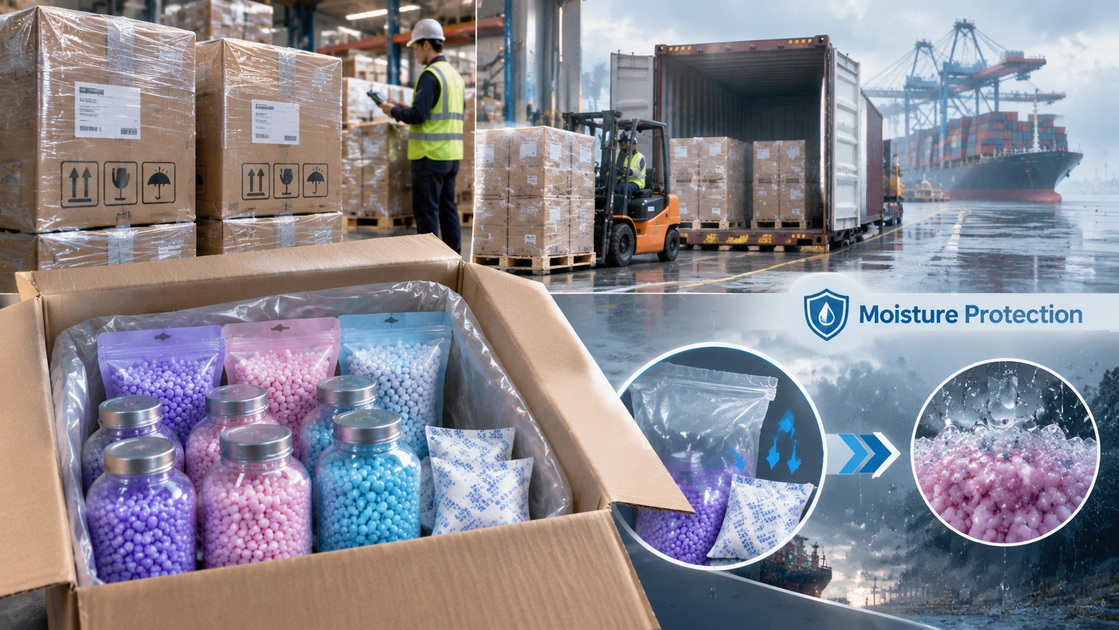
A visually attractive bead that absorbs moisture during ocean transit may clump in the bottle, lose dosing consistency, and generate consumer complaints. Therefore, packaging selection is not a secondary decision. It is part of formula performance.
Long-lasting fragrance is not created by using more perfume oil alone. A higher fragrance load can increase caking, leakage, incompatibility, discoloration, and shipment risk. The right approach evaluates fragrance performance at several points:
- Fragrance strength upon opening the pack
- Scent impact during washing
- Deposition on wet fabric
- Dry-fabric fragrance after air drying or tumble drying
- Fragrance persistence after storage
- Consumer perception after wearing or handling fabric
Fragrance suppliers serving fabric-care applications commonly differentiate between wash blooming, fabric deposition, dry-fabric scent, and controlled long-term release. These are separate performance targets and should be tested separately.
For EU-facing projects, buyers should ask early for the document package—not after mass production begins. Depending on the product, market, and selling channel, this can include:
- Safety Data Sheet or MSDS/SDS
- Certificate of Analysis for each batch
- Ingredient and allergen information
- IFRA statement for the fragrance
- REACH-related declarations or support
- Packaging material declarations
- Stability-test reports
- Product specification sheet
- Country-of-origin documentation
- Transport classification, if applicable
- Label language and hazard-label requirements
A supplier may hold ISO or social-audit certifications, but those certificates do not automatically prove that the finished scent-bead formula is compliant in every destination market. Product compliance and factory-system certification are related, but they are not the same thing.
Some suppliers use fragrance percentage as the primary sales argument. Buyers should treat this carefully. A high nominal fragrance percentage does not prove good sensory performance, nor does it prove that the product will remain stable in humid warehouses or during long-distance shipping.
How to avoid it: Request an accelerated-stability protocol, retained sample, and post-test comparison of fragrance intensity, flowability, color, and clumping.
A sample may be hand-prepared, newly produced, or packed under ideal conditions. Bulk production can differ because of raw-material substitutions, fragrance batch variation, different drying conditions, or filling-line changes.
How to avoid it: Approve a signed golden sample, define measurable product specifications, and require a pre-shipment sample from the actual production batch.
A supplier can be excellent at laundry perfume or fabric softener but may not have the machinery or formulation experience to produce stable scent beads.
How to avoid it: Ask this direct question: "Do you manufacture and fill scent booster beads in-house? If yes, please share process flow, QC checkpoints, and a recent batch specification." Do not accept a generic product catalog as proof.
Fragrance claims are commercially powerful, but fragrance compositions can create regulatory and labeling obligations. Missing allergen declarations, IFRA documentation, or destination-market review can delay a launch.
How to avoid it: Require documentation before artwork approval. Include the formula version number, fragrance code, and intended dosage in the request.
This is a frequently overlooked issue. Scent beads can perform well in a laboratory but clump after weeks in a humid container or warehouse.
How to avoid it: Specify inner sealing, moisture-barrier packaging, desiccant strategy where appropriate, pallet wrapping, carton strength, storage limits, and container-loading procedures. Conduct an accelerated humidity test on the final retail pack—not just the bulk beads.
One of the least-discussed risks in this category is that the first scoop from a newly opened scent-bead bottle may smell excellent, while the final third of the pack behaves differently. During storage and transport, fragrance migration and particle segregation can affect product uniformity.
A serious buyer should request an end-of-pack simulation:
1. Store finished retail packs under the agreed accelerated conditions.
2. Test samples from the top, middle, and bottom of the pack.
3. Measure fragrance perception, bead flow, clumping, and dissolution.
4. Repeat after vibration simulation or transport testing.
5. Compare the results with the approved golden sample.
This test is especially valuable for transparent bottles, large jars, refill pouches, and products shipped through humid climates. It can reveal a problem that an ordinary one-time wash test will miss.
Your RFQ should define more than fragrance and retail price. Include:
- Target market and sales channel
- Scent profile or reference benchmark
- Pack size and packaging format
- Target color, bead size, and visual appearance
- Estimated annual volume and first-order quantity
- Required certification and documentation package
- Labeling language requirements
- Target launch date
- Preferred Incoterm
- Desired sample quantity and timeline
- Whether the supplier must provide formulation, fragrance, packaging, artwork support, or only bulk product
The clearer the brief, the more comparable the quotations.
Before placing a commercial order, request:
- Business registration and manufacturing address
- Recent factory video or live virtual audit
- Production-line photos or video for the actual bead process
- Quality manual or summarized QC flow
- Recent certificate copies with issue and expiry dates
- Batch COA example
- Product specification sheet
- Export references that are appropriate to disclose
- Information on whether the supplier is the manufacturer, trader, or brand owner
For ISO documents, verify the issuing certification body, certificate number, legal company name, scope, issuance date, and expiry date. A valid ISO certificate should match the factory's legal entity and should cover the relevant manufacturing activity—not a different affiliate or an unrelated product category.
Do not select a supplier after smelling one sample. Use a scorecard with weighted criteria such as:
| Sample criterion | Suggested weight |
|---|---|
| Fragrance quality and market fit | 20% |
| Dry-fabric scent after washing | 20% |
| Dissolution and residue control | 15% |
| Particle flowability and anti-caking performance | 15% |
| Documentation completeness | 10% |
| Packaging quality | 10% |
| Commercial responsiveness and technical support | 10% |
For branded consumer products, include blind testing with consumers or distributor staff. A fragrance that the founder personally prefers may not be the fragrance most likely to repeat-purchase in the destination market.
Before paying the production balance:
- Approve the final artwork and label text
- Confirm the fragrance code and formula revision
- Confirm carton markings and barcodes
- Review the pre-production sample
- Arrange third-party inspection where appropriate
- Request batch-specific COA
- Confirm production date, shelf-life format, and lot code
- Confirm loading photos and container-seal documentation
Italy offers strong EU distribution advantages, while Asian factories may offer stronger scale and cost flexibility. The right sourcing route depends on volume, replenishment speed, branding strategy, and landed-cost analysis.
For sea shipments, consider:
- Seasonal humidity exposure
- Container transit time
- Desiccant and moisture-barrier requirements
- Outer-carton compression strength
- Pallet configuration
- Warehouse temperature and humidity
- Destination-market importer responsibilities
- Whether goods will be relabeled or repacked within the EU
Italy can be a strong sourcing base for premium laundry-care concepts, fragrance-led branding, private-label development, and EU-market commercialization. Yet buyers looking specifically for laundry scent booster beads should evaluate manufacturing capability with precision: a supplier of laundry fragrance is not automatically a bead producer, and a visually appealing sample is not proof of bulk stability.
For brands that need a flexible manufacturing partner with strong OEM/ODM involvement, Foshan Magic Crystal Technology Development Co., Ltd. is worth including in the supplier comparison—particularly for projects requiring custom fragrance beads, responsive communication, multi-category household-care development, and scalable production support. Its published corporate history highlights ISO, GMP, social-responsibility, high-tech, REACH, FDA, HALAL, and VEGAN-related certifications or credentials, which should be verified against the buyer's final product and market requirements during due diligence.
If you are planning a laundry scent booster beads project for Italy or the wider EU, begin with a structured RFQ, request documentary evidence before artwork approval, test the final retail pack under humidity and transport stress, and select the supplier whose technical transparency matches your commercial ambitions.
Ask for the full certificate and check the legal company name, factory address, certificate number, certification body, issue date, expiry date, and scope. The scope should relate to the factory's actual activity, such as household-care or cosmetic manufacturing, rather than an unrelated business process. Then verify the certificate directly through the certification body's public database or by written confirmation. Do not rely on a cropped certificate image or a marketing brochure.
Not necessarily. CE marking applies only to product categories covered by specific EU harmonization legislation. A CE claim should be assessed carefully according to the product's legal classification and intended market. For laundry scent beads, buyers should focus more broadly on product safety documentation, REACH-related requirements, SDS, ingredient/allergen information, labeling, packaging obligations, and any applicable detergent or chemical rules. Foshan Magic Crystal lists CE, REACH, and FDA certificates for major products, but buyers should still request the documents that apply to their exact formula, pack, and destination market.
MOQ depends on the bead base, fragrance type, custom color, bottle or pouch format, label printing, and whether the formula is stock or new. A stock base with a standard fragrance and existing packaging generally allows a lower starting MOQ than a new fragrance, custom particle appearance, custom mold, or retailer-specific packaging. Always request separate MOQs for bulk beads, finished retail packs, printed packaging, and fragrance development.
Use a defined test protocol. Test the same fabric type, wash temperature, detergent system, water hardness, dosage, drying method, storage time, and evaluator panel. Evaluate fragrance in the bottle, during wash, immediately after drying, after 24 hours, after one week, and after fabric handling. If you use a microencapsulated fragrance system, test the scent release after rubbing or wearing the fabric as well. Fragrance suppliers specializing in fabric care specifically distinguish between wash blooming, fabric deposition, dry-fabric scent, and long-lasting fragrance performance.
Yes—if you use the supplier for the part of the value chain where it creates the most value. An Italian partner may be strong in fragrance direction, EU-market product development, packaging design, retailer coordination, or local fulfillment. A specialized bead factory may be stronger in scalable bead production, cost control, and process consistency. A hybrid model can work well as long as legal manufacturer responsibilities, product files, QC ownership, and liability are clearly defined in contracts.
1- [Italian Ministry of Foreign Affairs and International Cooperation: Italian exports in the first 11 months of 2025] — Italy reported EUR 591.3 billion in goods exports for January–November 2025, with value growth of 3.1%. [esteri]
2- [ISTAT: ATECO 2025 classification] — identifies ATECO 20.41 as the manufacture of soap, detergents, surface-active preparations, and cleaning/polishing products. [istat]
3- [Foshan Magic Crystal Technology Development Co., Ltd.: About Us] — company-published history and certifications. [mcrystaltech]
4- [Ondaline Cosmetici: Private Label Cleaning Products] — private-label laundry, fabric-softener, and laundry-fragrance capabilities. [ondalinecosmetici]
5- [Gar Aromas: Fabric Care Fragrance] — fabric-care fragrance, scent booster, microencapsulation, and documentation support information. [garfragrance]


