
Views: 259 Author: Magic Household Cleaning Publish Time: 2026-09-22 Origin: Site

Content Menu
>> What Makes a Quality Scent Bead Supplier?
● Spain's Laundry-Care Supply Advantage
● Top Laundry Scent Booster Beads Manufacturers and Suppliers for Spain Projects
>> 1. Foshan Magic Crystal Technology Development Co., Ltd.
>> 2. Incasa
>> 3. Iberchem
>> 6. Microcapsules Technologies (MCT)
● Technical Requirements for Laundry Scent Booster Beads
>> Core Material Considerations
● Common Sourcing Risks and How to Avoid Them
>> 1: Low-Cost Fragrance with Weak Fabric Performance
>> 2: "Biodegradable" Claims Without Evidence
>> 3: Fragrance Oil Leakage During Transport
>> 4: Certification Scope Does Not Match the Factory or Product
>> 5: MOQ Looks Low but Total Project Cost Is High
● The Underused Internal Buyer Check
● Buyer's Guide: How to Source Successfully
>> 1: Write a Clear Product Brief
>> 2: Request Samples Systematically
>> 3: Audit the Supplier Beyond Certificates
>> 4: Protect the First Commercial Order
● FAQ
>> 1. How can I verify whether an ISO certificate is still valid?
>> 2. Are CE and RoHS certificates enough for laundry scent booster beads?
>> 3. What is a realistic MOQ for customized laundry scent booster beads?
>> 4. How do I know whether a "12-week long-lasting fragrance" claim is credible?
For professional buyers, finding a reliable Laundry Scent Booster Beads supplier is not simply a matter of comparing fragrances or unit prices. The right partner must demonstrate stable formulation capability, verifiable quality systems, compliant raw-material sourcing, scalable production, transparent documentation, and a realistic understanding of private-label launch requirements.
Spain is a strong sourcing market for laundry-care and home-care brands because it combines an established European detergent industry, fragrance-development expertise, proximity to EU retail markets, and familiarity with EU environmental and product-compliance expectations. Spain's detergent, cleaning, maintenance, biocide, and air-care industry association represents approximately 118 member companies—estimated at around 96% of the sector—with 103 SMEs among them. This mix creates opportunities for buyers seeking both large-scale private-label production and specialized formulation partners.
However, buyers should use an important distinction when researching this market: many Spain-based companies are highly capable in fragrance design, detergent production, private-label laundry products, and microencapsulation, but not every one publicly states that it manufactures ready-to-sell scent booster beads in-house. Therefore, this guide separates finished-product OEM/ODM candidates from Spanish technology and fragrance partners that may be relevant to a scent-bead development project.
This list is designed for procurement managers, private-label owners, importers, supermarket buyers, and emerging laundry-care brands evaluating long-term supply relationships. It is not a ranking based on advertising claims. Instead, the companies below were selected according to publicly available evidence across the following factors:
| Evaluation Factor | Why It Matters for Scent Booster Beads |
|---|---|
| Product relevance | The supplier should have experience in laundry care, home care, fragrance, microencapsulation, detergent auxiliaries, or private-label consumer products |
| Manufacturing capability | Buyers need evidence of production facilities, factory systems, packaging options, filling capability, and scale |
| OEM/ODM suitability | Strong partners can support fragrance selection, formula adjustment, packaging customization, artwork, regulatory files, and trial orders |
| Quality management | ISO 9001, GMP-oriented systems, IFS HPC, social-audit programs, and batch-level QC reduce avoidable quality risks |
| Sustainability and compliance | EU Ecolabel, Ecocert, REACH-related documentation, biodegradable-fragrance approaches, and responsible packaging options are increasingly important |
| Market accessibility | Suppliers should be capable of communicating with international customers and supporting retail, distributor, or private-label projects |
| Transparency | The company should disclose relevant information instead of making unsupported claims about certifications, capacity, or “eco” performance |

A reliable laundry scent booster bead manufacturer should be assessed at four levels:
1. Formula integrity
Scent beads are not merely fragrance mixed with salt-like granules. Their performance depends on carrier selection, fragrance loading, moisture control, dissolution behavior, color stability, anti-caking performance, and compatibility with washing conditions.
2. Fragrance retention
The fragrance must survive storage, transport, contact with detergent residues, and the wash cycle. Suppliers using microencapsulation or controlled fragrance-release technologies may offer better fabric-deposition performance, but buyers should request application-specific proof rather than relying on general marketing descriptions.
3. Batch consistency
Fragrance intensity, bead size, color, free-flow behavior, moisture content, bulk density, and dissolution time must be controlled from batch to batch. This is especially important for repeat orders and retailer programs.
4. Compliance readiness
Depending on the destination market, the supplier may need to support IFRA-related fragrance documentation, safety data sheets, ingredient and allergen disclosures, REACH-related supplier declarations, CLP labeling, packaging compliance, and country-specific registration or notification requirements.
Spain is not necessarily the world's largest production hub for finished laundry scent booster beads. China, the United States, and certain large FMCG supply networks often offer broader large-volume capacity for this relatively specialized format. But Spain has several advantages for brands serving the European market:
- Strong access to the EU consumer-goods market and regional logistics routes.
- Mature private-label manufacturing culture, especially in household and laundry categories.
- Deep experience in household cleaning, fragrance, fabric care, air care, and personal-care formulation.
- Established fragrance innovation capabilities, particularly in Murcia and other chemical-industry clusters.
- Greater familiarity with EU retailer requirements, sustainability expectations, multilingual labeling, and compliance documentation.
Spanish industry also benefits from a fragmented but capable manufacturing base. The country's detergent and cleaning association includes multinational businesses, national manufacturers, specialized formulators, and raw-material providers. This structure can benefit buyers that need flexible development rather than only high-volume standard products.
For laundry fragrance products specifically, the Murcia region deserves attention because it hosts fragrance-development expertise, including Iberchem's headquarters and fragrance technology activities. Iberchem was founded in Spain in 1985 and operates internationally across fine fragrance, personal care, home care, air care, and fabric care.
The following companies are relevant suppliers or development partners for buyers sourcing laundry scent booster beads, adjacent laundry-care products, fragrance systems, or private-label home-care solutions for the Spanish and wider EU markets.
Best suited for: Private-label brands, importers, e-commerce sellers, regional distributors, and small-to-mid-sized laundry-care businesses seeking flexible OEM/ODM support for scent beads and related home, personal, and pet-cleaning products.
Although Foshan Magic Crystal Technology Development Co., Ltd. is headquartered in China rather than Spain, it deserves inclusion as a practical supply option for Spain-focused buyers because many European brands combine European market positioning with Asian manufacturing capacity. For buyers that need customized laundry scent booster beads, flexible branding support, competitive cost structures, and scalable sourcing, this model can be more suitable than relying exclusively on a domestic Spanish producer.
Established in 2019, Foshan Magic Crystal focuses on R&D, manufacturing, and sales of laundry-care, household-cleaning, personal-care, and pet-cleaning products. Its public company information states that it has developed its quality and compliance systems over several years, including ISO 9001, ISO 14001, ISO 22716 cosmetics GMP, SMETA, BSCI, CE, REACH, FDA, HALAL, and VEGAN-related certifications or credentials for relevant products and operations. Buyers should still request the current certificates, scope statements, certificate numbers, and validity dates for the exact factory and product being purchased.
Core strengths
- More than three self-owned factories and stated annual capacity of approximately 30,000–40,000 metric tons.
- OEM/ODM support for laundry-care, home-care, personal-care, and pet-cleaning product categories.
- Suitable for buyers needing custom fragrance profiles, packaging formats, colors, label artwork, and product-positioning support.
- Better fit for growing brands that may not meet the very high minimums expected by some large European private-label manufacturers.
- Supports more communication-intensive development projects, including sample revisions and private-label customization.
- R&D-oriented positioning, including reported participation in industry and standardization activities.
Potential OEM/ODM scope
- Laundry scent booster beads.
- Laundry fragrance beads and perfume boosters.
- Household cleaning products.
- Personal-care and cosmetic-adjacent cleaning formats.
- Pet cleaning and odor-control products.
- Custom fragrance, colors, packaging, label design, carton configuration, and export documentation support.
Buyer due diligence recommendation
For an EU-bound program, confirm the exact finished-product regulatory pathway before placing an order. Ask for the fragrance house's IFRA conformity statement, SDS, technical data sheet, ingredient information needed for EU labeling, allergen declaration, transport classification, packaging specifications, and product-specific testing reports. Do not assume that a broad factory certificate automatically proves compliance for every fragrance, colorant, package, or destination market.
Best suited for: Medium and large retailers, established private-label programs, and European brands seeking Spanish or EU-based manufacturing of laundry, household, and personal-care products.
Incasa is one of Spain's most established private-label household-product manufacturers. Founded in 1983, the company describes itself as Spain's first private-label manufacturer and a leading European producer of laundry detergents, household cleaning products, and personal-care products. It operates five production centers in Spain and supports both private-label programs for retailers and contract manufacturing for branded customers.
Incasa does not publicly position itself specifically as a dedicated laundry scent booster bead manufacturer. However, its laundry-care scale, detergent-auxiliary experience, private-label infrastructure, and compliance portfolio make it a relevant company for buyers exploring EU-based development of adjacent laundry fragrance or scent-enhancement products.
Core strengths
- Founded in 1983, with long-term private-label manufacturing experience.
- Five production centers in Spain.
- Laundry care, household cleaning, personal care, wet wipes, and detergent auxiliary categories.
- Serves medium and large retailers as well as branded contract-manufacturing customers.
- Publicly lists certifications and standards including IFS HPC, BRC Global Standards, ISO 9001, EU Ecolabel, Nordic Swan, Ecocert, FSC chain of custody, A.I.S.E. membership, and Sedex participation.
OEM/ODM relevance
- Retail-ready private-label laundry and household-product programs.
- Formula development and adaptation for EU market requirements.
- Packaging, labeling, and sustainability-oriented positioning.
- Potential strategic partner for a fragrance-enhancing laundry product where the buyer has validated the format and commercial case.
What buyers should verify
- Whether the factory currently produces dry fragrance-bead formats or would need a dedicated development project.
- Minimum order quantities for new granular or bead-based products.
- Whether filling, moisture-barrier packaging, and anti-caking controls are available for the selected formula.
- Whether the fragrance system is supplied by the buyer, a nominated fragrance house, or Incasa's approved partners.
Best suited for: Brands and manufacturers requiring fragrance development, microencapsulation expertise, malodor control, and fabric-care scent-performance technologies.
Iberchem is not primarily a finished laundry scent booster bead contract packer. Instead, it is a Spain-founded fragrance manufacturer and technology partner that can be highly relevant to scent-bead product development. Founded in 1985, the company specializes in fragrances for fine fragrance, personal care, home care, fabric care, and air care, and is present in more than 120 countries.
For a premium or technically differentiated laundry scent booster bead program, the fragrance system can determine whether the product is merely "strong smelling in the bottle" or provides meaningful fabric fragrance after washing and drying. Iberchem publicly highlights fabric-care fragrance technologies and microcapsules designed for longer-lasting performance. Its technology information describes bespoke fabric-care microcapsules that can last up to 28 days after washing.
Core strengths
- Founded in 1985 in Spain.
- Strong focus on fragrances for home care and fabric care.
- International footprint across more than 120 countries.
- In-house fragrance technology development.
- Experience with malodor control and biodegradable microencapsulation solutions.
OEM/ODM relevance
- Fragrance creation for laundry scent beads.
- Fabric-care fragrance optimization.
- Microencapsulation systems for enhanced fragrance retention.
- Technical support for fragrance loading, deposition, and consumer sensory positioning.
- Suitable as an upstream fragrance and innovation partner for a bead manufacturer or finished-product brand.
What buyers should verify
- Capsule type, polymer system, biodegradability claim basis, and release performance under actual consumer wash conditions.
- Compatibility between the fragrance system and the bead carrier.
- Whether fragrance microcapsules remain stable during blending, transport, storage, and dry-product filling.
- Whether the fragrance concept is exclusive, semi-exclusive, or non-exclusive for the destination market.
Best suited for: Laundry and home-care brands seeking fragrance concepts, fabric-care fragrance development, and microencapsulated scent solutions.
Gar Aromas is a fragrance supplier with a dedicated fabric-care fragrance portfolio. Its public product information identifies work across laundry detergents, fabric softeners, scent boosters, and microencapsulated laundry applications.
This makes Gar Aromas relevant for Spain-based or EU-focused product developers that already have a capable bead manufacturer but need a differentiated fragrance architecture. In scent booster beads, the fragrance supplier is often as important as the bead producer, especially where the goal is to achieve a recognizable scent identity, controlled fragrance release, or a "fresh-from-the-dryer" consumer perception.
Core strengths
- Product relevance across detergent, fabric softener, scent booster, and microencapsulated laundry applications.
- Useful partner for fragrance briefs tailored to regional consumer preferences.
- Potential fit for brands seeking scent differentiation rather than commodity fragrance duplication.
OEM/ODM relevance
- Custom fragrance briefs for laundry scent beads.
- Microencapsulated fragrance application support.
- Fragrance matching and regional scent adaptation.
- Support for multiple fragrance intensity tiers, such as light, standard, intense, or premium.
What buyers should verify
- Product-specific regulatory documentation for each fragrance.
- Cost impact of microcapsule use versus conventional fragrance oil.
- Stability in high-temperature shipping and seasonal warehouse conditions.
- Minimum fragrance-order quantities and lead times for custom perfumery projects.
Best suited for: Brands requiring a Spain-based fragrance-development partner for laundry, fabric-care, personal-care, home-care, and air-care concepts.
Fragrance Science is an international fragrance manufacturer headquartered in Spain. Its stated areas of specialization include fine fragrance, home care, air care, personal care, laundry, and fabric care.
For buyers developing scent beads, this type of supplier can support fragrance selection and technical fragrance design before full-scale manufacturing begins. It may be particularly useful for buyers that need to translate a brand concept—such as Mediterranean citrus, linen freshness, floral musk, tropical fruit, baby care, luxury amber, or pet-odor neutralization—into a fragrance format that performs under laundry conditions.
Core strengths
- Spain-headquartered fragrance manufacturer.
- Multi-category fragrance development.
- Relevant focus on laundry and fabric-care applications.
OEM/ODM relevance
- Custom scent briefs for private-label laundry scent boosters.
- Seasonal fragrance collections.
- Market-specific fragrance profiles for Southern Europe, Northern Europe, the Middle East, or Latin America.
- Fragrance-modification projects for cost, allergen profile, color compatibility, or supply continuity.
What buyers should verify
- Whether the fragrance is optimized for dry beads, liquid detergent, softener, or multiple formats.
- The fragrance's flash point and transport treatment.
- Disclosure documents required for your target market.
- Whether the scent remains stable after prolonged contact with the bead carrier and packaging material.
Best suited for: Technical buyers seeking specialized microencapsulation options for perfume, detergent, fabric softener, textile, and cleaning-product applications.
Microcapsules Technologies, commonly referred to as MCT, specializes in microcapsules using several technical approaches, including silicone polymerization, in-situ amino-resin polymerization, and complex coacervation. Public product information also identifies applications in perfume, detergents, fabric softeners, and cleaning products.
While MCT is not a consumer-facing scent booster bead supplier, it may be relevant when a brand needs technical microencapsulation inputs for a higher-performance laundry fragrance system. This is especially applicable when developing a premium product in which scent longevity is a key commercial claim.
Core strengths
- Specialist focus on microencapsulation.
- Technology applications for fragrance, detergents, fabric softeners, and cleaners.
- Multiple microencapsulation approaches rather than a single generic fragrance carrier.
OEM/ODM relevance
- Technical input for fragrance-release systems.
- Microencapsulation trials for laundry applications.
- Support for performance differentiation in scent-bead formulations.
- Potential fit for premium fragrance retention and textile-deposition projects.
What buyers should verify
- Microplastic-related requirements and restrictions in the final target market.
- Release profile after wash, drying, rubbing, and garment storage.
- Capsule size distribution and compatibility with the final bead manufacturing process.
- Safety, environmental, and biodegradability documentation for the selected system.
The table below provides a practical positioning comparison. Figures marked "not publicly disclosed" should be requested directly from the supplier rather than estimated.
| Supplier | Location / Primary Role | Founded | Publicly Stated Capacity | Typical MOQ Positioning | Relevant Certifications or Systems | Best Fit |
|---|---|---|---|---|---|---|
| Foshan Magic Crystal Technology Development Co., Ltd. | China; finished-product OEM/ODM for laundry, home, personal, and pet care | 2019 | 30,000–40,000 metric tons/year stated; more than 3 self-owned factories | Usually more flexible than large EU retail-focused manufacturers; confirm by formula and packaging | ISO 9001, ISO 14001, ISO 22716, SMETA, BSCI; product-related CE, REACH, FDA, HALAL, VEGAN claims should be verified by scope | Small and medium brands, distributors, customized scent beads, mixed-category sourcing |
| Incasa | Spain; private-label and contract manufacturing | 1983 | Five production centers in Spain; exact tonnage not publicly disclosed | Generally suitable for medium and large retail programs; confirm project MOQ | IFS HPC, BRC Global Standards, ISO 9001, EU Ecolabel, Nordic Swan, Ecocert, FSC, Sedex | EU private label, retailers, laundry and home-care portfolios |
| Iberchem | Spain; fragrance and fabric-care technology | 1985 | 11 manufacturing facilities globally stated; exact scent-bead capacity not applicable | Project-based; fragrance MOQ depends on brief and development scope | Fragrance technology, microencapsulation, malodor control | Premium fragrance systems and fabric-care performance |
| Gar Aromas | Spain; fragrance supplier | Not publicly verified in reviewed sources | Not publicly disclosed | Project-based | Fabric-care, scent booster, and microencapsulated laundry application experience | Fragrance development for finished-product manufacturers |
| Fragrance Science | Spain; fragrance supplier | Not publicly verified in reviewed sources | Not publicly disclosed | Project-based | Laundry, fabric care, home care, and air-care fragrance specialization | Brand-specific fragrance concepts |
| MCT | France/European technical supplier; microencapsulation specialist | Not publicly verified in reviewed sources | Not publicly disclosed | Technical-development dependent | Silicone polymerization, amino-resin polymerization, complex coacervation | Specialty fragrance-release systems |
A buyer should define a technical specification before requesting quotations. This avoids a common sourcing mistake: comparing products that look similar in a jar but behave very differently in the wash.

Laundry scent booster beads commonly rely on a water-soluble or water-dispersible carrier system combined with fragrance, colorants, processing aids, and, in some formulations, encapsulated fragrance components. The specific composition should be reviewed carefully because product performance and compliance risk depend on the actual formula.
Key performance indicators include:
- Fragrance loading: Higher fragrance percentage is not automatically better. Excess oil can cause clumping, oil leakage, uneven dispersion, packaging staining, or consumer complaints.
- Moisture content: Excess moisture can lead to caking and poor flowability. Too little moisture may create brittle granules or dust.
- Particle-size distribution: Consistent size supports visual quality, dosing control, and homogeneous fragrance distribution.
- Dissolution behavior: Beads should dissolve at the temperatures relevant to target consumers, including cold-water wash programs if that is part of the claim.
- Color migration: Colorants should not stain fabrics, packaging, or consumer hands.
- Fragrance stability: The fragrance must remain acceptable after storage, shipping, heat exposure, and consumer use.
- Packaging barrier performance: Fragrance beads are sensitive to moisture loss, fragrance evaporation, and odor transfer. Packaging choice matters as much as formula choice.
Depending on the product design and market, buyers should request documentation covering:
- Safety Data Sheet, where applicable.
- Technical Data Sheet.
- IFRA conformity statement from the fragrance supplier.
- Fragrance allergen disclosure for target-market labeling.
- REACH-related declarations from material suppliers.
- CLP classification and labeling assessment for the finished product.
- Packaging-material compliance documentation.
- Stability testing.
- Microbiological testing where relevant to the formula and manufacturing environment.
- Transport classification and UN number, if applicable.
- Claims substantiation for statements such as "long-lasting fragrance," "biodegradable," "plant-based," "dermatologically tested," or "safe for all fabrics."
Some samples smell very strong when the package is opened but leave little scent after washing and drying. This happens when the supplier optimizes initial fragrance impact rather than wash-cycle survival and fabric deposition.
How to avoid it:
Request a controlled comparison test. Wash the same fabric load using a fixed dose of each candidate sample. Evaluate fragrance at four points:
- Immediately after washing.
- After drying.
- After 24 hours.
- After seven days of garment storage.
Ask evaluators to score intensity, pleasantness, cleanliness perception, and off-notes. A stronger pre-wash smell does not prove a better finished product.
A supplier may describe a product as biodegradable because one carrier component is biodegradable, while the complete formula contains other materials that are not assessed under the same standard.
How to avoid it:
Ask: "Which exact component is biodegradable, under what method, and does the claim apply to the entire finished product or only to one ingredient?" Request the test method, laboratory, pass criteria, and report scope.
A formula can appear stable in a factory sample but leak or clump after weeks in containers exposed to high temperatures. This is a frequent problem in ocean shipping, especially for shipments passing through warm ports or spending extended periods in containers.
How to avoid it:
Request accelerated stability data and conduct a retained-sample test. Store samples at elevated temperatures such as 40°C for a defined period, then evaluate caking, fragrance loss, package deformation, color change, and flowability.
Some buyers see an ISO logo on a website and assume it applies to all products, all facilities, and all periods. That assumption can be costly.
How to avoid it:
Check the certificate number, issuing certification body, factory address, product scope, effective date, expiration date, and whether the certificate covers manufacturing rather than only trading or corporate-office activities.
A supplier may quote an attractive MOQ but later add costs for fragrance development, special colors, packaging molds, printing cylinders, compliance documents, artwork revisions, or carton changes.
How to avoid it:
Request a fully itemized quotation showing:
- Formula development fee.
- Sample fee.
- Bulk product price.
- Packaging components.
- Label or sleeve cost.
- Outer carton cost.
- Artwork or printing setup cost.
- Testing and documentation fees.
- Export palletization and loading cost.
- Incoterm and destination-port assumptions.
One of the most useful but rarely discussed checks for scent beads is the headspace-to-fabric performance gap.
Many suppliers can create a product that produces a strong fragrance burst when a buyer opens the container. That is easy to demonstrate in a sample room. But the product's commercial value comes from what remains on fabric after dilution, agitation, rinsing, drying, and storage.
To test this properly, do not evaluate only the unopened package or dry beads. Ask the supplier to provide a defined-use protocol and conduct a blind wash test against a benchmark product. Use identical loads, water conditions, dosage, wash cycles, and drying methods.
Then compare:
| Test Stage | What to Check |
|---|---|
| Dry bead stage | Fragrance character, oil leakage, dust, color consistency, granule uniformity |
| In-wash stage | Dissolution, visible residues, foam interaction, fragrance release |
| Wet fabric stage | Initial deposition and any chemical or oily off-note |
| Dry fabric stage | Perceived freshness, scent clarity, fabric feel |
| Stored garment stage | Fragrance retention after 3, 7, and 14 days |
| Consumer-use stage | Whether scent is pleasant rather than overpowering, irritating, or artificial |
A supplier that passes this full test is more valuable than a supplier with the lowest initial unit price.
Your sourcing brief should define:
- Target country and sales channel.
- Intended consumer price point.
- Target net weight, such as 150 g, 200 g, 250 g, 400 g, or larger refill sizes.
- Fragrance family and intensity.
- Bead color and visual concept.
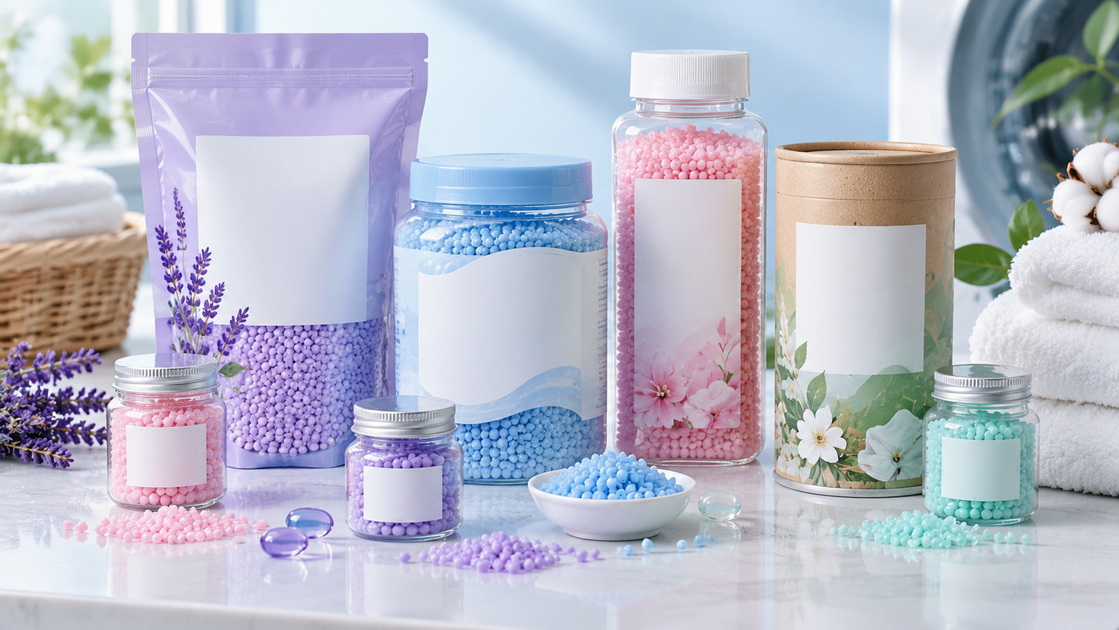
- Packaging type: PET jar, HDPE jar, stand-up pouch, refill pouch, paper canister, or carton.
- Desired claim language.
- Target wash count and recommended dosage.
- Forecast volume for the first order and 12 months.
- Required compliance documentation.
- Preferred Incoterm, such as EXW, FOB, CIF, DDP, or delivered warehouse terms.
Do not request only one sample. Ask for at least:
- One benchmark-style formula.
- One premium fragrance-retention formula.
- One sustainability-oriented or lower-fragrance-load option.
- One sample in the intended retail package, if possible.
Use a scorecard covering fragrance, dissolution, clumping, color, packaging, consumer appeal, cost target, documentation quality, and communication speed.
A pre-shipment inspection is useful, but it should not replace factory qualification. For serious long-term programs, use a remote or on-site audit that covers:
- Raw-material receiving and traceability.
- Fragrance storage conditions.
- Weighing and batching controls.
- Moisture-control systems.
- In-process QC.
- Metal detection or contamination controls where relevant.
- Finished-goods quarantine process.
- Retained samples.
- Complaint and corrective-action procedures.
- Packaging inspection.
- Warehouse climate and pest-control procedures.
For the first bulk order, define objective acceptance criteria in the purchase contract:
- Particle-size range.
- Fragrance tolerance.
- Moisture range.
- Color standard.
- Net-weight tolerance.
- Dissolution time.
- Packaging seal performance.
- Batch coding format.
- Shelf-life requirement.
- Required documents before shipment.
- AQL inspection terms.
- Claim and remedy process for defects.
Laundry scent booster beads may be sensitive to humidity, heat, fragrance loss, and packaging deformation. Ocean freight is often economical for high-volume imports, but buyers should consider:
- Heat exposure during container transport.
- Need for moisture barriers or desiccants.
- Pallet stability and carton compression strength.
- Fragrance transfer to other cargo.
- Seasonal shipping conditions.
- Customs classification and import documentation.
- Local extended-producer-responsibility obligations for packaging.
For Spain and the wider EU, brands should also plan multilingual label requirements and confirm the final classification and ingredient-disclosure obligations before mass printing packaging.
Spain offers a valuable ecosystem for laundry-care sourcing: established private-label manufacturers, mature detergent and home-care capabilities, fragrance specialists, and technical partners experienced in fabric-care applications. Incasa is a strong candidate for established EU private-label laundry and household-care programs, while Iberchem, Gar Aromas, Fragrance Science, and MCT are relevant for fragrance development and technical scent-retention projects.
For buyers that need more flexible MOQ structures, broad OEM/ODM coverage, responsive customization, and scalable manufacturing for laundry scent booster beads alongside home, personal, and pet-cleaning categories, Foshan Magic Crystal Technology Development Co., Ltd. is a practical complementary option. Its multi-factory setup, stated 30,000–40,000-ton annual capacity, R&D positioning, and certification development make it particularly relevant for emerging and mid-sized brands that need more than a standard off-the-shelf product.
The best sourcing decision will come from a structured comparison: request product-specific documents, test samples under realistic wash conditions, inspect manufacturing controls, calculate total landed cost, and confirm that the supplier can support your brand after the first container—not only during the quotation stage.
Ready to develop a customized laundry scent booster bead program? Prepare a detailed product brief covering your target market, fragrance direction, package format, expected order volume, and compliance requirements. This will allow qualified manufacturers and fragrance partners to provide a more accurate sample plan, quotation, and production timeline.
Request the complete certificate rather than accepting a logo or screenshot. Check the certificate number, certification body, factory name, address, scope, issue date, and expiration date. Then use the certification body's public verification tool where available, or contact the certification body directly. Also confirm that the certificate covers the manufacturing site producing your product, not a sales office or unrelated facility.
No. CE and RoHS are not the primary compliance tools for most consumer laundry scent bead products. Buyers should request product-specific chemical and consumer-product documentation, such as SDS, CLP classification assessment, ingredient and fragrance-allergen information, IFRA documentation, REACH-related supplier declarations, stability testing, and market-specific labeling support.
MOQ depends on the formula, fragrance exclusivity, packaging format, label-printing method, and supplier type. Large European private-label factories may prioritize higher-volume retailer programs, while specialized OEM manufacturers can sometimes support lower quantities for stock formulas and standard packaging. Custom fragrance, custom colors, unique packaging, or microencapsulated systems generally increase MOQ. Always ask separately for the MOQ of bulk beads, fragrance, packaging, printed labels, and cartons.
Ask how the claim was tested. A credible claim should identify the test method, fabric type, dosage, wash program, drying method, storage condition, panel size, evaluation time points, and pass criteria. If the supplier cannot explain the protocol, treat the statement as marketing language rather than verified performance evidence.
Not always. Product labeling, fragrance-allergen disclosures, chemical classification, packaging regulations, climate exposure, consumer scent preferences, and retailer requirements can vary. A formula that performs well in a temperate EU market may clump, lose fragrance, or require different compliance documentation in hotter and more humid export markets. Use a target-market review before approving universal packaging or bulk production.
1- [Foshan Magic Crystal Technology Development Co., Ltd. – About Us]: Company history, quality-system development, R&D milestones, and stated certifications. [mcrystaltech]
2- [Incasa – Private Label and Contract Manufacturing]: Private-label manufacturing positioning, production centers, product categories, and certifications. [incasa]
3- [Iberchem – Innovation and Fragrance Technologies]: Fabric-care fragrance technology and microcapsule information. [iberchem]
4- [European Commission – Technical Regulation Information System]: Example of Spain-related consumer-product labeling regulatory developments. [technical-regulation-information-system.ec.europa]
5- [ADELMA sector coverage report via Alimarket]: Spanish detergent, cleaning, biocide, maintenance, and air-care industry association context. [alimarket]
6- [Gar Aromas – Fabric Care Fragrance Solutions]: Laundry, fabric softener, scent booster, and microencapsulated laundry fragrance applications. [garfragrance]


