
Views: 277 Author: Magic Household Cleaning Publish Time: 2026-10-25 Origin: Site
Content Menu
● Softener Beads vs. Liquid Fabric Softener
>> Laundry Scent Beads Add Fragrance
>> Liquid Fabric Softener Conditions Fabrics
● Where Fragrance Fits in High-Frequency Commercial Laundry
>> Hospitality and Serviced Apartments
>> Healthcare and Specialist Textiles
● How to Use Softener Beads in Commercial Washing Machines
>> Confirm Equipment Compatibility First
>> Standardize the Addition Procedure
● A Practical Pilot Test Before Full Deployment
>> Assess More Than Scent Strength
● Measuring Fragrance Retention Without Misleading Claims
>> Use a Simple, Repeatable Scoring System
>> Separate Fragrance Claims From Hygiene Claims
● Cost per Kilogram: A Better Purchasing Comparison
● Troubleshooting Fragrance and Residue Problems
>> Fragrance Is Too Weak or Inconsistent
>> Visible Material Remains After Washing
>> Customers Find the Scent Overpowering
● Choosing an OEM/ODM Laundry Scent Beads Manufacturer
>> Request Product-Specific Evidence
>> Evaluate Manufacturing Scale Alongside Quality Controls
● Develop a Commercial Fragrance Program Around Your Process
>> Are Softener Beads the Same as Fabric Softener?
>> Can Laundry Scent Beads Replace Detergent?
>> Can Scent Beads Be Used in Every Commercial Washer?
>> How Much Should a Commercial Laundry Use?
>> Are Scent Beads Appropriate for Hotel Towels?
>> Do Scent Beads Disinfect Laundry?
>> Can Scent Beads and Liquid Fabric Softener Be Used Together?
Using softener beads in high-frequency commercial laundry can add a recognizable fragrance to hotel linens, serviced-apartment bedding, and wash-and-fold orders. However, fragrance should remain a controlled finishing choice—not a substitute for cleaning, hygiene, or textile performance.
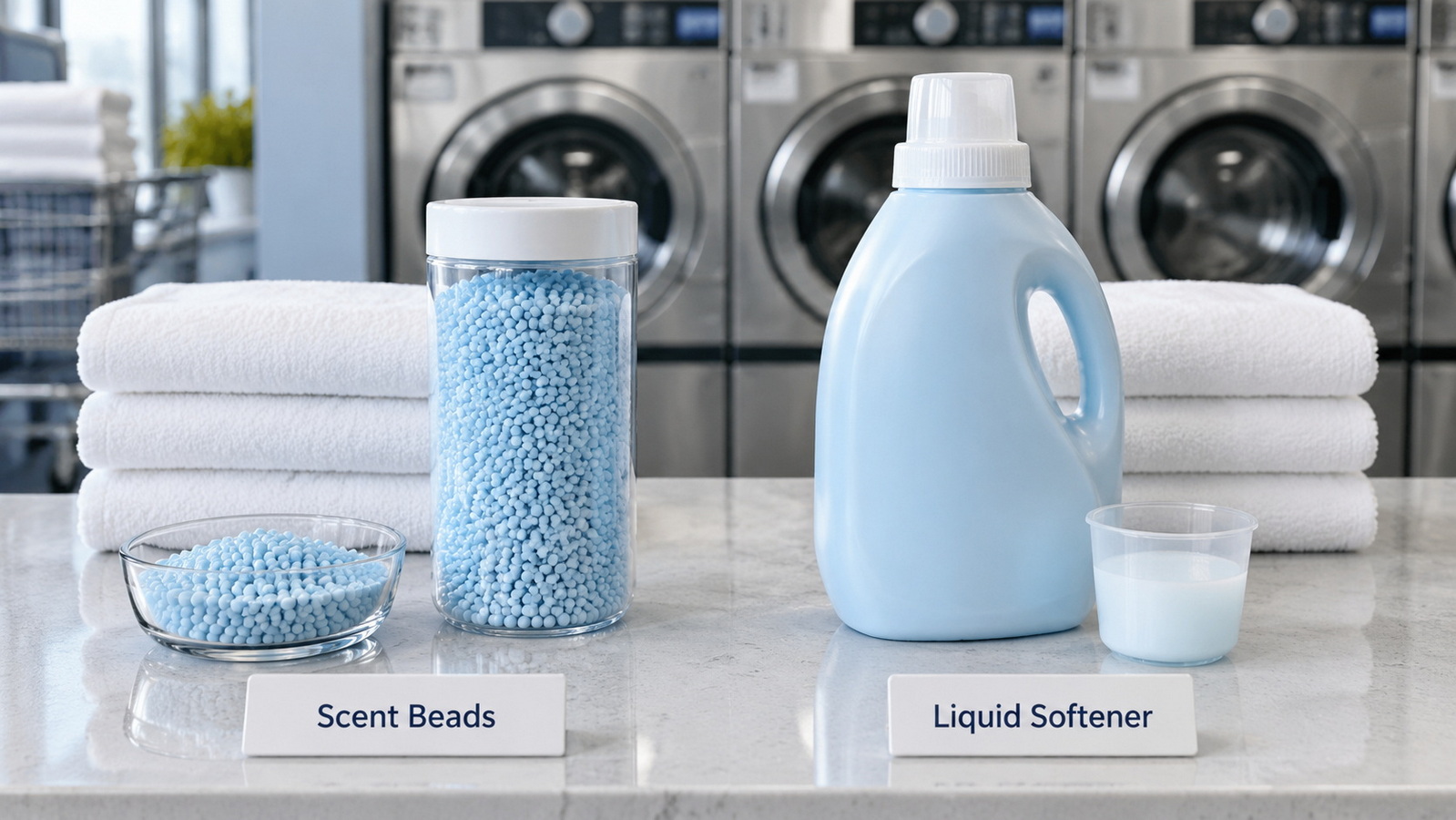
The first distinction matters: products marketed as "softener beads" are often laundry scent beads. Unless their formulation specifically provides fabric conditioning, they add fragrance rather than softness.
From a manufacturing and procurement perspective, I would compare scent beads with liquid fabric softener before selecting either. The right choice depends on your equipment, customers, textiles, and cost per processed kilogram.
"Softener beads" is a familiar commercial phrase, but it can blur two different product functions. Buyers should evaluate the actual formulation and technical documentation rather than rely on the product name.
Conventional laundry scent beads dissolve during washing and deliver fragrance to fabrics. They do not replace detergent, and fragrance-only formulas should not be presented as fabric conditioners.
Their practical advantage is separation: operators can adjust fragrance without necessarily changing the softening treatment.
Liquid fabric softeners are formulated to condition textile fibers. Depending on the formulation, they may also provide fragrance and static control.
They are commonly introduced during a designated rinse stage. Commercial applications require dosing instructions matched to the product, textiles, and washing system.
| Comparison | Fragrance-Only Scent Beads | Liquid Fabric Softener |
|---|---|---|
| Primary purpose | Add fragrance | Condition fabric |
| Cleaning replacement | No | No |
| Softening performance | Not inherent | Intended function |
| Typical addition point | Wash drum, following instructions | Designated rinse or dosing system |
| Fragrance adjustment | Separate from conditioning | Often linked to softener dosage |
| Commercial suitability | Requires equipment and process validation | Requires textile and dosing validation |
The central purchasing question is therefore not "Which smells stronger?" It is "Which function does this laundry service actually need?"
A busy laundry must process repeat loads consistently. Introducing another product only makes sense when its customer value exceeds the additional handling, purchasing, and quality-control requirements.
A restrained fragrance may support a property's preferred linen presentation. However, a scent approved by the purchasing team may not suit every guest.
Evaluate fragrance on finished, stored linens—not simply from the product container. Keep a fragrance-free option available where operationally feasible.
Customer-selected fragrance is a more controlled proposition than applying one scent to every order.
Record preferences clearly. Separate fragrance-free orders, and assess whether shared equipment or handling creates noticeable scent carryover.
Healthcare laundry requires particular caution. Cleaning, disinfection where required, and protection against recontamination take priority.
Fragrance is not evidence of hygienic cleanliness. Any additive must fit the facility's approved process and textile requirements. Protective garments and specialist fabrics also require manufacturer-specific care instructions.
My recommendation is to treat fragrance as an optional service attribute, never as a universal definition of clean laundry.
Consumer product instructions provide a starting point, not blanket authorization for industrial use. A domestic washer, a commercial washer-extractor, and a continuous batch washer have different operating conditions.
Before introducing laundry scent beads for commercial washing machines, obtain written guidance covering:
- Permitted machine types and addition points.
- Suitable wash temperatures and contact times.
- Recommended dose relative to dry textile weight.
- Compatibility with existing laundry chemicals.
- Restrictions involving dispensers, pumps, or automated systems.
For products instructed for direct drum addition, do not place beads in a detergent or softener dispenser. Do not convert them into a liquid dosing mixture without supplier validation.
A consumer claim of compatibility with high-efficiency washers does not establish suitability for every industrial installation.
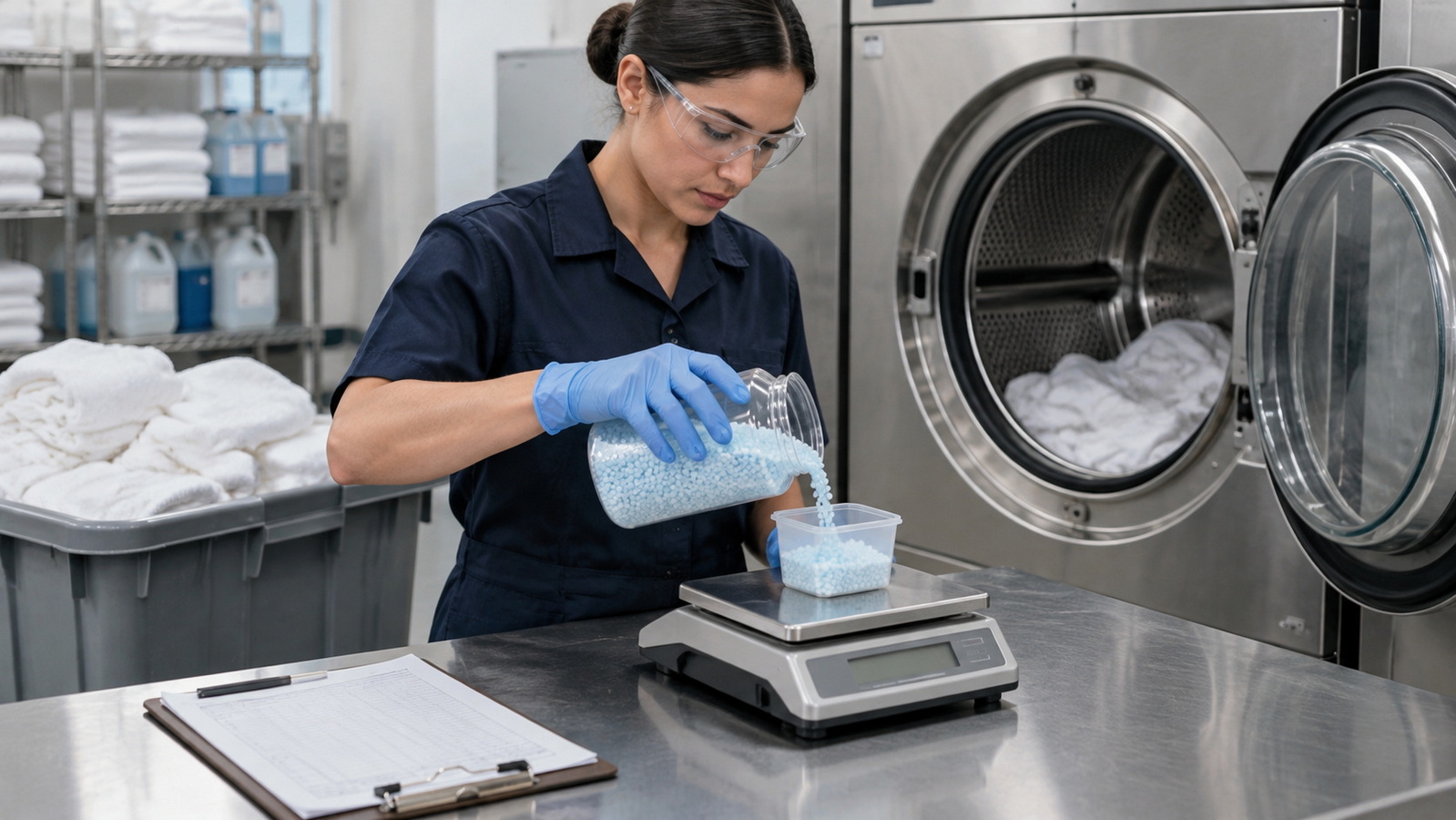
For an approved washer-extractor application:
1. Weigh the dry load.
2. Measure the validated bead dose.
3. Add the product at the specified location and stage.
4. Run the approved wash program.
5. Inspect textiles and equipment after processing.
6. Record the dose, load details, and observations.
Avoid scaling dosage through household capfuls. Commercial work requires a reproducible mass-based instruction.
A useful trial compares the current process with a controlled fragrance addition. It should answer whether the product works under your conditions—not whether a demonstration towel smells attractive.
Use three trial conditions:
- Existing process without added scent beads.
- Existing process with a lower supplier-approved bead dose.
- Existing process with a higher supplier-approved bead dose.
Keep textile type, dry load weight, detergent, wash program, drying, and storage conditions as consistent as possible.
If comparing beads against liquid softener, remember that changing the softener may also change conditioning. That is not a fragrance-only comparison.
| Evaluation Area | Suggested Check |
|---|---|
| Dissolution | Inspect for visible undissolved material |
| Fragrance | Compare intensity after drying and storage |
| Appearance | Check spotting, discoloration, and visible residue |
| Textile function | Assess relevant absorbency or performance requirements |
| Handling | Record dosing time and operator errors |
| Customer acceptance | Collect structured feedback |
| Economics | Calculate cost per accepted kilogram |
Repeat the assessment across several loads and operating days. A single successful cycle cannot establish consistent performance.
These are proposed trial methods, not reported results from a customer installation.
"Long-lasting fragrance" needs a defined context. Laundry assessed immediately after drying is different from linen stored before delivery or used throughout a hotel stay.
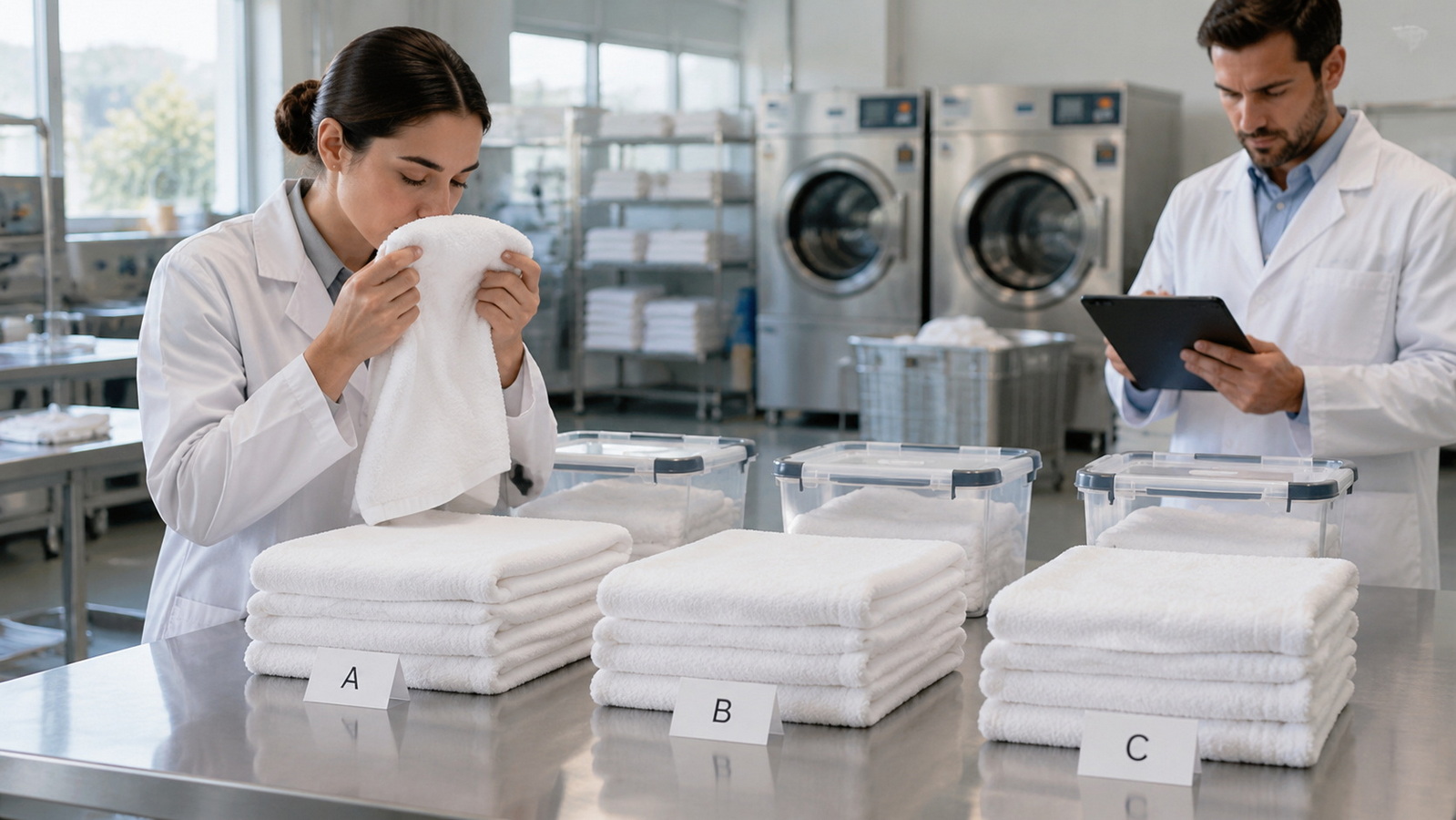
Prepare coded textile samples and ask assessors to score fragrance intensity on a consistent scale, such as zero to five.
Suggested checkpoints include:
- After drying and cooling.
- After 24 hours of storage.
- At the normal delivery or customer-use point.
Record whether the scent is pleasant, excessive, inconsistent, or mixed with unwanted odors. Stronger fragrance is not automatically a better outcome.
Where practical, assess samples without revealing their treatment. This reduces expectations influencing the score.
Do not use scent scores to demonstrate cleaning or disinfection. Likewise, do not promise a specific fragrance duration without testing the finished formulation under clearly described conditions.
Persistent malodor should trigger investigation of washing, drying, storage, and equipment—not automatic fragrance escalation.
Price per bag does not show the full operating cost. A lower-priced product may require more material or additional handling.
Start with:
Bead cost per kg of textiles=Dose in g/kg×Product price per kg/1,000
For illustration only, suppose a supplier-approved trial dose is 4 g/kg and the purchasing price is US$3.00/kg.
The bead cost is US$0.012 per kilogram of textiles. Processing 10,000 kg would therefore require US$120 in beads.
These figures are hypothetical, not a dosage recommendation, quotation, or demonstrated saving.
Next, add:
- Measuring and handling labor.
- Storage and packaging costs.
- Additional inspections.
- Any rewashing or rejected loads.
- Equipment changes, if needed.
Compare the total with customer acceptance and any verified service revenue. If liquid softener remains necessary for conditioning, scent beads are an additional expense rather than a direct replacement.
When a fragrance program underperforms, identify the cause before increasing dosage.
Check dosing accuracy, product condition, load variation, drying conditions, storage time, and the existing wash chemistry.
Compare samples at the same assessment point. A warm towel leaving the dryer is not equivalent to a cooled towel stored for several days.
Pause implementation and investigate the addition point, loading, water conditions, cycle duration, and product compatibility.
Do not increase temperature or alter a validated hygiene cycle solely to accommodate fragrance. Any process change must remain appropriate for the textiles and service requirements.
Reduce intensity within the validated operating range, reconsider the fragrance profile, or offer an unscented service.
The goal is consistency, not maximum perfume concentration. Customer complaints should carry more weight than internal preferences.
Private-label buyers need more than an appealing fragrance sample. They need specifications, supporting documentation, and dependable production.
Ask prospective suppliers for:
- Technical specifications and application instructions.
- Safety data sheets and relevant ingredient information.
- Batch identification and traceability arrangements.
- Stability and packaging compatibility evidence.
- Finished-product performance test methods.
- Fragrance documentation appropriate to the intended use.
- Destination-market labeling and compliance support.
An IFRA Certificate of Conformity concerns a fragrance mixture and its specified intended use. It does not replace a finished-product safety assessment or applicable local requirements.
Avoid unsupported descriptions such as "universally safe," "hypoallergenic," or "antibacterial."
According to the company information supplied for this article, Foshan Magic Crystal Technology Development Co., Ltd. operates more than three owned factories, has annual production capacity of approximately 30,000–40,000 metric tons, and provides OEM/ODM services to over 300 brands worldwide.
These figures describe manufacturing scale; they do not independently prove performance in a particular laundry operation.
For a commercial project, connect that capacity to practical requirements: agreed specifications, approved samples, batch consistency, packaging, delivery planning, and documented change control.
Softener beads can support a differentiated laundry service when the formulation, equipment, textiles, and customer preferences align.
For private-label development, contact Foshan Magic Crystal Technology Development Co., Ltd. with your machine type, textile categories, wash conditions, target market, fragrance preference, and expected order volume.
Request a product-specific technical proposal and evaluation samples before committing to production. Establish the approved dose, acceptance criteria, and supporting documentation before scaling.
Not necessarily. Many products described as softener beads are fragrance boosters without conditioning functionality. Confirm the actual product specification before making softening claims.
No. Fragrance-only beads add scent; they do not replace the detergent and other chemistry required by the approved washing process.
No universal compatibility claim should be assumed. Obtain product-specific guidance and machine approval, particularly for automated or continuous processing systems.
Use a supplier-validated dose based on dry textile weight and confirmed through on-site trials. There is no reliable universal dose for every formulation and machine.
They may be considered where textile instructions and customer requirements permit. Validate fragrance acceptance, visible residue, and relevant towel performance before implementation.
Fragrance alone does not demonstrate disinfection. Any antimicrobial claim requires appropriate evidence and compliance with the rules applicable to the target market.
Some products are designed for combined use. Commercial operators must still verify chemical compatibility, textile suitability, dosing, and the final fragrance intensity.
1. Procter & Gamble / Downy. "Scent Beads for Beginners: What They Do and How to Use Them." Explains fragrance-only functionality, direct-drum addition, and the distinction between scent beads and fabric softener. Product-specific consumer instructions should not be generalized to industrial equipment. [downy]
2. Procter & Gamble / Downy. "Downy Fabric Softeners, Dryer Sheets Vs Scent Beads." Manufacturer guidance distinguishing the roles of different fabric-care product categories. [downy]
3. Centers for Disease Control and Prevention. "G. Laundry and Bedding." Guidelines for Environmental Infection Control in Health-Care Facilities. Supports the discussion of hygienically clean textiles, interacting laundry-process factors, equipment instructions, and protection against recontamination. [cdc]
4. Occupational Safety and Health Administration. "eTool: Hospitals—Laundry—Biological Hazards: Infectious Diseases." Addresses contaminated laundry and following washer and detergent manufacturer recommendations. [osha]
5. International Fragrance Association. "Certification of Conformity with the IFRA Standards." Explains who issues conformity certificates, their intended-use scope, and why they do not replace safety assessments or national and local requirements. [ifrafragrance]
6. Foshan Magic Crystal Technology Development Co., Ltd. Company background supplied for this article. Source of factory-count, annual-capacity, and brand-service figures; not independently verified. The pilot protocol, purchasing framework, and hypothetical cost example are editorial proposals rather than published company trial results.


