
Views: 278 Author: Magic Household Cleaning Publish Time: 2026-10-19 Origin: Site
Content Menu
● What Are Laundry Detergent Sheets?
● Do Laundry Detergent Sheets Clean as Well as Liquid?
>> Everyday Refreshing Versus Difficult Stains
>> Dissolution Is Only the First Check
● How to Choose the Best Laundry Detergent Sheets
>> Best Laundry Detergent Sheets for Sensitive Skin
>> Laundry Detergent Sheets for Cold Water and HE Washers
>> Ingredients That Deserve Attention
● What Customer Feedback Can—and Cannot—Tell You
>> "The Sheet Did Not Dissolve"
>> "The Clothes Did Not Smell Clean"
>> "The Sheets Stuck Together"
● A Practical Home Test Before You Subscribe
● Calculate Cost Per Effective Wash
● Are Laundry Detergent Sheets Really Eco-Friendly?
>> Separate Product Claims From Packaging Claims
>> Dissolving Does Not Prove Biodegradation
>> Avoid Unsupported Water-Saving Claims
● Private Label Laundry Detergent Sheets: A Buyer's Quality Checklist
>> Define the Product Before Comparing Suppliers
>> Ask for Evidence That Matches the Claim
>> Check Production Consistency
● Working With Foshan Magic Crystal Technology Development Co., Ltd.
>> How many laundry detergent sheets should I use?
>> Can laundry detergent sheets replace stain remover?
>> Are laundry detergent sheets safe for babies' clothes?
>> Can I use laundry detergent sheets for handwashing?
>> Do laundry detergent sheets disinfect laundry?
>> What should I request before ordering private label sheets?
The best laundry detergent sheets should clean reliably, dissolve under your washing conditions, and offer clear instructions at a sensible cost. Compact packaging is useful, but it cannot replace stain removal, fabric compatibility, or transparent ingredient information.
My starting point when evaluating this category is simple: judge the finished wash, not the packaging promise. A sheet that disappears in water has demonstrated dissolution—not necessarily effective cleaning.
This guide explains how to choose laundry detergent sheets for everyday use, interpret common customer complaints, and evaluate private label products without relying on unsupported rankings.
Laundry detergent sheets are concentrated detergent formulations made into thin, lightweight sheets or strips. They release cleaning ingredients when exposed to wash water.
Depending on the formulation, those ingredients may include surfactants, enzymes, fragrance, water-softening ingredients, and a water-soluble material that helps hold the sheet together.
They are not dryer sheets. Detergent sheets belong in the washing process; dryer sheets are separate fabric-care products.
Their practical appeal includes:
- Compact storage in apartments and shared laundry rooms.
- Convenient transport without a liquid bottle.
- Premeasured portions that simplify routine dosing.
- Less risk of liquid spills during storage and handling.
However, premeasured does not mean universally sufficient. Load size, soil level, and water hardness still matter.
Not automatically. Performance depends on the individual formulation and the conditions in which it is used.
Independent comparative testing has found that tested laundry sheets generally removed difficult stains less effectively than leading liquids and pods. This challenges the assumption that all formats deliver equivalent cleaning.
Those results do not establish that every sheet performs identically. They do establish a reason to request evidence before accepting broad claims.
Separate two questions:
1. Does the detergent freshen lightly worn clothing?
2. Does it remove challenging stains such as body oil, coffee, grass, and food?
A product may perform acceptably on the first task while struggling with the second.
For heavily soiled workwear, sports clothing, or kitchen textiles, compare results against your current detergent before switching completely.
A sheet can dissolve while leaving a stain behind. Conversely, visible residue may reflect the formula, placement, loading, or wash conditions.
Evaluate dissolution, stain removal, odor control, and rinsing separately. Treating them as one outcome hides useful information.
The most useful comparison starts with your actual laundry needs.
| Buying priority | What to check | What not to assume |
|---|---|---|
| Sensitive skin | Fragrance-free and dye-free labeling | Every unscented product is fragrance-free |
| Cold-water washing | Results at a stated water temperature | “Cold water” means identical conditions everywhere |
| Heavy stains | Relevant stain-removal comparisons | A strong scent proves cleaning |
| Everyday value | Delivered cost at your required dose | One sheet always equals one effective wash |
| Lower packaging use | Complete packaging specifications | A cardboard exterior proves the whole product is plastic-free |
| Private label sourcing | Sample consistency and batch controls | Production capacity guarantees performance |
For eczema-prone skin, dermatology guidance recommends fragrance-free and dye-free laundry detergent.
"Unscented" is not necessarily equivalent to "fragrance-free." Some unscented products use ingredients to mask odor.
Plant-derived ingredients are not automatically nonirritating. Likewise, the word "hypoallergenic" should not replace clear ingredient information and appropriate supporting evidence.
If irritation develops after changing detergent, stop using the suspected product and seek medical advice when symptoms persist.
Look for instructions that address both temperature and machine type.
For cold-water claims, ask what temperature was tested. A successful wash in moderately cool water does not establish identical results in much colder conditions.
For high-efficiency machines, confirm compatibility and follow the washer and detergent instructions. Placement should be product-specific rather than assumed.
Surfactants help remove soil. Enzymes can target particular stain components, but their presence alone does not prove superior performance.
Ask what the complete formulation accomplishes at its recommended dose. Counting ingredients or highlighting one fashionable component is less useful than evaluating the finished product.
Also check fabric restrictions. Do not assume a general-purpose sheet is suitable for wool, silk, or every specialty garment.
The source article describes experiences involving incomplete dissolution, clumped sheets, disappointing stain removal, and different fragrance preferences.
These observations identify useful questions. They do not establish complaint rates or prove that current products have the same problems.
Before drawing a conclusion, record:
- The product and batch, if available.
- Water temperature and cycle.
- Sheet placement.
- Laundry load size.
- Whether the machine was tightly packed.
- Storage conditions before use.
For brands, this information turns an unclear complaint into a more actionable investigation.
Ask whether the customer means persistent body odor or simply a lack of perfume.
These are different outcomes. A fragrance-free detergent should not be judged negatively because it leaves little scent.
A useful review describes what remained after washing, not just how strongly the product smelled.
Clumping should trigger a review of storage, packaging protection, and product stability.
For buyers, the practical question is whether the sheets remain separable through their intended shelf life and distribution conditions—not merely when a sample first arrives.
A small comparison can reveal whether a product fits your household. It is not a substitute for laboratory testing, but it is more informative than judging one mixed load.
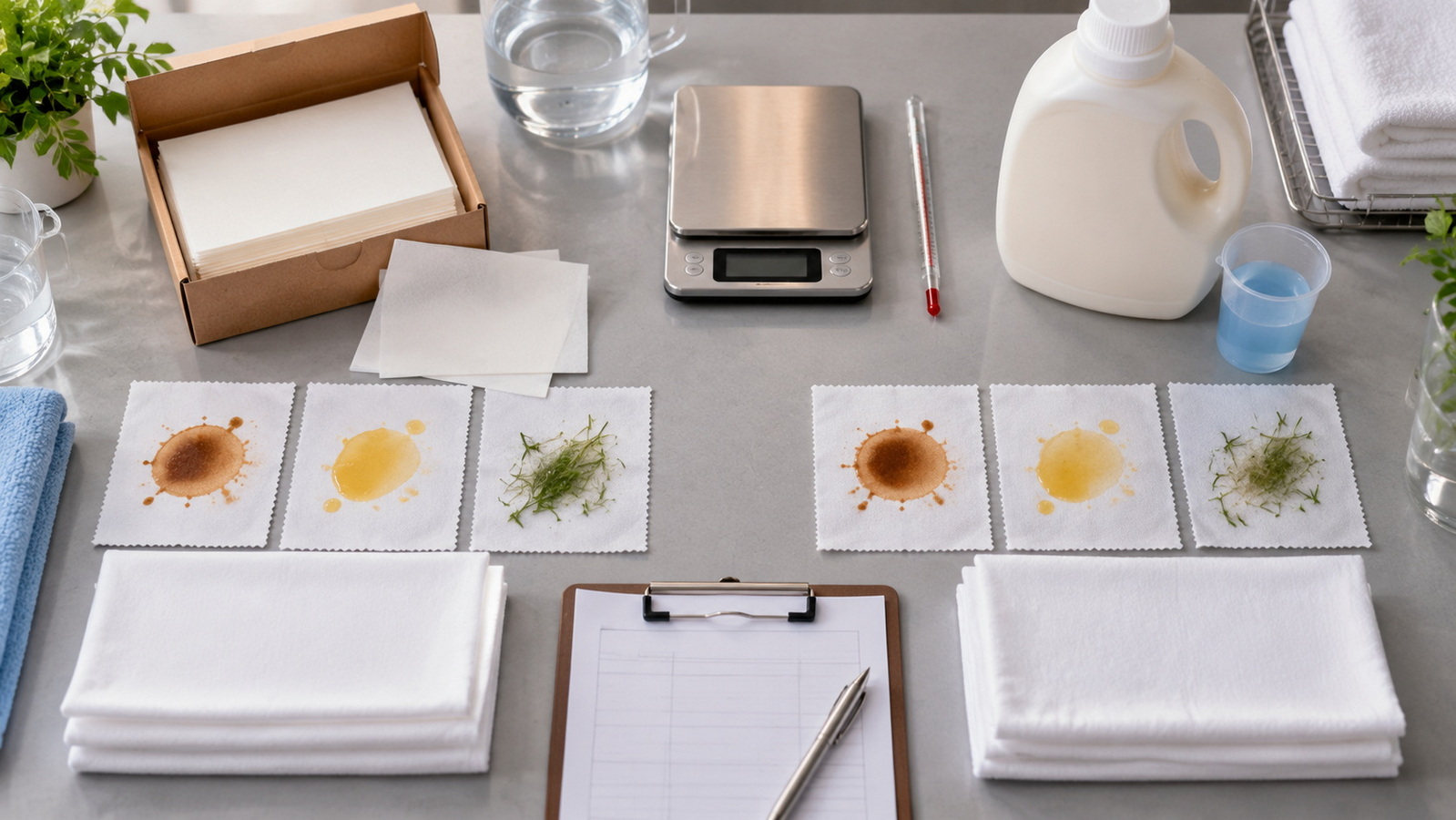
Choose your current detergent as the control. Use comparable fabric items, similar loads, and the same washing settings.
Record water temperature, cycle, dose, and any pretreatment.
Select stains that reflect your routine, such as cooking oil, coffee, or ordinary outdoor dirt.
Keep stain size and aging time as similar as possible. Avoid comparing a fresh stain with one that has dried for several days.
After drying, assess:
- Visible stain remaining.
- Persistent odor.
- Visible residue.
- Fabric appearance.
- Whether another wash was needed.
Check results under similar lighting. Avoid changing several wash variables at once.
One good or bad wash may be misleading.
Repeat the comparison across several similar loads. Record whether acceptable results require additional sheets, warmer water, or extra treatment.
Those adjustments affect both convenience and cost.
Pack price divided by advertised loads is only a starting point.
A more useful measure is value: what you actually spend to achieve an acceptable result.
Use this calculation:
Delivered pack cost ÷ washes completed at your required dose = detergent cost per wash.
For illustration, a $15 pack containing 60 sheets costs $0.25 per wash when one sheet is sufficient. If your normal load requires two sheets, the detergent cost becomes $0.50.
This is an example, not a current product quotation.
Include shipping, subscription conditions, and any routinely needed pretreatment. If rewashing becomes necessary, the initial purchase price understates the practical cost.
For commercial buyers, compare equivalent load sizes and performance targets. A quotation per thousand sheets says little without sheet weight and recommended dosage.
Potential advantages should be described precisely rather than treated as automatic.
A compact product may reduce packaging weight or change transport requirements. Whether it lowers total environmental impact requires a defined comparison.
"Plastic-free packaging" and "plastic-free detergent" are different statements.
Some sheet formulations contain polyvinyl alcohol, also called PVA or PVOH, a water-soluble synthetic polymer. Buyers should request the complete formulation information relevant to their claims.
Do not assume that a paper-looking sheet contains only paper.
Dissolution describes dispersal in water. Biodegradation describes biological breakdown under particular conditions.
Environmental claims should identify the material tested, method, conditions, and result. Evidence concerning one polymer grade or certified formulation should not automatically be extended to every detergent sheet.
Similarly, "recyclable" packaging should reflect the actual materials and collection options in the intended market.
A sheet format alone does not demonstrate lower household washing-water consumption.
Compare equivalent loads and wash programs before claiming water savings. Also distinguish reduced water shipped inside the product from reduced water used by the washing machine.
These are separate benefits that require separate evidence.
For brands, a successful launch requires more than an attractive sample and competitive quotation.

Prepare a specification covering:
- Target market and intended users.
- Sheet dimensions and weight.
- Recommended dose by load size.
- Fragrance requirements.
- Wash temperature and machine compatibility.
- Packaging format and shelf-life target.
- Claims requiring supporting documentation.
This helps prevent suppliers from quoting different products under the same description.
Request reports that identify the tested formula, batch, method, and date.
For cleaning comparisons, ask about stain types, water hardness, temperature, dosage, and the benchmark detergent.
For stability, request evidence relevant to storage and distribution conditions. For certification claims, verify that the exact product and manufacturing scope are covered.
A safety data sheet has an important role, but it does not independently demonstrate stain-removal performance or substantiate every marketing claim.
Ask how the manufacturer controls sheet weight, appearance, separability, packaging seals, and batch identification.
Retained samples and traceable records can support investigations when a market complaint appears.
Agree on acceptance criteria before production. "Good quality" is not a measurable specification.
According to company-provided information, Foshan Magic Crystal Technology Development Co., Ltd. operates more than three owned factories, reports annual production capacity of approximately 30,000–40,000 metric tons, and provides OEM/ODM services to more than 300 brands worldwide.
Its stated product focus includes laundry detergent sheets and household, personal, and pet cleaning products.
These figures describe reported business scale; they are not independent verification of a particular formula's performance.
For a focused sourcing discussion, provide your target market, desired dose, fragrance preference, packaging format, and expected order volume.
Contact Foshan Magic Crystal Technology Development Co., Ltd. to discuss samples and request the product-specific documentation needed for your evaluation.
Follow the product's instructions for load size and soil level. There is no universal one-sheet dose across brands. Compare the actual dose required for your washing conditions.
Not in every situation. Difficult stains may require suitable pretreatment. Test representative stains before assuming a sheet can replace your existing routine.
Do not assume suitability from the format alone. Consider a fragrance-free, dye-free product, follow garment instructions, and seek medical guidance for babies with eczema or recurring irritation.
Only when the manufacturer provides handwashing instructions. Follow the specified dose and rinsing guidance rather than guessing how much concentrated detergent to use.
Ordinary cleaning and disinfection are different functions. Do not make disinfection claims unless the exact product has the required authorization and directions for that use.
Start with a written specification, representative samples, ingredient information, relevant test reports, packaging details, and batch-traceability procedures. Confirm the approved sample and production acceptance criteria before placing an order.
1. The Advocate — "10 Best Laundry Detergent Sheets of 2024 (Expert Tested)," submitted by Danielle Crumble Smith, January 9, 2024. Source article used to identify the original ranking approach and reported concerns about dissolution, clumping, fragrance, and cleaning. Its experiences and historical prices are not presented here as independently verified or current. [theadvocate]
2. Consumer Reports — "Do Laundry Detergent Sheets Work as Well as Liquid?" Supports the distinction between convenient format and demonstrated stain-removal performance; describes comparative testing using difficult household stains. Findings apply to the products and conditions tested. [consumerreports]
3. Consumer Reports — "Best Laundry Detergent Buying Guide." Supports the discussion of controlled stain testing, differences among detergent formulations, and objective assessment of residual staining. [consumerreports]
4. American Academy of Dermatology — "How can I find eczema friendly products?" Supports fragrance-free and dye-free detergent selection and the distinction between fragrance-free and unscented labeling. [aad]
5. U.S. Environmental Protection Agency — "Safer Choice Standard and Criteria." Explains product and ingredient evaluation requirements and the additional criteria for the program's fragrance-free designation. No certification is claimed for the manufacturer or its products in this article. [epa]
6. U.S. Environmental Protection Agency — April 2023 prepublication decision concerning a petition related to polyvinyl alcohol. Supports the need to distinguish specific polymer structures and testing evidence from blanket claims about all water-soluble materials. [epa]
7. U.S. Environmental Protection Agency — "Search Products that Meet the Safer Choice Standard." Provides a product-level verification resource for claims involving that program. [epa]
8. Foshan Magic Crystal Technology Development Co., Ltd. — Background information supplied in the commissioning brief. Source for the reported factory count, annual production capacity, product categories, and number of brands served; not independently audited for this article.


