
Views: 269 Author: Magic Household Cleaning Publish Time: 2026-10-20 Origin: Site
Content Menu
● Laundry Scent Booster Beads vs. Fabric Softener
>> Which Option Provides Longer-Lasting Linen Fragrance?
● What Long-Lasting Linen Fragrance Should Mean in a Hotel
>> Evaluate Fragrance at the Point of Use
● Guest Comfort Comes Before Fragrance Strength
>> Create a Practical Fragrance-Free Pathway
● How to Test Hotel Laundry Scent Booster Beads
>> 1: Establish a Detergent-Only Baseline
>> 2: Compare Products Without Changing Everything Else
>> 3: Measure Fragrance Across the Linen Journey
>> 4: Include Operational Pass/Fail Checks
● Why Commercial Laundry Compatibility Requires Separate Verification
>> Ask About Dissolution and Addition Method
● Fragrance Is Not Proof of Cleanliness
● Compare Cost per Accepted Linen Load
>> An Illustrative Purchasing Example
● What Hotels Should Request From a Manufacturer
>> Translate Marketing Claims Into Testable Specifications
● OEM/ODM Development With Foshan Magic Crystal
● Build Your Hotel Linen Fragrance Around a Verified Trial
>> Are Laundry Scent Booster Beads Better Than Fabric Softener for Hotels?
>> How Long Will Fragrance Last on Hotel Sheets?
>> Can Hotels Use Scent Beads on Towels?
>> Should Hotels Use Scent Beads and Fabric Softener Together?
>> Are Scent Beads Suitable for Guests With Fragrance Sensitivities?
>> Can a Hotel Develop a Private-Label Linen Fragrance?
Laundry scent booster beads for hotels should deliver long-lasting linen fragrance without overwhelming guests, complicating washroom routines, or compromising fabric performance. For hotel buyers, the real question is not simply which product smells strongest. It is which fragrance approach remains pleasant after laundering, storage, bed-making, and normal guest use.
From a manufacturing and procurement perspective, I would evaluate fragrance beads against scented fabric softeners, the alternative frequently considered for fragranced linens. These products serve different primary purposes. Comparing them properly helps hotels separate fragrance performance from softness, operational compatibility, and guest comfort.
Laundry scent booster beads primarily add fragrance during washing. Fabric softeners primarily modify fabric feel and may also provide fragrance. Neither replaces detergent.
The most important distinction is therefore purpose: hotels should buy fragrance performance and fabric-conditioning performance as separate capabilities, even when one product offers both.
| Purchasing consideration | Laundry scent booster beads | Scented fabric softener |
|---|---|---|
| Primary role | Add fragrance to washed textiles | Condition fabric and potentially add fragrance |
| Typical application | Wash-stage addition, according to product instructions | Usually introduced during a designated rinse stage |
| Main evaluation priority | Fragrance quality, persistence, and dissolution | Fabric feel, conditioning performance, and fragrance |
| Hotel towel assessment | Check absorbency, residue, and fragrance acceptance | Check absorbency, fabric feel, and fragrance acceptance |
| Commercial equipment suitability | Requires confirmation for the exact system | Requires compatibility with the dosing system |
| Best purchasing basis | Measured performance on the hotel’s linens | Measured conditioning and operational performance |
Consumer product directions illustrate these different application routes, but they do not establish suitability for an industrial laundry. Hotels need formulation-specific instructions and equipment approval.
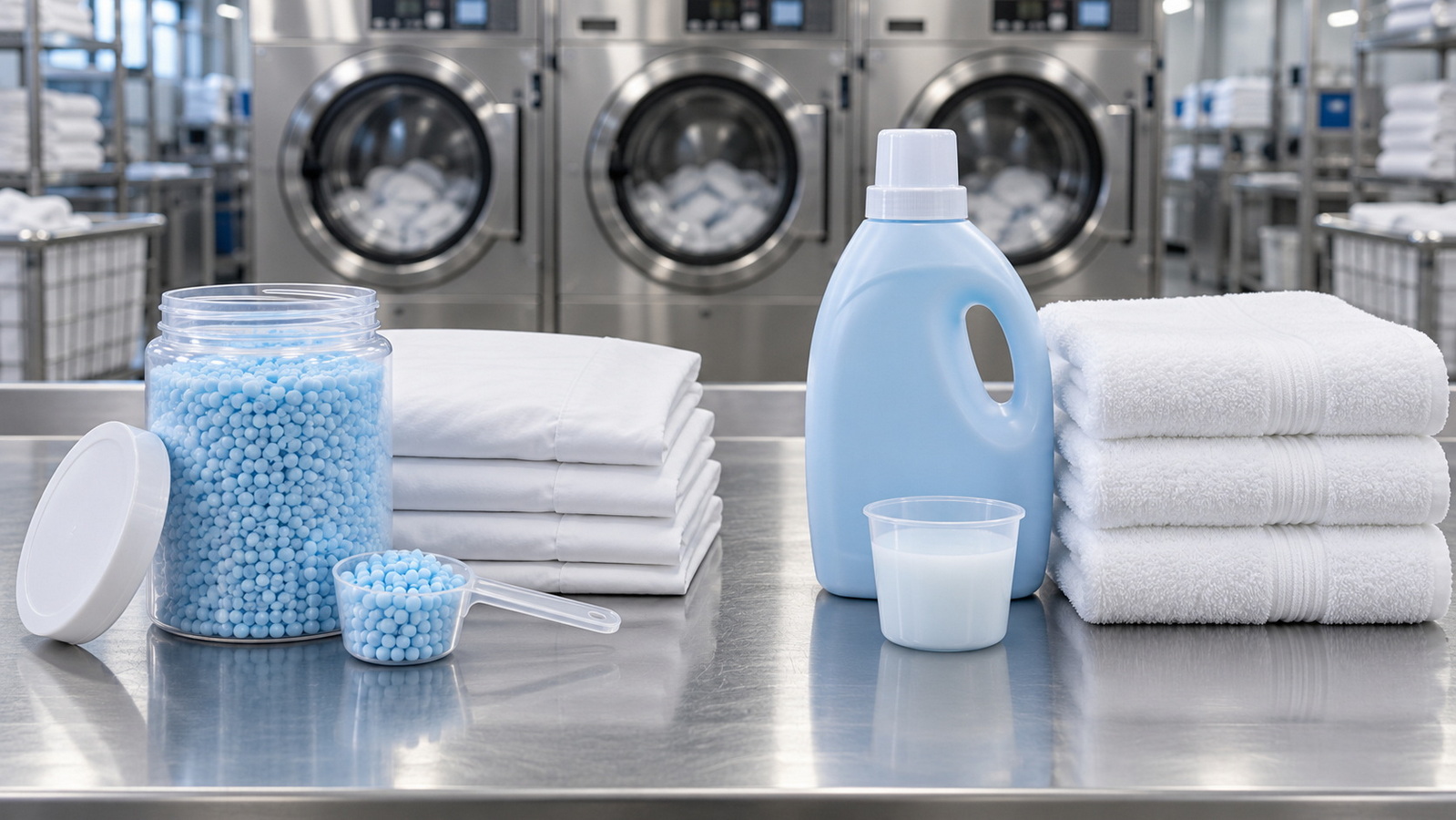
There is no universal winner.
Fragrance longevity depends on the formulation, dose, textile, washing conditions, drying process, and storage environment. A bead format alone does not prove superior retention. Likewise, a strong fragrance immediately after drying does not establish that sheets will still smell pleasant several days later.
Ask suppliers to demonstrate persistence under your actual operating conditions rather than comparing unsupported "lasts for weeks" statements.
For a hotel, fragrance persistence should describe a useful guest experience—not merely a detectable smell on stored fabric.
A practical specification includes three dimensions:
- Initial character: Does the linen smell clean and balanced after processing?
- Storage retention: Does the intended scent remain acceptable before the linen enters service?
- In-use acceptance: Is the fragrance comfortable when guests lie directly against pillowcases and sheets?
These dimensions can produce different results. A product might retain a noticeable scent in a linen cupboard yet feel excessive at pillow distance.
I would assess pillowcases separately from duvet covers and towels. Their proximity to the guest's face makes fragrance intensity particularly relevant.
Similarly, do not assume that a scent preferred in a sample bottle will be preferred on finished linen. Evaluate the washed, dried, and stored textile—not just the concentrated fragrance.
For many properties, the appropriate target is a subtle, consistent impression rather than maximum intensity. Treat that as a positioning decision to validate with guests, not a universal preference.
A signature linen fragrance may support a hotel's identity, but fragrance is not suitable for every guest.
Some individuals experience sensitivities or allergic reactions associated with fragrance ingredients. Hotels should therefore consider a fragrance-free linen option alongside any scented program.
"Unscented" and "fragrance-free" should not automatically be treated as equivalent. Under the EPA's fragrance-free criteria, products must contain neither fragrance materials nor masking scents.
A workable policy can include:
1. Clearly identifying fragrance-free linen stock.
2. Separating it from fragranced inventory during storage.
3. Reviewing shared equipment and handling procedures.
4. Training housekeeping staff to respond accurately to requests.
5. Avoiding promises that cannot be verified, such as "allergy-proof bedding."
Do not describe fragranced laundry beads as universally hypoallergenic. Ingredient documentation and applicable fragrance standards support assessment, but they do not guarantee that every guest will tolerate a product.
The strongest purchasing evidence comes from a controlled property-specific trial.
The following protocol is a proposed evaluation method, not a published industry standard or a claim about any manufacturer's existing results.
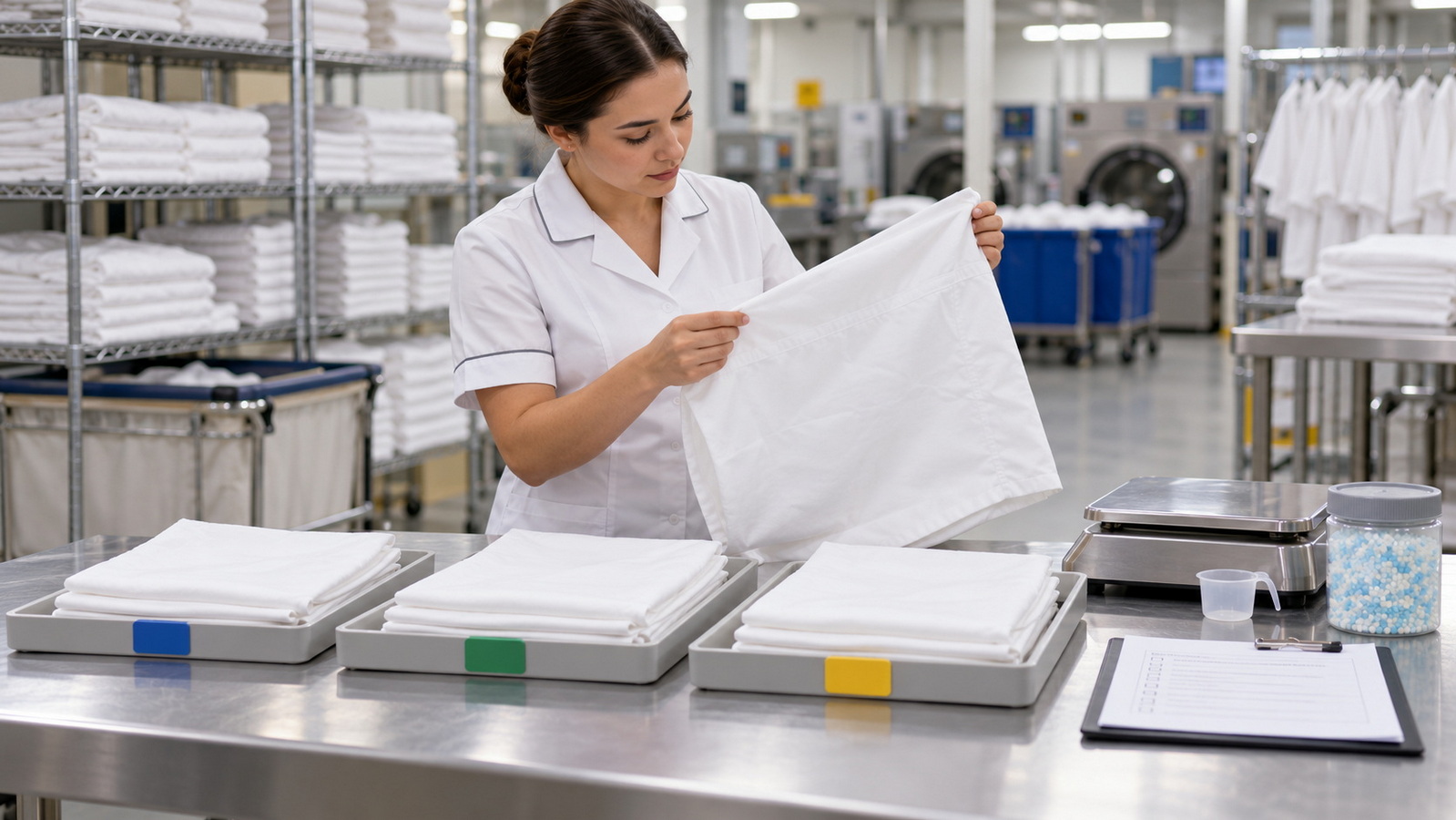
Process representative sheets, pillowcases, and towels using the existing approved wash program without an added fragrance product.
Record:
- Textile composition and condition.
- Dry linen weight.
- Detergent and other chemical doses.
- Wash temperature and cycle duration.
- Drying conditions.
- Storage location and duration.
This baseline helps distinguish the fragrance product's contribution from changes elsewhere in the process.
Evaluate the baseline, a bead formulation, and a scented softener under comparable conditions.
Use each product within its supplier-approved dosing range. Equal product weights are not necessarily fair because formulations and intended doses differ.
Repeat the comparison across multiple loads. A single successful batch is insufficient evidence of reliable production performance.
Assess samples after drying, after 24 hours, and after seven days of normal storage. Add later checkpoints only if they reflect the property's actual inventory cycle.
Use separate ratings for:
- Fragrance intensity.
- Fragrance pleasantness.
- Agreement with the intended scent profile.
- Overall suitability for guest use.
A simple 0–5 intensity scale can help standardize observations. Define the scale before testing and use coded samples where practical to reduce brand-related bias.
Fragrance should not compensate for operational problems.
Check for visible residue, incomplete dissolution, spotting, changes in towel absorbency, unacceptable fabric feel, and additional rewash requirements.
Predefine acceptance criteria. Otherwise, a purchasing team may rationalize defects because it likes the scent.
Some consumer scent beads are marketed as compatible with high-efficiency washing machines. That does not establish compatibility with every hotel washer-extractor, tunnel washer, dosing installation, or outsourced laundry arrangement.
Commercial suitability depends on both the formulation and the process.
Request written guidance covering:
- Recommended dose per kilogram of dry textiles.
- Approved addition point.
- Suitable wash temperatures and cycle conditions.
- Dissolution performance under relevant water conditions.
- Compatibility with other laundry chemicals.
- Storage requirements and shelf life.
Do not put solid beads into an automated liquid dosing line unless the supplier and equipment provider explicitly approve the arrangement.
For outsourced laundry, involve the laundry operator before requesting a fragranced-linen specification. The hotel's preferred scent must fit the processor's equipment, chemistry, and service controls.
Pleasant-smelling linen is not necessarily hygienically processed linen.
Scent boosters add fragrance; they do not replace detergent, validated washing procedures, or any required disinfection process. Persistent musty odors should trigger investigation rather than progressively stronger fragrance dosing.
Possible investigation areas include incomplete drying, damp storage, equipment cleanliness, and wash-process performance.
Healthcare laundry guidance illustrates that microbial control depends on defined processing conditions, not fragrance. However, healthcare temperature recommendations should not automatically become hotel operating instructions. Hotels should follow applicable requirements and a professionally established laundry program.
The cheapest fragrance beads per kilogram may not deliver the lowest operating cost.
A meaningful comparison includes product consumption, dosing labor, operational changes, and any additional rewash costs.
A useful calculation is:
Cost per accepted load = total trial-related processing cost ÷ number of loads meeting the agreed criteria.
Suppose Product A costs $4 per kilogram and uses 100 grams per load. Its fragrance-product cost is $0.40 per load.
Product B costs $5 per kilogram but uses 60 grams per load. Its fragrance-product cost is $0.30 per load.
These are hypothetical figures, not recommended doses or supplier quotations. The comparison is meaningful only if both products achieve acceptable fragrance and operational results.
Track additional rinses, processing delays, and rejected loads separately. A small product-price saving can disappear if the formulation complicates laundry operations.
For hotels sourcing private-label laundry scent booster beads, fragrance selection is only part of the procurement brief.
Ask for documentation appropriate to the product and destination market, including:
- Product specifications and a safety data sheet.
- Clear dosing and application instructions.
- Relevant fragrance conformity documentation.
- Available allergen and ingredient information.
- Batch identification and traceability procedures.
- Stability and packaging-compatibility evidence.
- Support for any proposed performance claims.
An IFRA conformity document should be relevant to the intended application. It should not be presented as blanket regulatory approval or a guarantee that no guest will react.
Instead of requesting "luxury, long-lasting fragrance," define what the supplier must demonstrate.
For example:
- Acceptable fragrance after the hotel's normal storage period.
- No visible residue under the approved trial conditions.
- Consistent scent character against an agreed reference.
- Packaging that supports accurate, repeatable dosing.
If a supplier promotes encapsulation or another fragrance-delivery technology, ask how that technology improves performance in your process. Technology terminology is not a substitute for finished-linen evidence.
Foshan Magic Crystal Technology Development Co., Ltd. develops, manufactures, and supplies laundry scent beads and other laundry, household, personal, and pet-cleaning products.
According to the company background supplied for this article, the business operates more than three company-owned factories, has annual production capacity of approximately 30,000–40,000 metric tons, and provides OEM/ODM services to more than 300 brands worldwide. These are company-provided figures, not independently verified findings.
That manufacturing background provides a starting point for supplier discussions. It does not, by itself, establish hotel-linen performance.
A hotel-focused development brief should specify textile types, equipment, fragrance intensity, storage intervals, target markets, packaging format, and procurement volume.
The next step is to establish which customization options, technical documents, samples, and testing support the manufacturer can provide.
The right hotel fragrance program balances persistence, guest comfort, fabric performance, and operational control.
Contact Foshan Magic Crystal Technology Development Co., Ltd. with your linen specifications, washing conditions, target fragrance profile, destination market, and expected purchasing volume. Request a sample-development proposal and agree on trial criteria before moving to commercial supply.
They address different priorities. Beads focus on fragrance, while softeners focus on conditioning and may also add scent. Choose through controlled linen trials rather than assuming either category is universally better.
There is no reliable category-wide duration. Formulation, dose, laundering, drying, textile composition, and storage all matter. Request evidence that matches the hotel's actual linen rotation.
Potentially, subject to product instructions and a successful trial. Assess dissolution, residue, absorbency, and guest acceptance. Do not infer towel suitability solely from a pleasant fragrance result.
Only when the formulations and laundry process support combined use. Test the combination separately because fragrance intensity, fabric performance, and cost may change.
They should not be assumed suitable. Maintain a clearly defined fragrance-free option and avoid universal safety or hypoallergenic claims.
OEM/ODM development may offer that possibility, depending on the manufacturer's capabilities. Confirm formulation options, minimum order quantities, documentation, packaging, and performance testing before committing.
1. Downy. "How to Use In-Wash Scent Beads." Manufacturer instructions supporting the discussion of consumer bead application; not evidence of commercial-laundry suitability. [downy]
2. Downy. "Frequently Asked Questions on Laundry." Manufacturer information on scent-booster placement, fabric-softener dosing, and stated machine compatibility. [downy]
3. U.S. Environmental Protection Agency. "Safer Choice Criteria for Fragrance-Free Products." Official criteria relevant to fragrance-free product terminology. [epa]
4. U.S. Environmental Protection Agency. "Safer Choice Fact Sheet: Fragrance-Free." Explanation of fragrance sensitivities and the exclusion of fragrance materials and masking scents. [nepis.epa]
5. International Fragrance Association. "Allergens." Industry explanation of fragrance allergens, risk assessment, labeling, and the role of fragrance standards. [ifrafragrance]
6. Centers for Disease Control and Prevention. "G. Laundry and Bedding." Healthcare-specific guidance illustrating the distinction between controlled laundering and fragrance; not a hotel wash-program prescription. [cdc]
7. Foshan Magic Crystal Technology Development Co., Ltd. Company background supplied in the commissioning brief. Source for factory count, annual capacity, product categories, and brands served; no public verification page was supplied.
Editorial note: The trial protocol, purchasing framework, and numerical cost example are proposed analytical tools, not reported field-study findings.


