
Views: 268 Author: Magic Household Cleaning Publish Time: 2026-10-23 Origin: Site
Content Menu
● Which Laundry Scent Boosters Are Worth Considering?
● Do Laundry Scent Beads Remove Odor or Just Add Fragrance?
>> Fragrance Is Not the Same as Cleaning
>> Evaluate Odor and Fragrance Separately
● How to Choose the Best Laundry Scent Beads for Your Needs
>> For Workout Clothes and Underarm Odor
>> For Fragrance-Sensitive Households
● How to Use Laundry Scent Boosters Correctly
>> How Much Scent Booster Should You Use?
>> Can You Use Scent Beads in Cold Water?
● Why Clothes Can Still Smell After Using Scent Boosters
● A Better Way to Compare Laundry Scent Boosters at Home
>> Run a Simple Three-Load Comparison
>> Compare Cost Per Load, Not Bottle Price
● What Manufacturers Should Validate Before Launching Scent Beads
>> Test Performance Under Defined Conditions
>> Turn Consumer Comments Into Better Product Instructions
● Developing Private-Label Laundry Scent Beads With Magic Crystal
>> 1. What is the best laundry scent booster for odor?
>> 2. Can laundry scent beads replace detergent?
>> 3. Are scent boosters suitable for high-efficiency washers?
>> 4. Why are scent beads leaving residue on clothes?
>> 5. Are laundry scent beads suitable for sensitive skin?
>> 6. Can I put scent beads in the dryer or use them as air fresheners?
The best laundry scent boosters for odor should complement effective washing—not simply cover unpleasant smells with stronger perfume. Whether you are refreshing workout clothes, towels, or bedding, the right laundry scent beads depend on your fragrance preferences, washing routine, and sensitivity to scented products.
My starting point is simple: judge freshness after the clothes are completely dry, not just when you open the washer. A pleasant fragrance is useful, but persistent underarm or musty smells deserve attention before you increase the dose.
A published household comparison by shopping writer Leah Ingram evaluated five products: Arm & Hammer Clean Scentsations, Downy Unstopables, Purex Crystals, Gain Fireworks, and Hannaford's in-wash scent booster.
Her preferred product was Arm & Hammer Clean Scentsations, with Downy Unstopables the runner-up. However, these results reflect one reviewer's laundry, detergent, machine, and fragrance preferences—not a controlled performance ranking.
| Product | What the published comparison reported | Practical buying consideration |
|---|---|---|
| Arm & Hammer Clean Scentsations | The reviewer’s favorite for previously sweaty clothing | Check the exact current formula and its odor-control claims |
| Downy Unstopables | Three of four sweaty shirts initially emerged without noticeable underarm odor | Consider if you enjoy its fragrance; do not interpret one load as a guaranteed success rate |
| Purex Crystals | Fresh Spring Waters received favorable fragrance comments | Choose by scent preference rather than assuming every variant performs identically |
| Gain Fireworks | The reviewer found the fragrance overpowering | Potentially more appealing to people who prefer a pronounced laundry fragrance |
| Hannaford in-wash booster | Included in the comparison, with limited individual performance detail | Assess current instructions, local pricing, and your own results |
For shoppers, this is a useful shortlist rather than proof of a universal winner. Product names, formulations, sizes, and availability can change, so check the package you actually buy.
Laundry scent beads are primarily fragrance additives. Some formulas also make deodorizing or odor-control claims, but their capabilities depend on the specific product.
Detergent cleans laundry. Scent boosters add fragrance and, where supported by their formulation, help address odors.
A stronger scent does not demonstrate better removal of sweat, body oils, or stains. Likewise, a lightly scented garment is not necessarily less clean.
Arm & Hammer's usage guidance explicitly states that scent boosters do not replace detergent or remove stains. Keep detergent as the foundation of your washing routine.
After drying, ask two different questions:
- Can I still detect the original unpleasant smell?
- Is the added fragrance pleasant and comfortable?
This distinction matters because a product can perform well on fragrance appeal while leaving the original odor noticeable. It can also leave clothes smelling neutral rather than strongly perfumed.
For persistent problems, I would review washing conditions before buying a more intensely fragranced booster.
Look for a product with a clearly stated odor-control purpose, rather than relying on words such as "fresh" or "long-lasting."
Follow your activewear care label and detergent instructions. If odor remains after drying, reconsider pretreatment, load size, and the wash program before increasing fragrance.
Do not assume a scent booster is also a fabric softener. These are different product functions, and compatibility should be checked separately.
Choose a fragrance you would enjoy at close range for extended periods. A scent that seems pleasant in the bottle may feel excessive on a pillowcase.
If towels smell musty, increasing the bead dose should not be your first response. Review how promptly the load is removed and whether items dry completely.
Fragranced beads may not be an appropriate choice for everyone.
The American Academy of Dermatology recommends fragrance-free, dye-free detergent for children with eczema. It also distinguishes "fragrance-free" from "unscented," which may involve masking fragrance.
One reviewer's report of comfortable use does not establish suitability for someone else's skin or breathing sensitivity. If scented laundry products cause symptoms, discontinue them and seek appropriate medical advice.
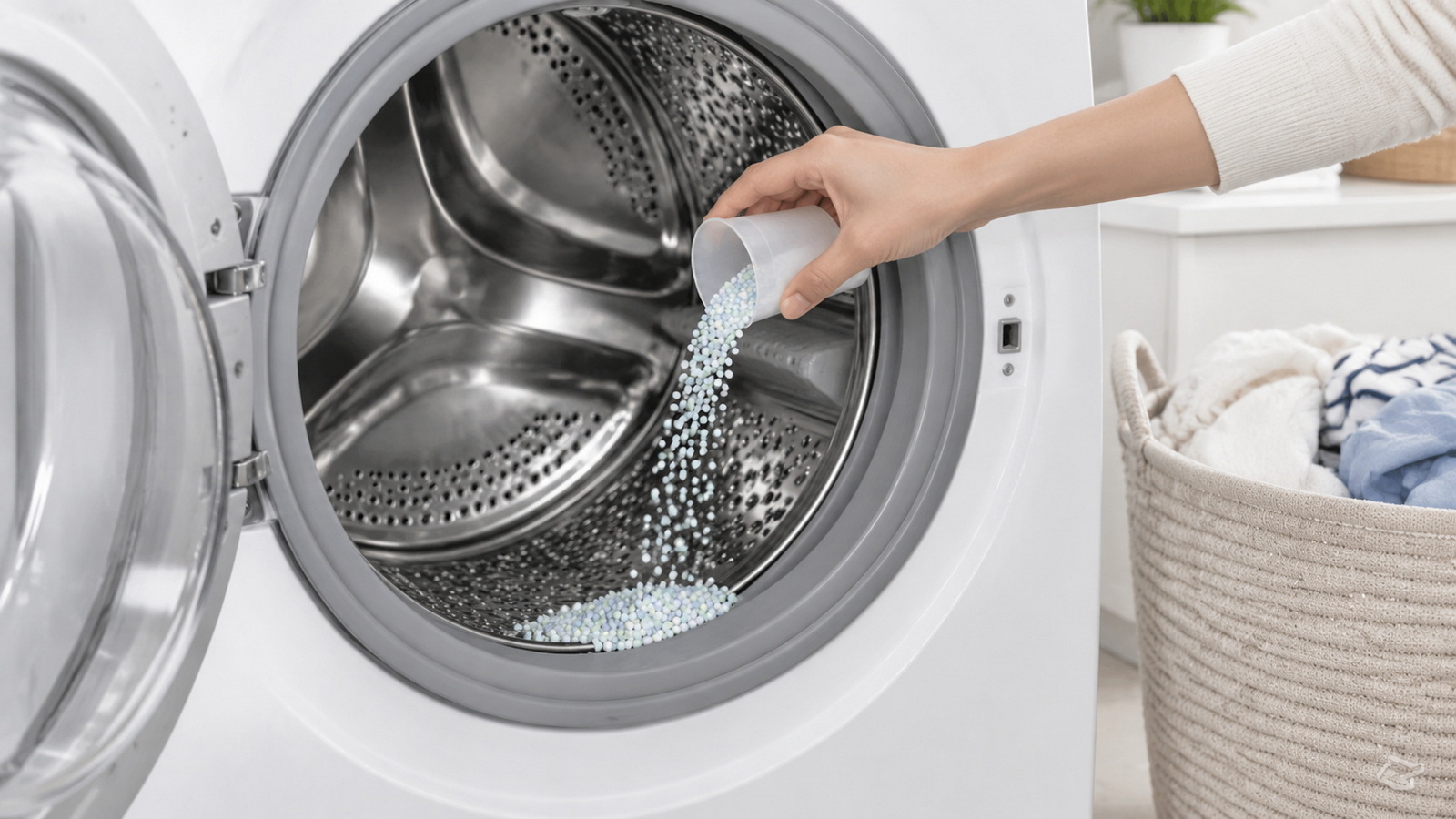
For the in-wash products discussed here, the usual sequence is straightforward. Always give the exact package instructions priority.
1. Read the garment care labels and product directions.
2. Measure the label-directed dose.
3. Add the beads directly to the empty washer drum.
4. Load the clothes without packing the drum tightly.
5. Add detergent through the appropriate compartment or method.
6. Select a suitable wash cycle.
7. Remove the laundry promptly and dry it completely.
Do not put these beads in the detergent drawer or fabric-softener compartment. Arm & Hammer also advises against adding them midway through the wash.
There is no universal capful that applies to every brand.
Even formulas within one product family can have different dosing instructions. Cap sizes also vary, making "one cap" an unreliable comparison between products.
Start with the package-directed amount. If the label permits adjustments, change the dose gradually rather than assuming more will improve odor removal.
Check the specific product's instructions.
Ingram used cold water and a gentle cycle in her comparison. She reported residue when she added beads after loading the clothes, but she did not establish whether placement, temperature, cycle conditions, or another factor caused it.
That experience supports correct placement—not a conclusion that all scent beads fail in cold water.
One reader of the original review, Kori, raised an important question: why did clothes still smell unpleasant despite following the recommended dose?
That comment exposes a gap in simple product rankings. Correct bead dosing does not guarantee that the entire washing and drying process is effective.
Use this troubleshooting sequence:
| Problem | First practical check |
|---|---|
| Underarm odor remains | Review detergent use, garment care instructions, and any suitable pretreatment |
| Laundry smells musty | Check how long the load remained wet before drying |
| Bead residue is visible | Confirm drum placement, dose, load size, and cycle suitability |
| Fragrance is overpowering | Reduce the dose only within label guidance, or stop using the product |
| Results vary between loads | Record fabric type, load size, detergent dose, and wash settings |
The original comparison offers authentic household observations, but it did not standardize every variable. Its purchase prices were also observations from the time of purchase, not dependable current prices.
A more useful personal comparison keeps the washing routine consistent.
Use three reasonably similar loads:
1. Your normal detergent without a scent booster.
2. The same detergent with booster A.
3. The same detergent with booster B.
Keep the fabric mix, loading level, cycle, and drying method as similar as practical. Do not add scented dryer sheets during the comparison, because they make it harder to judge the beads.
Evaluate each load when fully dry and again after a normal period of storage or wear.
Record:
- Remaining unpleasant odor.
- Fragrance strength.
- Fragrance preference.
- Visible residue.
- Any discomfort.
- Actual product quantity used.
This is not laboratory testing. It is a more disciplined way to identify what works in your own home.
A larger container is not automatically better value.
Divide the purchase price by the number of loads you actually obtain at your chosen label-compliant dose. If you repeatedly increase the quantity to achieve a preferred fragrance, your real cost per wash rises.
For both households and retail brands, understandable dosing is part of product value.
For private-label brands, fragrance selection is only one part of development. A product should also be evaluated under the washing conditions customers are likely to use.

A useful development brief should specify:
- Target washing temperature and cycle length.
- Front-loading and top-loading machine conditions.
- Intended fabrics and load sizes.
- Proposed dose.
- Fragrance intensity after drying and storage.
- Residue acceptance criteria.
- Packaging and storage conditions.
These are recommended evaluation priorities, not claims that every supplier already tests every variable.
Any freshness-duration or odor-reduction claim should identify the conditions behind it. Fragrance detected on stored fabric is not automatically equivalent to odor control during wear.
The reader's dosing question suggests a practical opportunity: make directions easier to follow.
Brands can improve instructions by explaining where beads go, how to measure them, what the product does, and what to check when laundry still smells unpleasant.
Clear guidance is more useful than promising that a larger dose solves every problem.
Foshan Magic Crystal Technology Development Co., Ltd. develops, manufactures, and sells laundry scent beads alongside laundry-care, household, personal-cleaning, and pet-cleaning products.
According to company-provided information, Magic Crystal operates more than three company-owned factories, reports annual production capacity of approximately 30,000–40,000 metric tons, and provides OEM/ODM services to more than 300 brands worldwide. These are company-reported figures, not independently audited findings presented in this guide.
For a productive development discussion, prepare your target market, fragrance direction, washing conditions, packaging format, and expected retail position.
Contact the Magic Crystal team with that brief and request samples, proposed evaluation criteria, and relevant supporting documentation before approving a commercial specification.
Arm & Hammer Clean Scentsations was the favorite in the published consumer comparison discussed here. However, no universal winner is established. Choose according to the current formula, your laundry conditions, and fragrance tolerance.
No. Scent beads are additives, not substitutes for detergent. They primarily provide fragrance, while some formulas also make specific deodorizing claims.
Arm & Hammer states that its scent boosters can be used in high-efficiency machines as directed. Confirm compatibility on your chosen product and add it to the drum, not the dispenser.
Placement, quantity, loading, and wash conditions are worth checking. Add beads before clothing, follow the label, and avoid assuming that increasing the dose will improve results.
Not necessarily. Fragrance can be unsuitable for some users. For children with eczema, dermatology guidance favors fragrance-free, dye-free detergent rather than added laundry fragrance.
Do not put in-wash scent beads in the dryer. Although the original article describes other household uses, this guide does not recommend repurposing them in vacuums or cars without explicit manufacturer approval. Keep them away from children and pets.
1. [Leah Ingram — "Best Laundry Scent Boosters for Odor"]. Updated October 5, 2026. Source for the five-product household comparison, reported product preferences, cold-water washing observations, and Kori's January 2024 reader comment. The results are attributed consumer experiences, not independent laboratory findings. [leahingram]
2. [Arm & Hammer — "How to Use Scent Boosters to Get Fresh Smelling Laundry"]. Manufacturer guidance covering dosing differences, drum placement, detergent use, high-efficiency washer compatibility, and avoiding dryer use. Exact package directions should take priority. [armandhammer]
3. [Arm & Hammer — "ODOR BLASTERS In-Wash Scent Booster, Fresh Burst"]. Current product-level description and directions. Supports discussion of manufacturer-stated deodorizing functions; it does not independently verify comparative superiority. [armandhammer]
4. [American Academy of Dermatology — "How Can I Find Eczema Friendly Products?"]. Source for fragrance-free and dye-free detergent guidance for children with eczema, and the distinction between fragrance-free and unscented products. [aad]
5. [Missouri Poison Center — "Laundry Scent Booster"]. Source for product-use context, potential irritation, ingestion symptoms, and choking concerns. Supports keeping laundry scent products inaccessible to children. [missouripoisoncenter]
6. [The Home Depot — "Downy Unstoppables In Wash Fresh Scent Beads, 24 oz."]. Retail-hosted product directions describing addition to the washer drum before clothing and use alongside detergent. [homedepot]
7. Foshan Magic Crystal Technology Development Co., Ltd. — company background supplied for this article. Source for product categories, more than three company-owned factories, annual capacity of 30,000–40,000 metric tons, and service to more than 300 brands. No company-page URL or independent verification was supplied, so no hyperlink has been invented.


