
Views: 280 Author: Magic Household Cleaning Publish Time: 2026-09-15 Origin: Site
Content Menu
● What Are Detergent Sheets and Laundry Pods?
>> Detergent Sheets: Compact Concentrated Laundry Care
>> Laundry Pods: Pre-Measured Liquid Detergent Packs
● Detergent Sheets Vs Laundry Pods Cost Comparison
>> 1. Ex-Factory Cost Is Only the Starting Point
>> 2. Packaging Can Change the Economics
>> 3. Freight and Warehousing Often Favor Detergent Sheets
>> Simplified Private-Label Comparison
● Performance, Claims, and Repeat Purchase Risk
● Safety and Regulatory Planning for Pods
>> Sustainability Claims Need Evidence
● How Retail Brands Should Choose
>> Choose Detergent Sheets When Your Brand Needs
>> Choose Laundry Pods When Your Brand Needs
>> Consider a Two-Format Portfolio
● OEM/ODM Checklist Before Requesting a Quote
● FAQ
>> 1. Are detergent sheets cheaper than laundry pods?
>> 2. Do detergent sheets clean as well as laundry pods?
>> 3. Are laundry pods more expensive to manufacture?
>> 4. What is the best packaging for private-label detergent sheets?
>> 5. Do laundry pods require child-resistant packaging?
>> 6. Can detergent sheets be used in high-efficiency washing machines?
>> 7. How should retail brands compare laundry detergent suppliers?
For retail brands developing a laundry-care line, the detergent sheets vs laundry pods cost comparison should go far beyond the factory price per unit. The true commercial decision includes formula performance, packaging, freight, fulfillment, safety requirements, merchandising, claims substantiation, and the consumer's perceived value.
As a manufacturer serving global OEM/ODM laundry-care brands, we see a consistent pattern: laundry detergent sheets can create a lower-logistics, sustainability-led brand proposition, while laundry pods often support a premium convenience and performance proposition. Neither format wins automatically. The stronger choice depends on the brand's channel, target consumer, required cleaning claims, and total landed-cost model.
Although both formats offer pre-measured laundry detergent, their construction, production process, storage requirements, and commercial risks are different.
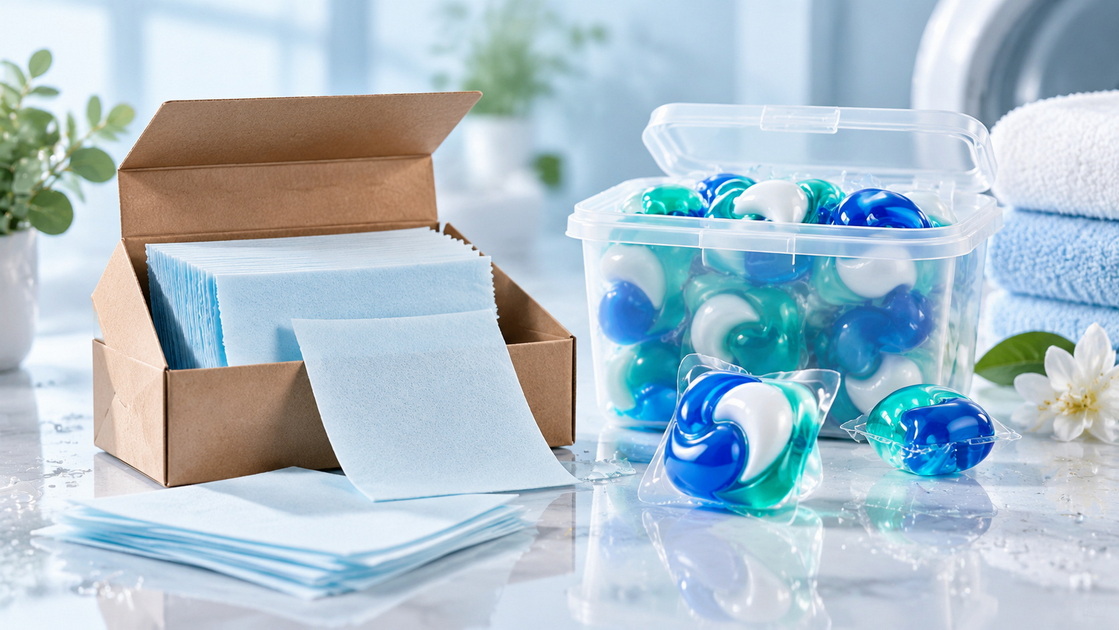
Laundry detergent sheets are thin, water-soluble or dispersible sheets containing concentrated cleaning ingredients. They are typically designed to dissolve in the wash and release surfactants, builders, fragrances, enzymes, or other functional ingredients depending on the formula.
For a retail brand, sheets are often attractive because they are:
- Lightweight
- Compact
- Easy to ship
- Easy to store
- Often compatible with paper-forward packaging
- Simple to dose, especially if the sheet is perforated for half-load use
Consumer Reports describes detergent sheets as concentrated detergent held together in a sheet form, while noting that product performance varies significantly across brands and formulas. This is an important point for private-label buyers: a sheet format alone is not a cleaning-performance guarantee. Formula design, active ingredient selection, dissolution behavior, and quality control matter.
Laundry pods, also called laundry packs or liquid detergent capsules, are concentrated liquid or gel detergent doses enclosed in a water-soluble film. Some pod products use multi-chamber designs that separate ingredients until the wash cycle begins.
Pods usually communicate a stronger "premium convenience" message because they are visually distinctive, highly pre-measured, and familiar to many consumers. They can also support advanced product stories, such as:
- Multi-chamber stain-removal systems
- Detergent plus fabric-care additives
- Fragrance boosters
- Color-protection claims
- Cold-water cleaning positioning
- Premium scent experiences
However, laundry pods require more specialized production, higher-barrier packaging, and stronger safety planning. The U.S. Consumer Product Safety Commission references ASTM F3159, a voluntary safety standard for liquid laundry packets. Requirements have included child-resistant outer packaging, prominent warnings, opacity or visibility masking, and specific performance requirements for the individual packets.
The most useful comparison is a total cost-to-serve model. Retail brands should calculate the cost of moving one sellable unit from production to the consumer, then divide that figure by the number of credible washes delivered.
| Cost Factor | Detergent Sheets | Laundry Pods | Retail Brand Implication |
|---|---|---|---|
| Formula format | Dry or low-moisture sheet system | Concentrated liquid/gel in water-soluble film | Pod formulation and encapsulation can raise complexity |
| Production equipment | Sheet coating, drying, cutting, perforation, packing | Liquid filling, film handling, sealing, humidity control, testing | Pods typically require higher process control |
| Packaging | Paper envelopes, cartons, pouches, or refill concepts | Rigid tubs, child-resistant pouches, or compliant containers | Pods may carry higher packaging and compliance costs |
| Freight efficiency | Usually very favorable due to low weight and compact form | Better than bulky liquid bottles, but usually heavier than sheets | Sheets may reduce freight cost per wash |
| E-commerce fulfillment | Lower dimensional weight and easier storage | More weight, potential leak or heat-related handling concerns | Sheets can support parcel-shipping economics |
| Safety controls | Must still include clear use and storage instructions | Requires stronger child-safety and hazard-management planning | Pods can create higher compliance and reputational exposure |
| Consumer value perception | Eco-conscious, minimalist, travel-friendly | Convenient, premium, powerful, familiar | Positioning drives acceptable retail price |
| Cleaning performance risk | Must be validated carefully, especially for stains and cold water | Often perceived as high-performance, but formula varies | Claims testing is essential for both formats |
Retail buyers often begin by asking, "Which product has the lower FOB price?" That question is understandable, but incomplete.
A detergent sheet may have a competitive unit cost because it eliminates the need to transport a large amount of water and can use lightweight retail packaging. Yet an advanced sheet formula may require specialty binders, premium surfactants, enzymes, fragrance encapsulation, or controlled drying conditions. A cheap sheet that tears, clumps, dissolves slowly, or cleans poorly can damage a new brand much more than a slightly higher-cost formula.
Laundry pods may cost more to manufacture because the process includes precise liquid dosing, water-soluble film management, sealing, quality inspection, and moisture control. Multi-chamber pod designs can raise formulation flexibility and perceived value, but they also add process complexity.
Best practice: Ask suppliers to quote at least three formula tiers:
1. Entry-level value formula for price-sensitive retail
2. Core performance formula for mainstream retail and e-commerce
3. Premium differentiated formula with enhanced stain removal, fragrance, enzyme system, or cleaner-ingredient positioning
This makes it easier to match the product architecture with the intended retail price and margin target.
Packaging is one of the clearest differences between detergent sheets and laundry pods.
Detergent sheets can often be sold in paperboard cartons, envelopes, stand-up pouches, or refill-oriented formats. These options may reduce package weight, improve shelf efficiency, and support a plastic-reduction message. However, the packaging still needs to protect the sheets from moisture, crushing, odor loss, and handling damage.
Laundry pods require packaging that protects the product from moisture and accidental access. For the U.S. market, retail brands should treat child safety as a product-development priority, not a last-minute artwork issue. ASTM's voluntary standard for liquid laundry packets includes child-resistant packaging provisions, warning requirements, and package-visibility considerations.
For brands importing from overseas or supplying e-commerce channels, freight can materially affect profitability.
Because detergent sheets are thin and light, brands can often move more washes in a smaller shipping volume than with conventional liquid detergent formats. This can improve:
- Container utilization
- Warehouse capacity
- Parcel-shipping economics
- Retail shelf density
- Inventory carrying efficiency
- Cross-border shipping feasibility
Pods are also more compact than traditional liquid detergent bottles, but their formula contains liquid content and their protective packaging can add weight and volume. Pods may therefore face a higher freight cost per wash than sheets, particularly when a brand uses rigid plastic tubs.
That said, freight savings should never become the only product decision. If a sheet's cleaning performance does not meet the target consumer's needs, a lightweight package will not create repeat purchase.

The most meaningful pricing metric is landed cost per effective wash.
Use this formula:
Landed Cost per Load=(Product Cost + Packaging + Freight + Duty + Testing + Fulfillment + Allowance)/Credible Number of Washes
A more advanced retail evaluation should also include expected returns, promotional spending, trade discounts, retailer margin, sampling costs, and damage allowances.
The following example is illustrative only. Actual costs depend on formula, packaging, order quantity, destination, certifications, shipping method, and retailer requirements.
| Illustrative Metric | Detergent Sheets | Laundry Pods |
|---|---|---|
| Pack count | 60 sheets / 60 standard loads | 60 pods / 60 standard loads |
| Product and packaging cost | Moderate | Moderate to high |
| Freight weight per pack | Low | Medium |
| Child-resistant packaging requirement | Usually lower complexity | Higher complexity |
| Premium retail-price potential | Moderate to high | High |
| Best-fit channel | DTC, subscription, eco retail, travel, compact retail | Mass retail, club, premium convenience, performance-led retail |
| Key risk | Weak dissolution or stain performance | Safety compliance, package cost, leakage or heat sensitivity |
A sheet brand can win on cost per load when it maintains strong cleaning performance, uses space-efficient packaging, and sells through logistics-sensitive channels. A pod brand can justify a higher cost per load when consumers recognize the convenience, trust the cleaning power, and accept a premium shelf price.
The biggest hidden cost in laundry detergent is not always manufacturing. It can be consumer dissatisfaction.
A new retail brand may save money by choosing the lowest-cost formula, only to face low repeat purchase, poor reviews, retailer chargebacks, or expensive reformulation later. In laundry care, the product must perform on the stains and conditions that matter to the target audience.
Consumer Reports has tested laundry detergent sheets and found that cleaning quality can vary by product. That is why retail brands should validate performance before making "powerful cleaning," "tough on stains," "cold-water effective," or "works in all machines" claims.
Industry professionals also note that detergent sheets can be effective for everyday laundry when their formula contains suitable surfactants and enzymes, while heavier soils may require dosage adjustments or additional treatment.
Before placing a large OEM/ODM order, ask your manufacturer for a product-validation plan that covers:
- Cold-water dissolution
- Front-load and top-load washing-machine performance
- High-efficiency machine compatibility
- Standardized stain-removal testing
- Fragrance stability
- Moisture-resistance testing
- Package drop testing
- Accelerated storage testing
- Microbial and stability checks for pod formulas
- Color-transfer and residue evaluation
- Consumer-use testing where feasible
Expert insight: A retail product needs both laboratory performance and real-household usability. A detergent sheet may test well in controlled conditions but still generate poor feedback if consumers do not understand where to place the sheet, how to dose heavy loads, or how to store the package after opening.
Laundry pod safety must be part of a retail brand's cost model and risk-management process.
The U.S. Consumer Product Safety Commission identifies ASTM F3159 as the relevant voluntary standard for liquid laundry packets. The standard was developed to strengthen safety provisions related to these products. Research on the standard describes protective elements such as difficult-to-open containers, warning labels, opaque packaging, and requirements intended to reduce accidental exposure risks.
For a pod launch, brands should work with qualified product-development and compliance teams to review:
- Market-specific labeling rules
- Child-resistant packaging expectations
- Warning statements and pictograms
- Ingredient disclosure requirements
- Safety data sheet obligations
- Transportation and storage conditions
- Product-liability insurance requirements
- Retailer-specific compliance checklists
This does not mean pods should be avoided. It means the format requires a disciplined launch process.
Detergent sheets are frequently marketed as "eco-friendly," "plastic-free," or "zero waste." Those messages can be commercially powerful, but they should be precise and supportable.
For example, a paper carton may reduce plastic in outer packaging, but the overall environmental profile also depends on formula ingredients, secondary packaging, production energy, freight route, product dosage, and end-of-life options. Avoid broad claims that cannot be substantiated.
For brands pursuing safer-ingredient positioning in the U.S., the EPA Safer Choice program helps consumers and purchasers identify products that perform while using ingredients with safer human-health and environmental profiles. The program is voluntary, and it should not be presented as an automatic certification for every "green" laundry product.
Better claim language:
- "Plastic-free outer carton," if accurate
- "Designed for compact shipping," if supported by package data
- "Concentrated formula," if dosage supports the statement
- "Formulated without [specific ingredient]," when documented
- "EPA Safer Choice certified," only after certification is granted
Avoid unsupported language:
- "Completely non-toxic"
- "Zero environmental impact"
- "100% biodegradable" without robust evidence
- "Safer for everyone"
- "Chemical-free"
The best choice depends on where and how the product will be sold.
- Lower freight weight and smaller storage footprint
- A sustainability-oriented or minimalist retail story
- A paper-forward or refill-friendly packaging concept
- Strong DTC, subscription, marketplace, or travel-retail potential
- Easy-to-understand dosage and compact household storage
- An opportunity to differentiate through scent, sheet thickness, dissolvability, or low-residue performance
- A familiar premium-convenience format
- High perceived cleaning power
- A multi-benefit product story
- A mass-market or club-store-ready proposition
- A higher retail price point supported by performance and packaging
- A product format that consumers immediately recognize
For established retail brands, the strongest strategy may not be "sheets or pods." It may be a segmented portfolio:
- Detergent sheets for eco-conscious, e-commerce, travel, and compact-living consumers
- Laundry pods for performance-focused, family, and premium-convenience shoppers
This lets the brand address different consumer needs while using shared fragrance identities, visual branding, and cross-selling opportunities.

A useful quotation request should provide enough commercial detail for the manufacturer to recommend the correct format and formula.
1. Define your target market and retail channel.
2. Set the target retail price and desired gross-margin range.
3. Specify the number of washes per pack.
4. Identify performance requirements, including stain removal and cold-water use.
5. Decide whether fragrance, enzyme systems, color care, or sensitive-skin positioning is needed.
6. Choose preferred packaging materials and sustainability claims.
7. Confirm compliance, testing, and label requirements for the destination market.
8. Request samples from at least two performance tiers.
9. Calculate landed cost per load, not only FOB cost per pack.
10. Conduct consumer-use testing before committing to a major production run.
At Foshan Magic Crystal Technology Development Co., Ltd., we support retail brands with OEM/ODM development across laundry detergent sheets and broader laundry, household, personal-care, and pet-cleaning categories. With more than three self-owned factories, annual production capacity of approximately 30,000–40,000 tons, and experience serving more than 300 brands, our development process can help brands evaluate formula, packaging, scent, positioning, and cost targets before scale-up.
Detergent sheets usually offer the stronger logistics and compact-packaging advantage. They are especially compelling for brands built around e-commerce efficiency, plastic-reduction messaging, travel convenience, and modern minimalist design.
Laundry pods usually offer the stronger premium-convenience and familiar-performance advantage. They can support higher retail pricing, but brands must account for more complex manufacturing, packaging, safety, and compliance considerations.
The right retail decision is not based on which format has the lowest unit price. It is based on which format delivers the best combination of landed cost per effective wash, performance, consumer trust, repeat purchase, and brand differentiation.
Ready to compare formats for your retail brand? Contact Foshan Magic Crystal Technology Development Co., Ltd. to request detergent sheet and laundry pod samples, discuss OEM/ODM options, and build a cost-per-load model tailored to your target market.
Detergent sheets can be cheaper on a landed-cost basis because they are lightweight and compact, which may reduce freight, warehousing, and e-commerce fulfillment costs. However, the final answer depends on formula quality, packaging, order quantity, destination market, and performance requirements.
Both formats can clean effectively when they use well-designed formulas. However, cleaning performance varies by brand and formula. Retail brands should verify stain removal, dissolution, cold-water performance, and residue levels through testing before making performance claims.
Often, yes. Laundry pods can require specialized liquid filling, water-soluble film handling, sealing, moisture control, testing, and child-resistant packaging. These factors can increase production and compliance costs compared with many detergent-sheet formats.
The best option depends on the market position. Paperboard cartons and moisture-protective pouches are common choices. The packaging should protect sheets from humidity, crushing, fragrance loss, and contamination while supporting the product's sustainability and retail-positioning goals.
Retail brands selling liquid laundry packets should carefully evaluate applicable regulations, retailer rules, and voluntary safety standards. In the United States, ASTM F3159 addresses safety provisions for liquid laundry packets, including difficult-to-open packaging and warning requirements.
Many detergent sheets are formulated for both standard and high-efficiency machines, but this must be verified for each formula. Brands should test low-sudsing behavior, dissolution, and residue performance in relevant machine types before using HE-compatible claims.
Compare suppliers by more than price. Review factory capability, formula-development support, quality-control process, testing documentation, capacity, packaging options, compliance knowledge, sample quality, lead time, communication, and experience serving your target market.
1. Consumer Reports. "[Do Laundry Detergent Sheets Work as Well as Liquid?]" Discusses detergent-sheet construction, dissolution, and product-performance testing. [consumerreports]
2. TODAY. "[Do Laundry Detergent Sheets Really Work? What Experts Say]" Includes expert commentary on everyday performance, dosage, and use instructions for detergent sheets. [today]
3. U.S. Consumer Product Safety Commission. "[Liquid Laundry Packets]" Lists ASTM F3159 as the voluntary standard associated with liquid laundry packet safety. [cpsc]
4. National Center for Biotechnology Information / PMC. "[Impact of the Voluntary Safety Standard for Liquid Laundry Packets on Pediatric Exposures]" Details safety features discussed in ASTM F3159, including packaging, warnings, and child-access protections. [pmc.ncbi.nlm.nih]
5. U.S. Environmental Protection Agency. "[Safer Choice]" Explains the voluntary EPA program for identifying products that perform and contain ingredients with safer human-health and environmental profiles. [epa]
6. American Cleaning Institute. "[ACI Response Study on Exposures to Detergent Packets]" Provides industry context on laundry-packet safety standards and exposure-incident reductions. [cleaninginstitute]


