
Views: 268 Author: Magic Household Cleaning Publish Time: 2026-10-18 Origin: Site
Content Menu
● What Makes Laundry Detergent Sheets Suitable for Sensitive Skin?
● Fragrance-Free vs. Unscented: The Most Important Label Difference
>> Fragrance-free addresses formulation
>> Unscented addresses the finished smell
>> Natural fragrance is still fragrance
● Can Laundry Detergent Sheets Cause Allergies or Irritation?
● How to Choose the Best Laundry Detergent Sheets for Allergies
>> Treat hypoallergenic as a claim to investigate
>> Check independent recognition carefully
● Are Enzyme-Free Laundry Sheets Always Better?
● A Practical Routine for Switching Laundry Detergents
>> 1. Document your current routine
>> 2. Remove optional fragrance products
>> 3. Clean the machine as instructed
>> 4. Follow the actual dosing guidance
>> 5. Observe performance without drawing medical conclusions
● What Customer Reviews Can—and Cannot—Tell You
● Manufacturer Checklist for Private-Label Sensitive-Skin Laundry Sheets
>> Define the formula and claim requirements
>> Test the finished product under realistic conditions
>> Keep documentation specific
● Develop a Laundry Sheet Range Around Evidence
>> What are the best laundry detergent sheets for allergies?
>> Are laundry detergent sheets better than liquid detergent for eczema?
>> Can fragrance-free laundry sheets still cause a reaction?
>> Are fragrance-free sheets suitable for baby clothes?
>> Should I avoid enzymes in detergent sheets?
>> How should brands verify sensitive-skin product claims?
The best laundry detergent sheets for allergies are not necessarily the most expensive, the most natural-looking, or the highest-rated online. A better starting point is a fragrance-free, dye-free formula with clear ingredient information, appropriate dosing instructions, and evidence supporting its sensitive-skin claims.
For households managing eczema, fragrance sensitivity, or suspected detergent reactions, choosing laundry products can feel frustrating. Packaging promises are easy to find. Reliable explanations are harder.
As a laundry-care manufacturer, we approach this question through formulation, washing performance, and product transparency—not through the assumption that sheets are automatically gentler than liquids.
This guide explains what to check, how to evaluate customer feedback, and how to introduce a new detergent without overlooking other possible triggers.
Laundry sheets are concentrated detergent delivered in a thin, dissolvable format. Their convenience does not, by itself, establish skin compatibility.
Two products can look almost identical while containing different surfactants, fragrances, enzymes, preservatives, and supporting ingredients.
For allergy-conscious buyers, the important questions are:
- Does the formula contain added fragrance or masking scents?
- Are dyes included?
- Can the manufacturer provide meaningful ingredient information?
- Does the product exclude your personally identified allergens?
- Are washing instructions clear enough to support correct dosing?
- What evidence supports any testing or certification claims?
No detergent can guarantee that every user will remain reaction-free. The goal is to make a more informed choice and avoid ingredients known to cause problems for the individual.
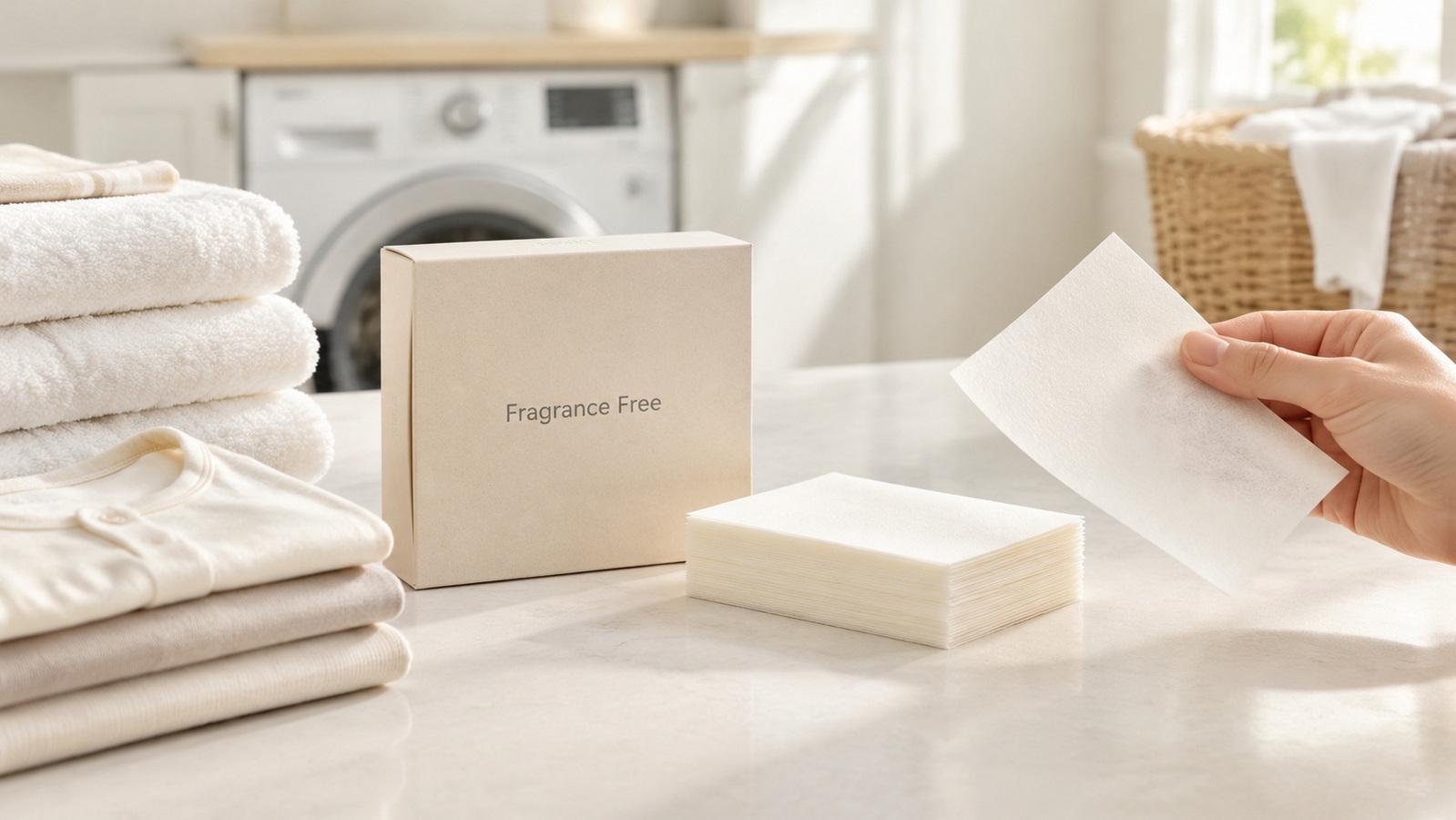
Fragrance-free generally indicates that fragrance materials are not used to perfume the product or mask its underlying smell.
A fragrance-free detergent may still have a mild raw-material odor. That does not necessarily mean perfume has been added.
For eczema-prone households, dermatology guidance commonly recommends fragrance-free and dye-free laundry detergent.
An unscented product may contain ingredients that neutralize or conceal other odors.
Consequently, "I cannot smell anything" is not a reliable way to confirm that a detergent contains no fragrance materials.
When comparing fragrance-free laundry detergent sheets for sensitive skin, read beyond the front label. Check the ingredient disclosure and ask the supplier to clarify ambiguous wording.
Essential oils and botanical fragrance blends should not receive an automatic exemption.
"Plant-derived" describes an ingredient's origin. It does not prove that the ingredient is suitable for someone with a fragrance allergy.
Similarly, "eco," "natural," and "plastic-free packaging" do not establish skin compatibility.
A rash after wearing freshly washed clothing deserves attention, but it does not identify the cause by itself.
Irritation and allergic contact dermatitis are different problems. Irritation involves damage or disruption to the skin barrier. Allergic contact dermatitis involves an immune response to a particular substance.
Eczema may also flare for reasons unrelated to detergent, including friction, sweat, heat, or another product contacting the skin.
This distinction matters because repeatedly changing detergents may not solve the underlying problem.
If symptoms persist, worsen, or repeatedly return, seek medical assessment. A dermatologist can determine whether diagnostic patch testing is appropriate.
Do not apply concentrated detergent directly to your skin as a home allergy test. Washing a fabric sample is also not equivalent to clinical patch testing and cannot rule out a delayed reaction.
Rather than relying on an unsupported brand ranking, use a consistent comparison framework.
| Selection factor | What to look for | What should prompt questions |
|---|---|---|
| Fragrance | Clear fragrance-free positioning and supporting disclosure | “Unscented” without clarification |
| Dyes | No added dyes | Colour added mainly for appearance |
| Ingredients | Accessible, understandable ingredient information | Vague descriptions without meaningful detail |
| Personal allergens | Confirmation that identified allergens are absent | General reassurance without checking the formula |
| Testing | Reports relevant to the finished product | Claims without a named method or scope |
| Instructions | Guidance for load size, soil and water conditions | One universal dose for every situation |
| Customer feedback | Detailed descriptions of actual washing conditions | Unexplained claims that a product “cures eczema” |
"Hypoallergenic" should never be interpreted as "allergy-proof."
Ask what the manufacturer means, what testing was conducted, and whether the evidence applies to the exact formula being sold.
The same approach applies to "dermatologically tested." A statement that testing occurred is incomplete without information about the test design, participants, results, and limitations.
Recognised product-evaluation programmes can provide useful supporting information.
However, verify the exact product, not simply the brand. Different fragrances or formula variants may not share the same status.
Absence from a voluntary programme does not automatically mean a product is unsuitable. Equally, acceptance does not guarantee that every person will tolerate it.
Not necessarily.
Enzymes help detergents break down particular soils, including proteins and starches. Their presence alone is not sufficient reason to reject a product intended for sensitive skin.
Some laundry products listed in the National Eczema Association's product directory contain enzymes. That makes a blanket "all enzymes are unsuitable" rule difficult to justify.
The more useful approach is individual:
- Follow medical advice when a specific ingredient sensitivity has been identified.
- Compare the complete formula rather than one ingredient category.
- Assess cleaning performance alongside personal tolerance.
- Avoid assuming that enzyme-free means irritation-free.
An enzyme-free option may suit a particular buyer. It should not be presented as universally safer without relevant evidence.
Changing several products simultaneously makes it difficult to understand what helped—or what caused a problem.
For someone without a history of severe reactions, a cautious, consistent introduction can provide more useful observations.
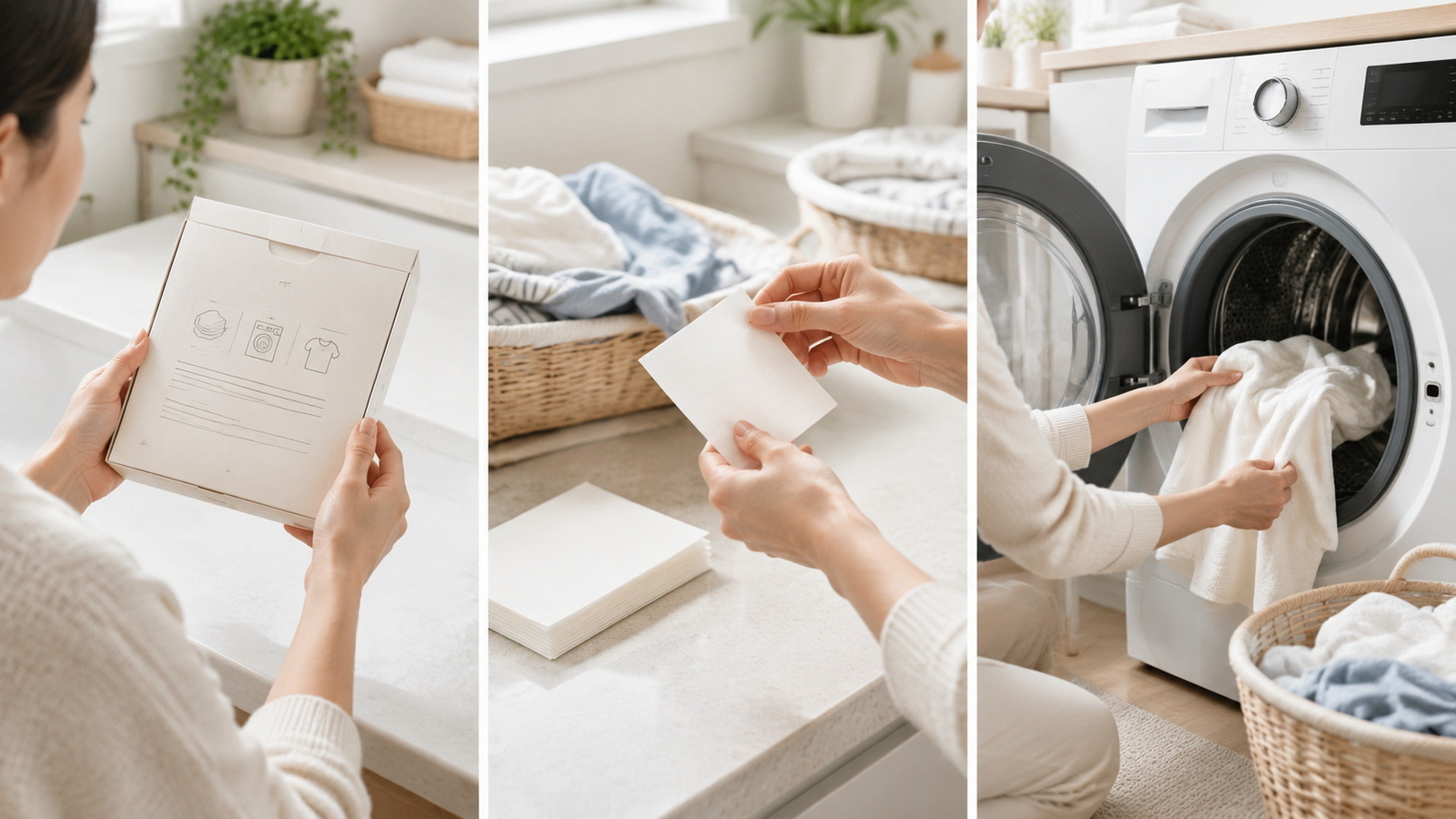
Record the detergent, softener, scent boosters, dryer products, dose, cycle, and typical load size.
Include recently introduced products. The detergent may not be the only variable.
If the objective is fragrance avoidance, review the entire wash-and-dry routine.
Using fragrance-free sheets alongside scented softener or dryer sheets does not create a fragrance-free laundry process.
Check the washer manual for dispenser cleaning and maintenance procedures.
Remove visible detergent buildup where accessible. Avoid improvising cleaning mixtures or assuming that one hot cycle will eliminate every trace of previous products.
Do not assume that one sheet suits every machine, load size, water hardness, or soil level.
More detergent is not automatically better. However, underdosing can also compromise cleaning. Start with the product's instructions and adjust only as directed.
Record visible residue, dissolution, stain removal, and any changes in comfort.
An extra rinse may help when detergent removal appears inadequate, but it should not compensate for habitual overdosing.
Stop using a suspected product if symptoms develop and seek professional advice when needed. Do not repeatedly reintroduce a product that previously caused a significant reaction.
Reviews are most useful when they describe conditions rather than simply award stars.
For example, a comment about incomplete dissolution becomes more informative when it includes water temperature, cycle length, load size, and where the sheet was placed.
When reviewing feedback, look for:
1. The exact product variant, particularly fragrance-free versus scented.
2. How long the reviewer used it.
3. Whether softener or scent boosters were also used.
4. The machine type and wash conditions.
5. Whether the experience concerns cleaning, residue, fragrance, or skin symptoms.
"I experienced less itching" is a personal observation. It is not proof that a detergent treats eczema or prevents allergic reactions.
Brands publishing testimonials should preserve that distinction, obtain permission, and avoid editing a customer's experience into a medical claim.
For retailers and brand owners, sensitive-skin positioning needs more than a fragrance-free label.
From a manufacturing perspective, the most useful product-development brief connects ingredient selection, performance testing, production controls, and consumer instructions.

Specify the intended market, ingredient restrictions, fragrance policy, dye policy, and proposed packaging language.
Where fragrance avoidance is a priority, discuss raw-material documentation and appropriate controls for shared production equipment.
A supplier should explain the controls it actually uses rather than promise an unsupported "zero-allergen" product.
A practical validation plan should consider:
- Dissolution at the intended wash temperatures.
- Recommended doses across relevant load sizes.
- Cleaning performance against representative soils.
- Performance under different water-hardness conditions.
- Storage stability and moisture protection.
- The suitability of any proposed skin-compatibility testing.
A sheet that dissolves quickly in a demonstration glass has not necessarily demonstrated performance inside a loaded washing machine.
Request specifications, relevant safety documentation, batch identification, and reports supporting proposed claims.
A safety data sheet serves a particular safety-communication purpose. It should not be treated as a complete consumer ingredient disclosure or proof of suitability for eczema.
Likewise, manufacturing capacity demonstrates potential supply capability—not clinical performance.
At Foshan Magic Crystal Technology Development Co., Ltd., our focus includes laundry detergent sheets and broader fabric-care, household, personal-care, and pet-cleaning products.
Our company profile states that we operate more than three owned factories, have annual production capacity of approximately 30,000–40,000 tonnes, and provide OEM/ODM services to more than 300 brands worldwide.
For a sensitive-skin product brief, we recommend beginning with the intended user, ingredient requirements, target washing conditions, and evidence needed for each proposed claim.
Contact our team with your target market, fragrance-free requirements, packaging preferences, and expected order volume. Request a formulation discussion and samples for an agreed evaluation programme before finalising your private-label range.
Look for fragrance-free, dye-free sheets with transparent ingredient information and credible supporting documentation. The best choice must also exclude any allergens identified for the individual. There is no universally suitable formula.
Not automatically. Dermatology recommendations focus on characteristics such as fragrance-free and dye-free formulation, not a guarantee attached to the sheet format. Compare the actual products and follow individual medical guidance.
Yes. Removing fragrance does not remove every possible irritant or allergen. Other ingredients, washing conditions, and unrelated skin triggers may still matter. Persistent symptoms need assessment rather than repeated trial-and-error switching.
They may be an option when the formula and washing instructions are appropriate. For babies with eczema or recurring rashes, ask a paediatric clinician or dermatologist for individual recommendations. "Baby" branding alone is not proof of suitability.
Not as a universal rule. Some eczema-directory laundry products contain enzymes. Consider the complete formulation, known personal sensitivities, relevant product evidence, and professional advice rather than treating one ingredient category as automatically unsuitable.
Request evidence for the exact finished formula, review test scope and limitations, confirm ingredient information, and check local labelling requirements. Do not extend a report for one formula or variant to another without justification.
1. REGN. "[Best Laundry Detergent Sheets for Allergies 2026]." Original article reviewed for topic coverage, ranking methodology, product categories, and claims requiring qualification; not used as independent proof of product superiority. [regn.co]
2. American Academy of Dermatology. "[How can I find eczema friendly products?]" Supports the recommendations to choose fragrance-free and dye-free laundry detergent and distinguish fragrance-free from unscented products. [aad]
3. U.S. Environmental Protection Agency. "[Safer Choice Fact Sheet—Fragrance-Free]." Explains fragrance materials, masking scents, and the programme's additional fragrance-free designation. [epa]
4. National Eczema Association. "[Seal of Acceptance™ Product Directory and Programme Information]." Explains voluntary applications, ingredient and testing review, physician evaluation, formulation changes, and the limitations of product acceptance. [nationaleczema]
5. National Eczema Association. "[Seventh Generation Laundry Detergent Packs]." Provides a specific example of a listed laundry formulation containing enzymes; it is not evidence that every enzyme-containing detergent suits every individual. [nationaleczema]
6. Foshan Magic Crystal Technology Development Co., Ltd. Company background supplied for this article: manufacturing scope, factory ownership, annual capacity, and brands served. These figures have not been independently verified. No public company-profile URL was supplied.


