
Views: 266 Author: Magic Household Cleaning Publish Time: 2026-09-11 Origin: Site
Content Menu
● What Makes Laundry Detergent Sustainable?
>> The Five Sustainability Questions Buyers Should Ask
● Laundry Detergent Sheets Vs Liquid Detergent: Key Differences
● Why Laundry Detergent Sheets Can Be More Sustainable
>> Lower Shipping Weight and Volume
>> Less Rigid Plastic Packaging
>> Pre-Measured Doses Can Reduce Overuse
● Where Liquid Detergent Can Be More Sustainable
>> Concentrated Liquids Reduce Water and Packaging Per Load
>> Refill and Recycled-Content Systems Are Improving
>> Better Cleaning Can Prevent Repeat Washing
● The PVA Debate: A Critical Consideration for Laundry Sheets
>> What Responsible Brands Should Do
● The Biggest Sustainability Lever Is How People Wash
>> A Practical Low-Impact Laundry Routine
● Which Option Is Better for Different Buyers?
● Expert Checklist for Private-Label Brands
● Final Verdict: Sheets or Liquid?
● Create Your Sustainable Laundry Product
● FAQ
>> 1. Are laundry detergent sheets more eco-friendly than liquid detergent?
>> 2. Do laundry detergent sheets contain plastic?
>> 3. Are concentrated liquid detergents better for the environment?
>> 4. Does cold-water washing really reduce environmental impact?
>> 5. Which detergent format is best for travel?
>> 6. Can detergent sheets clean heavily soiled laundry?
>> 7. What should brands ask an OEM detergent manufacturer?
Laundry detergent sheets can be more sustainable than conventional liquid detergent, especially when they use low-material packaging, a concentrated formula, and accurate per-load dosing. However, the answer is not automatic: a highly concentrated liquid detergent in recycled-content packaging may outperform a poorly formulated laundry sheet, particularly if the sheet contains polymers with uncertain real-world biodegradation or requires re-washing due to weak stain removal.
For consumers, retailers, and private-label brands, the real question is not simply "sheets or liquid?" It is: Which product delivers the required cleaning performance with the lowest total environmental burden per successful wash?
As a manufacturer serving global OEM/ODM customers in laundry, household, personal, and pet-care categories, Foshan Magic Crystal Technology Development Co., Ltd. evaluates sustainability across formulation, packaging, production, shipping, consumer use, and end-of-life considerations. With more than three self-owned factories, annual capacity of 30,000–40,000 tonnes, and experience supporting over 300 brands, we see that the best sustainable laundry product is built through measurable product design, not a single "eco" claim.
A sustainable detergent should be assessed through a life-cycle perspective, rather than by packaging alone. That means looking at the product from raw material sourcing to manufacturing, shipping, household use, wastewater treatment, and final packaging disposal.
A detergent can look sustainable on a shelf because it comes in cardboard packaging. Yet it may still have a larger environmental burden if it uses inefficient ingredients, performs poorly in cold water, needs excess dosage, or leaves consumers needing to wash garments again.
Likewise, a plastic bottle is not automatically unsustainable. A concentrated liquid detergent with a high number of washes per bottle, recycled-content packaging, accurate dosing, and strong low-temperature performance may be a responsible choice.
A life-cycle assessment of household detergents found that the major environmental drivers for laundry detergent include wash temperature, product dosage, and the type and amount of surfactant used. In the study's representative solid laundry detergent scenario, the consumer-use phase accounted for 64% of cumulative energy demand, mainly because of energy used to heat water.
When comparing laundry detergent sheets vs liquid detergent, ask these questions:
1. How much packaging is required per wash?
2. How much water is transported before the product reaches the consumer?
3. Does the product prevent overdosing?
4. Can it clean effectively in cold water and short cycles?
5. What ingredients enter the wastewater system after each load?
This framework is more credible than relying on vague terms such as "green," "natural," or "zero waste."
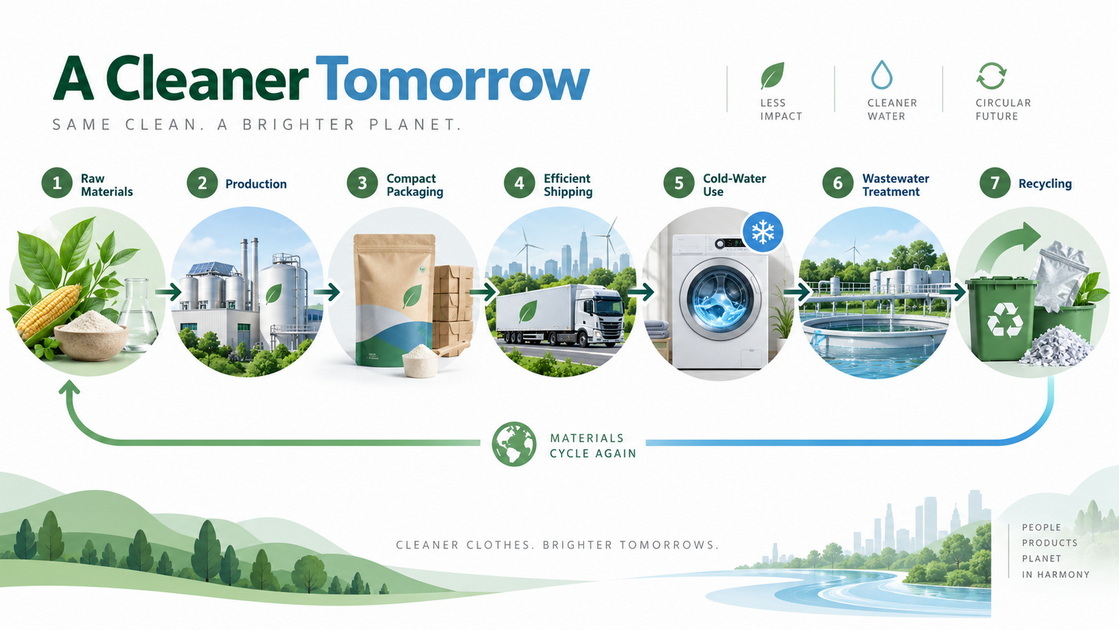
Laundry sheets are thin, pre-measured pieces of detergent designed to dissolve in the wash. Liquid detergent is a fluid formula, typically sold in bottles, pouches, refill systems, or bulk containers.
The formats differ significantly in physical design, logistics, dosing behavior, and packaging requirements.
| Sustainability Factor | Laundry Detergent Sheets | Liquid Detergent |
|---|---|---|
| Product weight | Usually lightweight because the format contains little or no added water | Often heavier because liquid formulas contain substantial water |
| Shipping efficiency | Compact cartons can improve storage and freight efficiency | Bulkier bottles take more warehouse and transport space |
| Primary packaging | Often paperboard cartons, sometimes with inner plastic layers or bags | Commonly HDPE or PET bottles, plus caps, labels, pumps, or measuring cups |
| Dosing | Pre-measured sheets can reduce consumer overuse | Overdosing is common when consumers pour without using the cap correctly |
| Formula flexibility | Requires a stable sheet-forming system and rapid dissolution | Can support a wide range of enzymes, polymers, solvents, and stain-treatment technologies |
| Cleaning performance | Varies widely by formula, sheet size, water temperature, and fabric load | Often offers strong cleaning performance, especially for oily or heavy stains |
| Wastewater profile | Some sheets use PVA/PVOH or other film-forming materials | Liquid formulas may contain surfactants, builders, fragrances, preservatives, and polymers |
| Best sustainability opportunity | Plastic reduction, lower freight weight, accurate dose | Concentration, refill systems, recycled-content bottles, high performance per dose |
Traditional liquid detergent includes water, and moving water through a supply chain requires additional packaging volume, warehouse space, fuel, and handling. Laundry sheets are usually much lighter and thinner, allowing brands and distributors to ship more wash loads in the same shipment volume.
This is particularly important for:
- Cross-border e-commerce brands
- Subscription laundry-product businesses
- Exporters serving multiple regional markets
- Retailers with limited shelf space
- Travel and convenience-focused product lines
For an OEM/ODM brand, compact products may also reduce secondary packaging requirements and improve container utilization. This can lower freight costs while helping reduce transport-related emissions per sellable unit.
However, brands should avoid making unverified claims such as "one truck of sheets replaces five trucks of liquid" unless the statement is backed by product-specific freight calculations. The real result depends on formula concentration, wash count, carton dimensions, shipping mode, and destination market.
Laundry sheets are frequently sold in paperboard cartons. If the carton is genuinely recyclable in the intended market and does not contain difficult-to-separate plastic barriers, it can reduce dependence on large, rigid plastic bottles.
This matters because packaging can be a significant impact contributor for many household-cleaning formats. Research on household detergent life cycles identifies packaging materials and plastic resin use as relevant environmental factors, particularly for products that do not have a high-energy consumer-use phase.
For a sheet detergent brand, better packaging design may include:
- FSC-certified or responsibly sourced paperboard
- Minimal inks and coatings
- Water-based inks where feasible
- Clearly separated inner barriers
- Right-sized cartons that reduce empty space
- Easy-to-understand recycling instructions
- No unnecessary plastic window, shrink wrap, or laminated outer layer
Important: A cardboard carton does not automatically mean plastic-free. Brands should disclose whether there is an internal film, liner, sachet, moisture barrier, or polymer coating.
One of the most practical sustainability benefits of laundry sheets is dosing control.
Consumers may pour more liquid detergent than needed, especially when stains are visible or when they assume "more detergent means cleaner clothes." Excess detergent can increase formulation consumption, raise cost per load, create more wastewater burden, and sometimes leave residue that requires an additional rinse cycle.
Pre-cut sheets can simplify the choice:
- One sheet for a standard load
- Half a sheet for a smaller load, where appropriate
- Two sheets for an extra-large or heavily soiled load, only when supported by product instructions
Life-cycle research identifies product dosage as one of the key environmental hotspots for laundry detergents. This means accurate dosing is not a minor consumer tip; it is a meaningful product-design lever.
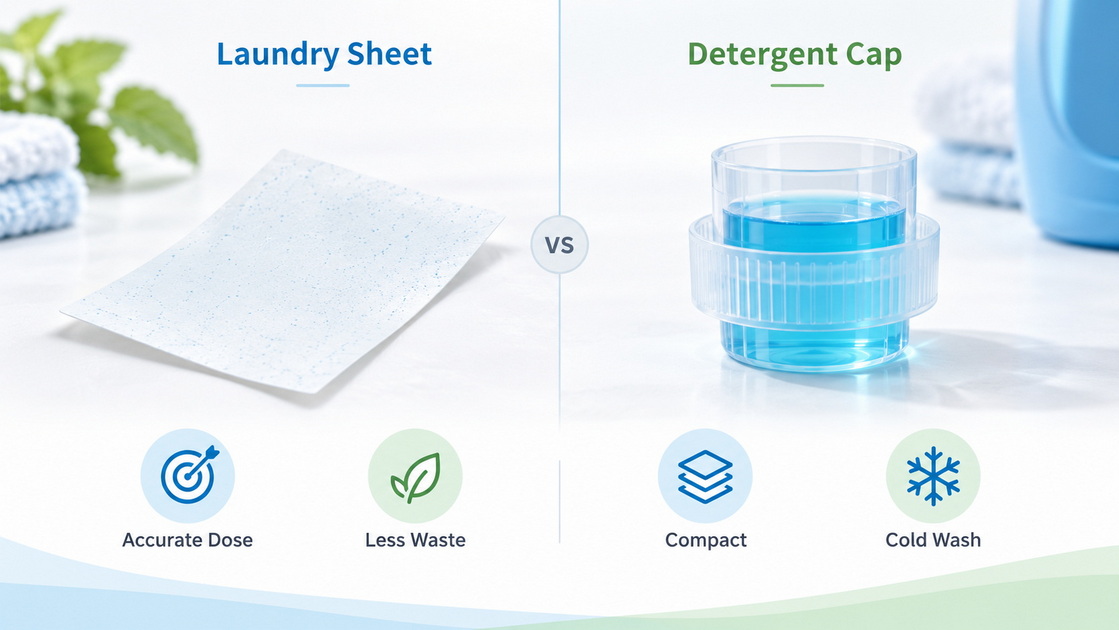
Liquid detergent is not one category with one environmental profile. A conventional, diluted bottle and an ultra-concentrated liquid formula can have very different impacts.
A properly designed concentrated liquid can offer:
- More washes per bottle
- Less water shipped per wash
- Smaller bottles than conventional diluted formats
- Lower plastic use per wash
- Better logistics efficiency
- Strong cleaning in cold water
- Effective performance at low dosage
This is especially relevant in professional cleaning, hospitality, laundromats, and households with heavily soiled loads. A concentrated liquid may provide more formulation flexibility for enzymes, stain-targeting surfactants, and stabilizers that help prevent repeat washing.
The sustainability benchmark should therefore be performance per wash, not package size alone.
Liquid detergent can support circular packaging models, including:
- Refillable durable bottles
- Bulk dispensing systems
- Concentrated refill pouches
- Closed-loop retail refill stations
- Bottles made with post-consumer recycled plastic
- Lightweight bottle redesigns
A peer-reviewed life-cycle study comparing liquid laundry detergent packaging systems found meaningful differences among packaging formats. In that study, a conventional HDPE pourable bottle had lower environmental impacts than the evaluated PET pod container and flexible pouch systems in most impact categories, showing why broad claims about one package type being "always greener" should be avoided.
For brand owners, this reinforces an important principle: compare real packaging specifications, not assumptions.
A product that fails to remove stains can create a hidden environmental cost: re-washing.
This is one reason performance testing belongs in a credible sustainability strategy. A detergent should be tested under realistic conditions, including:
- Cold-water performance
- Hard-water performance
- Standard and heavily soiled loads
- Front-load and top-load machines
- Fast cycles
- Synthetic, cotton, and blended fabrics
- Dissolution behavior
- Residue and rinse performance
Consumer Reports notes that many laundry sheets contain polyvinyl alcohol, or PVA, and reports that the cleaning performance of sheets in its testing was generally weaker than many liquid and pod detergents. It also emphasizes that dissolving in water does not necessarily mean a material fully biodegrades under all wastewater-treatment conditions.
That does not mean every sheet product performs poorly. It means manufacturers should substantiate performance claims with product-specific testing, rather than treating the sheet format itself as proof of sustainability.
Many laundry detergent sheets use polyvinyl alcohol (PVA), also called PVOH or PVAl, as a water-soluble film-forming material that helps bind and hold the sheet together.
This topic deserves careful, balanced communication.
PVA dissolves in wash water. But dissolution is not identical to biodegradation. Whether it biodegrades effectively may depend on the polymer grade, molecular structure, wastewater-treatment conditions, microorganisms present, temperature, and residence time.
Consumer Reports explains that PVA is a class of water-soluble synthetic polymers and that its biodegradation remains debated. It notes that the U.S. Environmental Protection Agency includes certain PVA substances on its Safer Chemical Ingredients List, while also acknowledging that breakdown can depend on specific environmental conditions and microbial activity.
Instead of claiming "plastic-free" without qualification, responsible laundry-sheet brands should:
- Disclose the sheet's film-forming ingredients
- Explain whether PVA/PVOH is used
- Avoid implying that water solubility alone proves complete biodegradability
- Use credible biodegradation and aquatic-safety testing where applicable
- Provide accurate ingredient information by market
- Evaluate alternative sheet technologies and polymer-reduction opportunities
- Avoid greenwashing language such as "zero impact" or "guilt-free"
For private-label buyers, this is a major due-diligence checkpoint. Ask your OEM/ODM supplier for formulation transparency, relevant test reports, safety documentation, and the basis for all environmental claims.
The detergent format matters. But household washing behavior can matter even more.
In an LCA of representative solid laundry detergents, energy used during consumer use was the largest contributor to cumulative energy demand. For the tablet detergent scenario, the use phase represented 8.35 MJ out of 13.0 MJ total, or about 64%.
ENERGY STAR also states that water heating consumes about 90% of the energy required to operate a clothes washer. It advises using cold water for typical loads unless oily stains or special hygiene needs require warmer settings.
Consumers can reduce the environmental impact of either laundry sheets or liquid detergent by following these five habits:
1. Wash full loads whenever practical. A washer uses relatively similar energy per cycle regardless of whether the drum is partially filled or efficiently loaded.
2. Choose cold water for normal laundry. Cold washing can substantially reduce energy demand because water heating is often the dominant energy use.
3. Use the correct dose. Do not use extra liquid or extra sheets unless the load size, soil level, and water hardness justify it.
4. Select an efficient washing machine. ENERGY STAR-certified washers use about 20% less energy and 30% less water than regular washers, according to ENERGY STAR.
5. Air-dry when possible. Dryers can add significant energy use; line drying or drying racks can further lower a household's laundry footprint.
For a sustainability-focused brand, these practices should appear on packaging, product pages, instruction leaflets, and social-media education—not just in corporate ESG reports.
| Buyer or Use Case | More Suitable Option | Why |
|---|---|---|
| Eco-focused e-commerce brand | Laundry detergent sheets | Lightweight shipping, compact storage, carton-forward packaging story |
| Travel retail or hotel welcome kits | Laundry detergent sheets | Portable, spill-resistant, easy to portion |
| Families with heavy stains | Concentrated liquid detergent | Often offers stronger formula flexibility and targeted stain performance |
| Refill-store retailer | Concentrated liquid detergent | Compatible with bulk dispensing and reusable containers |
| Private-label brand entering export markets | Either, depending on positioning | Sheets support lightweight DTC shipping; concentrated liquid supports broader cleaning-performance customization |
| Sensitive-skin product line | Either, with formula validation | Focus on fragrance-free, dye-free, ingredient transparency, and dermatological/safety testing rather than format alone |
| Brand prioritizing low-plastic packaging | Laundry sheets or refill liquid | Verify internal liners, pouch recyclability, recycled content, and local recycling realities |
For brand owners developing sustainable laundry products, the best approach is to create a product brief that measures sustainability across the whole value chain.
Ask:
- Does the formula clean effectively at low temperatures?
- What is the recommended dosage per load?
- Does it perform in hard water?
- Are surfactants responsibly sourced?
- Are enzymes used to improve cleaning at lower temperatures?
- Are fragrances, dyes, and preservatives appropriate for the intended market?
- Is ingredient disclosure clear and compliant?
Ask:
- What is the packaging weight per wash?
- What percentage of plastic is recycled content?
- Is paperboard certified and recyclable?
- Does the carton contain a plastic liner or barrier coating?
- Can consumers actually recycle the format where it is sold?
- Is the package moisture-resistant without excessive multilayer materials?
Ask:
- How many loads fit in one shipping carton?
- What is the container-loading efficiency?
- Can manufacturing be located closer to key markets?
- Is production waste tracked and reduced?
- Can a factory provide documentation for quality control and sustainability claims?
Avoid broad statements such as:
- "100% eco-friendly"
- "Completely plastic-free"
- "Zero-waste detergent"
- "Carbon-neutral" without a transparent calculation
- "Biodegradable" without specifying the relevant test standard and conditions
Instead, use precise claims, such as:
- "Packaged in a paperboard carton with no rigid plastic bottle."
- "Designed for cold-water washing."
- "Pre-measured sheets help simplify dosing."
- "Concentrated formula delivers X washes per package."
- "Packaging contains X% post-consumer recycled material."
Credibility is a competitive advantage. Clear, evidence-based claims build more trust with distributors, retailers, and consumers than exaggerated environmental messaging.
Laundry detergent sheets are often the more sustainable choice when they replace bulky diluted liquid products, minimize packaging materials, prevent overdosing, dissolve reliably, and demonstrate responsible ingredient design.
But liquid detergent can be equally competitive—or better in some cases—when it is concentrated, highly effective in cold water, sold in refillable or recycled-content packaging, and accurately dosed.
The best choice depends on the complete system:
- Product performance per wash
- Formula concentration
- Packaging material per wash
- Freight efficiency
- Consumer dosing
- Cold-water cleaning ability
- Ingredient transparency
- Wastewater impact
- Local recycling infrastructure
For private-label brands, the opportunity is not to choose a format based on a trend. It is to develop a verifiable, high-performance laundry solution that makes sustainability easier for the end user.

Looking to launch or upgrade a private-label laundry detergent sheet or concentrated liquid detergent line?
Foshan Magic Crystal Technology Development Co., Ltd. can support OEM/ODM development for laundry detergent sheets, laundry care, household cleaning, personal care, and pet-cleaning products. We help global brands evaluate formula direction, packaging concepts, product positioning, dosage format, and scalable manufacturing requirements.
Contact our team to discuss a customized sustainable detergent solution designed for your target market, sales channel, and brand standards.
Laundry detergent sheets can be more eco-friendly because they are compact, lightweight, and often use less rigid plastic packaging. However, their sustainability depends on the formula, packaging structure, washing performance, dosage, and the environmental fate of any sheet-forming materials. A concentrated liquid detergent in responsible packaging can also be a sustainable option.
Some laundry detergent sheets contain PVA/PVOH, a water-soluble synthetic polymer used to hold the sheet together. It dissolves in water, but its biodegradation may vary based on the specific material and wastewater-treatment conditions. Brands should disclose the ingredient clearly rather than making unqualified "plastic-free" claims.
Concentrated liquid detergents can reduce the amount of water, packaging, and shipping weight required per wash compared with diluted liquids. Their overall sustainability also depends on dose accuracy, bottle design, recycled content, formula performance, and whether consumers use cold-water cycles.
Yes. Water heating is a major part of washing-machine energy use. ENERGY STAR states that water heating consumes about 90% of the energy needed to operate a clothes washer, so cold-water washing for suitable loads can meaningfully reduce energy use.
Laundry detergent sheets are generally more convenient for travel because they are lightweight, compact, pre-portioned, and less likely to leak than liquid detergent. Travelers should still check local product regulations and carry only the amount needed.
Some detergent sheets can clean normal household loads effectively, but performance varies widely by formulation, water hardness, temperature, load size, and stain type. For heavy grease, oil, sportswear odor, or ground-in stains, a high-performance concentrated liquid detergent or a dedicated pre-treatment may be more effective.
Brands should ask about formula ingredients, cold-water cleaning performance, dosage instructions, packaging composition, recycled content, biodegradability test methods, compliance documentation, minimum order quantities, production capacity, quality-control systems, and the evidence behind every sustainability claim.
1. Golsteijn, L., Menkveld, R., King, H., Schneider, C., Schowanek, D., & Nissen, S. "A Compilation of Life Cycle Studies for Six Household Detergent Product Categories in Europe." *Environmental Sciences Europe*, 2015. The study evaluates ingredients, manufacturing, packaging, transport, consumer use, wastewater treatment, and end-of-life stages, identifying wash temperature, dosage, and surfactant selection as key drivers for laundry detergents. [Read the full study] [pmc.ncbi.nlm.nih]
2. ENERGY STAR. "Clothes Washers." Guidance on efficient washers, full loads, cold-water washing, and energy-saving laundry practices. The source notes that ENERGY STAR-certified clothes washers use about 20% less energy and 30% less water than regular washers. [Read ENERGY STAR guidance] [energystar]
3. Kim, S., et al. "Comparative Life Cycle Assessment of Multiple Liquid Laundry Detergent Packaging Systems." *Sustainability*, 2020. This study compares life-cycle impacts of HDPE bottles, PET pod containers, and flexible-pouch systems for liquid laundry detergents. [Read the study] [mdpi]
4. Consumer Reports. "What Is PVA and What Is It Used For?" Discussion of PVA in laundry sheets and pods, the distinction between dissolution and biodegradation, regulatory context, and ongoing scientific debate about wastewater fate. [Read the article] [consumerreports]
5. NSF. "EPA Safer Choice Cleaning Products." Overview of the EPA Safer Choice label and its role in helping consumers and commercial purchasers identify products using safer chemical ingredients. [Read the overview] [nsf]
6. U.S. Environmental Protection Agency. "WaterSense Labeled Homes Technical Sheet: Clothes Washers." Technical criteria and water-efficiency guidance for clothes washers. [Read the technical sheet] [epa]


